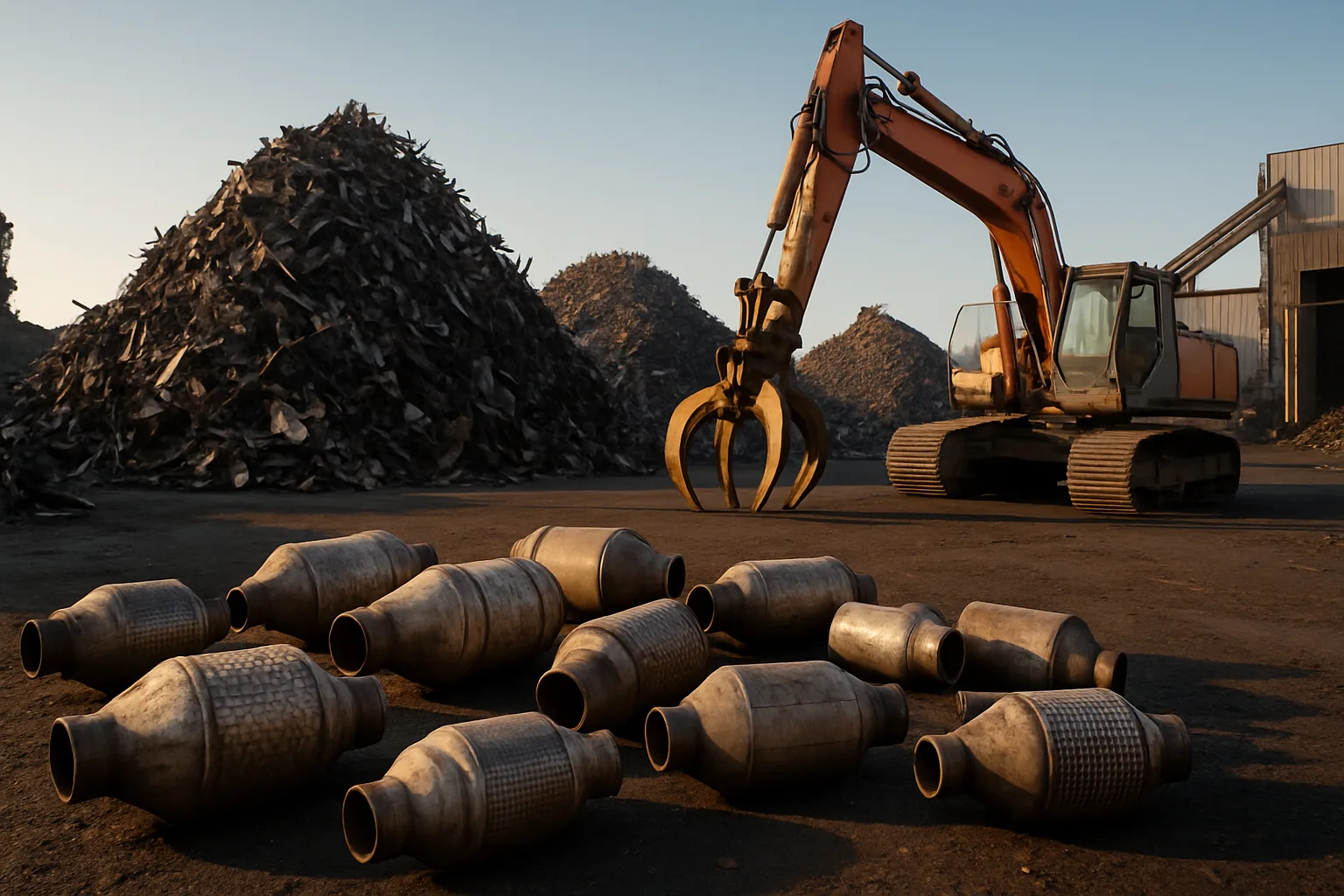
Foil vs. Bead Catalytic Converters: What Type Do You Have and What Is It Worth?
Most people selling scrap catalytic converters think all cats are created equal. They're not — and that misunderstanding costs sellers real money. The internal structure of your converter determines how much platinum, palladium, and rhodium it contains, which directly sets its scrap value. If you're selling in Buffalo or anywhere across New York, knowing the difference between foil and bead style converters puts you in a stronger position before you take a single offer.
Let's break down exactly what these two converter types are, how they differ, and what they're actually worth in the current scrap market.
What Are Foil Style Catalytic Converters?
Foil style catalytic converters — sometimes called metallic substrate converters — use a thin corrugated metal foil wound into a honeycomb-like structure. That foil is typically made from a high-temperature resistant alloy, and the precious metals (platinum, palladium, rhodium) are deposited as a washcoat directly onto the foil surface. The substrate itself is metallic, not ceramic.
These converters are most commonly found in high-performance and European vehicles. Think BMW, Mercedes-Benz, Audi, Porsche, and some Volkswagen models. They're also used in certain diesel applications and some motorcycles. Foil cats tend to run hotter and handle higher exhaust flow rates, which is why performance-focused manufacturers favor them.
From a scrap standpoint, foil converters have some specific characteristics that matter:
- Lower total weight — the metallic substrate is lighter than ceramic, so the overall converter weighs less
- Moderate precious metal loading — PGM (platinum group metals) content varies widely by manufacturer and application
- Different processing requirements — recyclers process foil and ceramic substrates differently, which affects which buyers are interested
- Often mistaken for lower-value units — because they're lighter and look different internally, some buyers undervalue them
The takeaway: foil cats aren't junk. But they require buyers who specifically process metallic substrates to get accurate assay results. Selling to the wrong buyer can mean leaving money on the table.
What Are Bead Style Catalytic Converters?
Bead style catalytic converters use small ceramic or alumina pellets — beads — as the substrate instead of a flat honeycomb. The precious metals are coated onto each individual bead, and the beads are packed loosely inside the converter housing. Exhaust gases flow through the gaps between the beads, making contact with the PGM-coated surfaces.
You'll find bead converters most commonly in older domestic vehicles — GM, Ford, and Chrysler products from the late 1970s through the 1990s predominantly used this design. Some industrial and heavy equipment applications still use bead-style units today. If you're breaking down older American iron, you're likely encountering bead cats.
Key characteristics for scrap sellers:
- Heavier than foil, sometimes heavier than standard ceramic honeycomb — the bead mass adds weight
- Higher rhodium content in some early designs — older bead converters can carry significant rhodium loading depending on the original OEM spec
- Easy to identify — shake the converter and you'll hear the beads rattling inside
- Requires specialized processing — bead material needs to be separated and sampled differently than honeycomb substrate
- Often underpriced at general scrap yards — buyers without proper assay capabilities may lump these in with lower-value units
Bead cats have a reputation in the recycling world for being either a hidden gem or a disappointment depending entirely on the vehicle source. A bead cat off a late-1970s full-size American vehicle can carry surprisingly strong PGM content. One off a mid-1990s economy car might yield considerably less. The only way to know is proper sampling and assay — which is exactly why competitive bidding matters.
What Are Foil and Bead Catalytic Converters Worth in 2026?
Pricing foil and bead converters accurately in 2026 is complicated by a few factors. Platinum, palladium, and rhodium spot prices have continued to shift through 2026 as EV adoption reshapes long-term demand forecasting for PGMs — but internal combustion vehicles still dominate the road, and the recycling pipeline for legacy converters remains active.
Disclaimer: Catalytic converter prices fluctuate daily based on PGM spot prices, converter condition, and market demand. Always check current catalytic converter prices before accepting any offer.
Here's what you need to understand about valuation for each type:
Foil Converter Value Factors
- Vehicle make and model — European luxury and performance vehicles typically yield higher PGM content
- OEM vs. aftermarket — original equipment converters carry higher precious metal loading than cheap aftermarket replacements
- Physical condition — damaged, crushed, or water-contaminated foil substrate can significantly reduce recoverable PGMs
- Buyer capability — not every buyer processes metallic substrate; working with a specialized buyer makes a measurable difference
Bead Converter Value Factors
- Vehicle year and manufacturer — pre-1990 domestic vehicles often carry more PGM per unit than later replacements
- Bead integrity — if beads have been contaminated with oil, coolant, or water, recoverable PGM content drops
- Weight — bead cats are sold by weight, so accurate weighing matters; some buyers lowball light units
- Assay accuracy — because beads vary in PGM distribution, proper sampling technique directly affects the payout number
The honest answer on pricing: foil and bead cats occupy a wide value range. Some units are worth significantly more than their appearance suggests. Others — particularly aftermarket replacements or heavily damaged units — yield less. The only way to get true market value is to put them in front of multiple qualified buyers. That's where a platform like smashscrap.com changes the equation.
Why Buffalo and New York Sellers Need Competitive Bidding for Specialty Cats
If you're selling foil or bead catalytic converters in Buffalo, the local market dynamic matters. Buffalo sits at a useful crossroads for the scrap metal trade — proximity to Great Lakes industrial routes, cross-border activity with Canada, and a dense population of older domestic vehicles that generate bead converter inventory consistently. That's not a small thing for shops and collectors working in this market.
The problem is that Buffalo scrap metal services vary widely in their ability to accurately assess specialty converter types. A general yard that handles bulk ferrous and non-ferrous material may not have the processing capability or buyer relationships to correctly value a bead cat off a 1983 Buick or a foil cat out of a 2006 BMW. They'll make you an offer — but it may reflect their uncertainty more than your converter's actual PGM content.
New York state has seen increasing scrutiny around catalytic converter transactions as part of broader anti-theft enforcement — documentation requirements and transaction records are now standard practice in compliant yards across the state. That's actually a good thing for legitimate sellers. Proper documentation, serial tracking, and photo records create the kind of transparency that attracts serious, vetted buyers. It's the exact infrastructure that platforms like SMASH are built around.
More buyers in the room means better price discovery. If you're only getting one number from one buyer, you don't know what your cats are actually worth. You know what that one buyer is willing to pay — which is a different thing entirely.
How to Get the Best Price for Foil and Bead Converters: A Practical Process
Whether you're an auto shop accumulating foil cats off European imports or a collector working through older domestic inventory with bead units, the process for maximizing your return is the same. Here's what actually works:
- Identify your converter type correctly — know whether you have foil, bead, or standard ceramic honeycomb. The rattle test works for bead units. Foil cats look metallic internally and are noticeably lighter than ceramic equivalents of the same size.
- Document everything — photos of the converter, the vehicle VIN, the serial or part number on the converter housing. This documentation supports higher bids from buyers who need assurance on sourcing.
- Separate your inventory by type — don't mix bead cats with standard honeycomb units. Buyers price mixed loads conservatively. Sorted loads get better numbers.
- Verify OEM vs. aftermarket — OEM converters carry significantly more PGM content than aftermarket replacements. If you know the unit is original equipment, that matters and should be communicated to buyers.
- Put the load in front of multiple buyers — this is the non-negotiable step. Use a competitive auction format to let the market set the price, not a single buyer's lowball.
Platforms like SMASH connect sellers with vetted buyers who specifically handle specialty converter types — including foil and bead units that general yards often underprice. The auction format creates the competition that reveals actual market value. No subscription fees. No guessing. If you want to get the best catalytic converter price today, competitive bidding is the mechanism that gets you there.
If you want to go deeper on how different converter types are valued and priced, read catalytic converter pricing guides covering OEM identification, PGM content by vehicle, and market timing strategies.
You've got specialty inventory. Don't let it get priced like it's generic. Get a free quote at best-catalytic-converter-price.com and find out what your foil and bead cats are actually worth in today's market.
Frequently Asked Questions
Q: How do I know if my catalytic converter is foil or bead style?
The simplest test for bead converters is to shake the unit — you'll hear the loose ceramic beads rattling inside. Foil converters are identifiable by their lighter weight compared to ceramic honeycomb units of the same size, and if you can see inside the housing, the substrate looks like layered metallic foil rather than a structured ceramic grid.
Q: Are bead catalytic converters worth more than standard honeycomb cats?
Not always — it depends heavily on the vehicle year, manufacturer, and original OEM specification. Some older bead converters from domestic vehicles carry strong PGM loading, particularly rhodium. Others yield less than comparable ceramic honeycomb units. Proper assay by a qualified buyer is the only accurate way to determine value.
Q: Where can I sell foil and bead catalytic converters in Buffalo, New York?
You have several options in the Buffalo area, but not every buyer has the capability to accurately process specialty converter types like foil or bead substrate. For the best outcome, use a competitive bidding platform that connects you with vetted buyers who specifically handle these converter types — rather than a general yard that may underprice specialty units.
Q: Do New York state regulations affect how I sell catalytic converters?
Yes. New York has transaction documentation requirements for catalytic converter sales as part of anti-theft enforcement. Compliant sellers need to provide identification, vehicle documentation, and transaction records. Proper documentation — including photos and serial tracking — also supports stronger bids from serious buyers who want sourcing verification.
Q: Why do scrap catalytic converter prices Buffalo vary so much between buyers?
Price variation comes down to buyer capability, PGM spot prices, and how well the buyer can accurately assess your specific converter type. Buyers without proper assay infrastructure for foil or bead units will price conservatively to protect their margin. Competitive bidding across multiple qualified buyers eliminates that uncertainty and lets the market set the actual price.
Follow SMASH on LinkedIn for scrap metal market updates, PGM pricing insights, and industry news that actually affects what your inventory is worth.