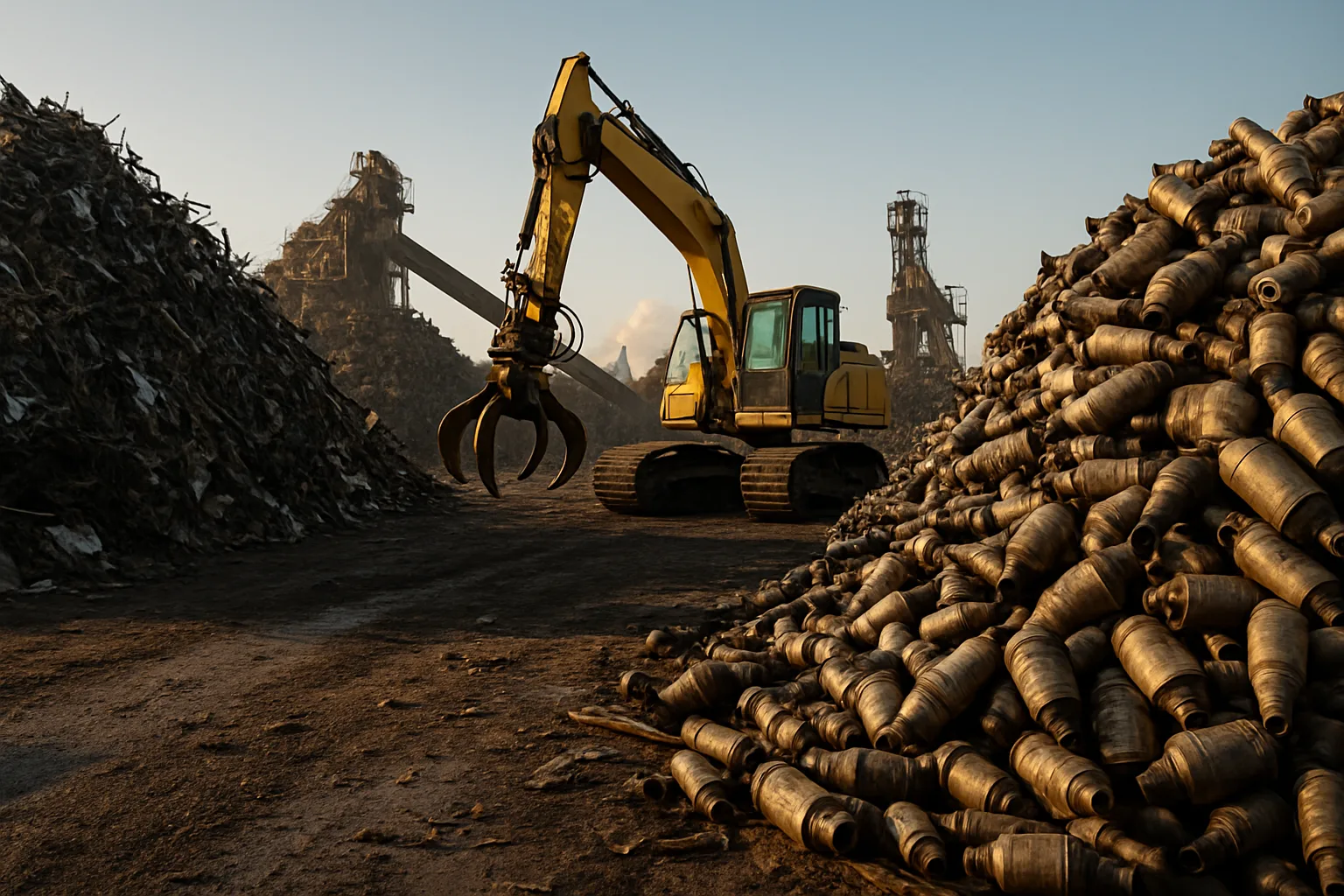
Most people selling scrap catalytic converters lump everything together — but foil and bead converters are a different animal, and treating them that way costs you money. If you've pulled a stack of cats and noticed some feel lighter or look different inside, there's a reason. And that reason affects what buyers will pay you. Understanding the difference between foil-style and bead-style catalytic converters is one of the fastest ways to stop leaving value on the table — especially when the platinum price today makes every gram count.
This week's roundup breaks down both converter types, what's inside them, and how to get the best price when you're ready to sell. Whether you're running a yard in Toledo, wrenching at an auto shop in Ohio, or collecting cats across the region, this one's worth your time.
Foil vs. Bead Catalytic Converters: What's Actually Inside
A catalytic converter does one job — it reduces harmful exhaust emissions by converting them into less toxic compounds. But not all converters use the same internal structure to do that job. The two most common types you'll encounter in the scrap market are foil-style and bead-style converters, and they differ significantly in construction, weight, and precious metal content.
Foil converters use a honeycomb substrate made from thin corrugated metallic foil — typically a stainless steel alloy. The precious metal catalyst (platinum, palladium, and rhodium) is coated onto that foil substrate. These converters are lightweight and compact. You'll find them mostly on European vehicles and some high-performance applications where weight and flow efficiency matter.
Bead converters take a completely different approach. Instead of a honeycomb foil structure, they contain small ceramic or alumina beads that are coated with the platinum group metals (PGMs). These beads are packed loosely inside the converter housing. Bead-style cats are bulkier and heavier than foil units, and they were more common on older domestic vehicles — think certain GM and Chrysler applications from the 1970s through the 1990s.
- Foil converters: Thin metallic substrate, lighter weight, more common on European/import vehicles
- Bead converters: Loose ceramic or alumina beads, heavier, more common on older domestic vehicles
- Both types contain platinum group metals — but in different concentrations and forms
- Processing methods differ between the two, which affects buyer pricing
How Platinum, Palladium, and Rhodium Drive the Scrap Catalytic Converter Price
Before you can understand what foil or bead cats are worth, you need to understand what makes any catalytic converter valuable: the platinum group metals locked inside. Platinum, palladium, and rhodium — collectively called PGMs — are the reason scrap catalytic converters are worth serious money. When the platinum price today moves, cat prices move with it. Same for palladium and rhodium, which often carry even more value per gram depending on market conditions.
The specific PGM mix and concentration varies by converter type, application, and manufacturer. That's the key insight: not all cats are equal, and foil versus bead is one of the major factors that separates them. Foil converters from certain European makes tend to carry higher PGM loadings per unit. Bead converters from older domestic applications can carry a wide range — some are loaded, some are lean. You won't know without assay data or solid reference pricing from a buyer who knows the material.
This is exactly why platforms like the SMASH scrap metal auction marketplace exist. When you're trying to price foil and bead cats accurately, guessing off a single buyer's quote is a losing strategy. Competition and transparency are how you find real market value — not one phone call to one buyer who has every incentive to buy low.
To check current catalytic converter prices and understand what your specific material is worth in today's market, you need access to real buyer data — not ballpark estimates.
What Foil and Bead Cats Are Actually Worth — and Why It Varies
Here's where most sellers get tripped up. Foil and bead converters don't fit neatly into a single price tier. Their value depends on several factors that any serious buyer will evaluate before making an offer.
For foil converters: The metallic substrate means specialized processing is required to recover the PGMs. Smelters and processors that handle foil material efficiently will pay more for it because they can recover value that others can't. If your buyer doesn't process foil in-house or doesn't have strong smelter relationships for it, their offer will reflect that gap — not the actual metal content. Documented foil lots from known European makes can command strong prices when they reach buyers who want them.
For bead converters: The loose bead structure means there's a processing and handling consideration — beads can spill, separate, or get mishandled during transport. Buyers price in that risk. That said, well-preserved bead converters from certain applications carry real PGM content. Clean, intact bead cats with proper documentation sell better than damaged or contaminated units. Photo documentation and accurate identification matter here more than most sellers realize.
Key factors that affect price for both types:
- Current PGM spot prices — platinum, palladium, and rhodium all fluctuate daily
- Converter condition — intact units with uncompromised substrates recover better
- Identification and documentation — serial numbers, vehicle source, and photos increase buyer confidence
- Lot size and composition — mixed lots versus sorted, separated material
- Buyer processing capability — not every buyer can handle foil material efficiently
Toledo Sellers: Why Local Knowledge and the Right Buyer Network Matter
If you're operating in Toledo or anywhere across Ohio, you already know the scrap market has its own rhythm. The region produces a consistent flow of catalytic converter material — from auto salvage, fleet maintenance, and collision shops throughout the area. That volume matters. It gives you leverage, if you use it right.
The mistake many Toledo-area sellers make is sticking with a single local buyer out of habit. One buyer, one price, no competition. That might feel simple, but it's not a strategy — it's convenience dressed up as business. When PGM prices shift and you're sitting on a mixed lot of foil and bead material, a single buyer quote tells you almost nothing about what the market will actually pay.
A better move: get your material properly identified, documented, and in front of multiple vetted buyers. That's what Toledo scrap metal services through platforms like SMASH are built to support. More buyers means better price discovery. That's not a pitch — it's how markets work.
Ohio has strong recycling infrastructure and active buyer networks. Use them. If you want to get the best catalytic converter price today, the answer isn't hoping your usual buyer is in a good mood — it's getting real competition on your material.
How to Prepare Foil and Bead Cats Before You Sell
Preparation separates sellers who get market value from sellers who get whatever the buyer feels like offering. For foil and bead converters specifically, a few steps make a real difference in what buyers will pay — and how fast transactions move.
Sort and separate. Don't mix foil and bead material in the same lot without flagging it clearly. Buyers who can process foil efficiently want to know that's what they're getting. Mixing without documentation creates uncertainty — and uncertainty lowers offers.
Photograph everything. Both ends of the converter, the substrate condition, any serial numbers or stampings. Photos build buyer confidence, especially on remote or auction-based transactions. Damaged substrates, cracked housings, or compromised bead cores will be spotted — you might as well document them upfront and price accordingly.
Use serial numbers and VIN data where available. For foil converters from European makes, OEM part numbers help buyers identify the specific PGM loading. For bead cats, vehicle application data — year, make, model — helps narrow down what the material likely contains. SMASH's inventory tools support serial tracking and photo documentation, which makes this process faster and more credible for buyers.
Know your weights. Bead converters are heavier. Foil cats are lighter. If your numbers seem off, double-check that you're weighing correctly and not conflating unit counts with weight assumptions.
For deeper guidance on valuation, read catalytic converter pricing guides that cover OEM converter price references, PGM breakdowns by vehicle type, and how to approach sorting mixed cat loads.
Scrap Catalytic Converter Pricing in 2026: What the Market Looks Like Now
The PGM market in 2026 continues to be shaped by supply chain dynamics, EV adoption curves, and industrial demand that extends well beyond the auto sector. Platinum and palladium remain core components in hydrogen fuel cell applications alongside their traditional catalytic converter role. Rhodium — historically the most volatile of the three — has settled into a tighter trading range compared to its extreme swings in prior years, but it still moves meaningfully on supply news.
What this means for foil and bead converter sellers: the platinum price today matters, but it's one input among several. The spread between platinum, palladium, and rhodium content in your specific material determines your actual value. A foil converter heavy in palladium from a European diesel application plays differently than a bead converter with a moderate platinum loading from a 1980s domestic truck.
No single published spot price tells you what your specific lot is worth. That's why auction-based platforms with vetted buyers — like SMASH — continue to gain traction with yards and collectors who are serious about price discovery. The old way of selling on gut feel and personal relationships has a ceiling. Competition doesn't.
Disclaimer: Catalytic converter prices and PGM spot prices fluctuate daily. All pricing referenced in this article reflects general market context as of June 2026. Always verify current rates with a qualified buyer before selling.
If you've got foil cats, bead cats, or a mixed load you haven't priced out yet, don't guess. Get it in front of real buyers and let the market tell you what it's worth. That's what best-catalytic-converter-price.com is here to help you do.
Frequently Asked Questions
Q: What is the platinum price today and how does it affect my catalytic converter value?
The platinum price today is a live market figure that changes throughout the trading day based on global supply, industrial demand, and investor activity. It directly affects the scrap catalytic converter price because platinum is one of three key precious metals — alongside palladium and rhodium — recovered from cats during processing. A higher platinum spot price generally lifts converter values, but the actual price you receive also depends on the PGM mix in your specific converter type.
Q: Are foil catalytic converters worth more than bead converters?
Not always — it depends on the specific converter, its application, and current PGM prices. Foil converters from certain European makes can carry high PGM loadings and command strong prices from buyers equipped to process them. Bead converters vary widely depending on the vehicle application and era. The best approach is to get both types properly identified and priced through a competitive buyer network rather than assuming one type is always worth more.
Q: Where can I sell catalytic converters in Toledo, Ohio?
Toledo has local scrap buyers and recyclers, but limiting yourself to one local buyer usually means leaving money on the table. Using a platform that connects you with multiple vetted buyers — like SMASH — gives you competitive pricing on your material rather than a single take-it-or-leave-it offer. You can explore Toledo scrap metal services to get started with pricing and buyer access in the area.
Q: How do I identify whether my catalytic converter is foil or bead style?
Weight is often the first clue — bead converters are generally heavier and bulkier, while foil converters are lighter and more compact. If you can see or shake the unit gently, bead cats sometimes rattle slightly due to the loose bead structure. Foil cats have a rigid, honeycomb metallic interior. For accurate identification, serial numbers or OEM part numbers combined with vehicle application data are the most reliable approach.
Q: Does the scrap catalytic converter price by model vary a lot between different vehicles?
Yes — significantly. The scrap catalytic converter price by model reflects the specific PGM loading that the OEM specified for emissions compliance on that vehicle. Luxury European makes, certain Japanese hybrids, and high-displacement domestic trucks often carry higher PGM content than economy vehicles. Using reference data by make, model, and year is essential for accurate pricing — especially for foil converters where the metallic substrate and PGM coating varies widely by manufacturer specification.
Ready to stop guessing and start getting real market value for your foil and bead cats? Whether you're in Toledo, across Ohio, or anywhere in the US, the process starts with documentation, proper identification, and access to competitive buyers. Get the best price for your catalytic converter — get a free quote at best-catalytic-converter-price.com.
Follow SMASH on LinkedIn for weekly scrap metal market updates, PGM price insights, and industry news that helps you sell smarter.
```