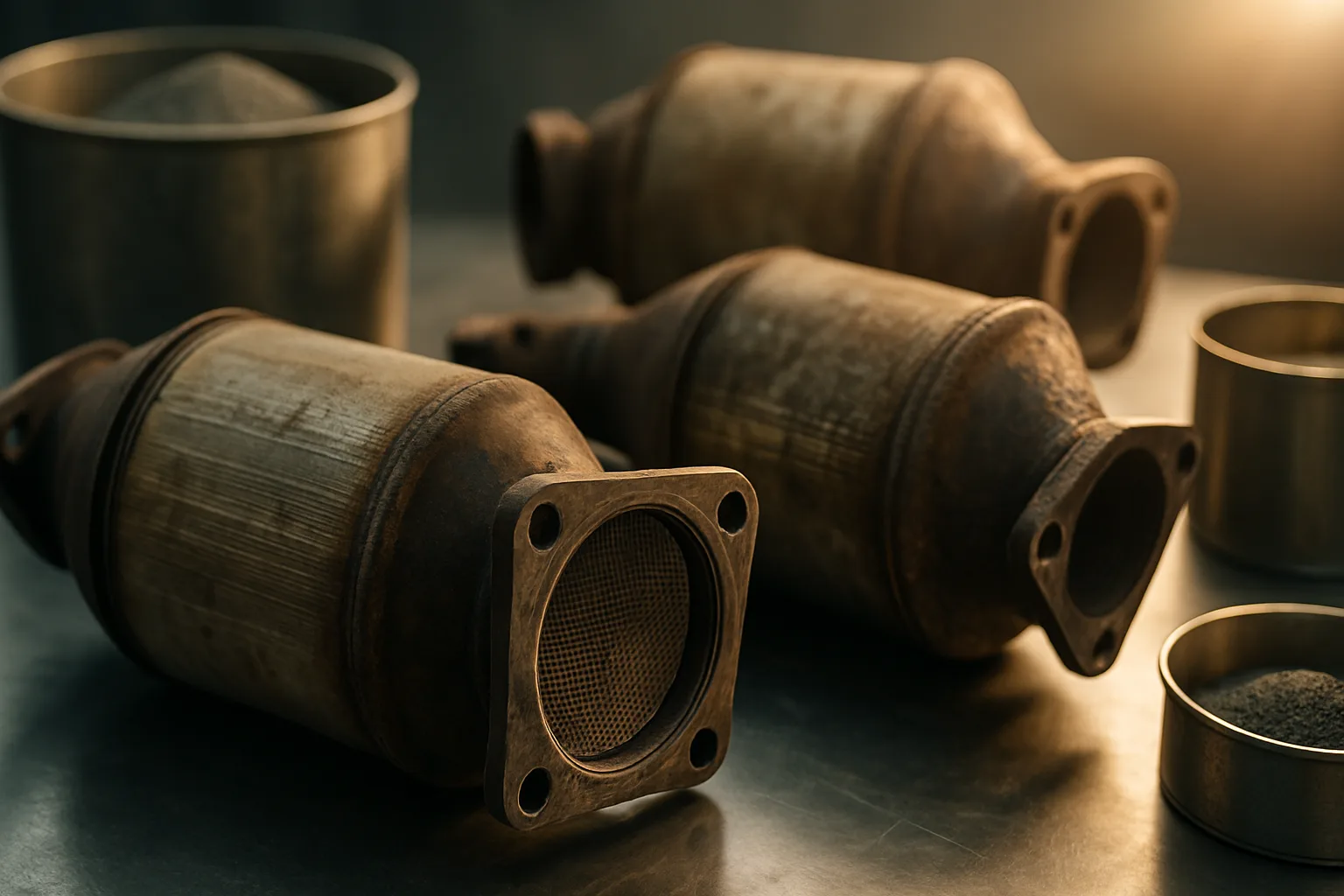
Most people selling a scrap catalytic converter have no idea what happens to it after it leaves their hands. They hand it over, get a number, and hope for the best. But if you're a catalytic converter buyer in Jacksonville — or a yard operator, auto shop, or collector trying to understand why prices vary so wildly — the answer is in the science. Assaying and smelting are what determine real value. And knowing how they work puts you in a much stronger negotiating position.
This isn't chemistry class. It's a practical breakdown of the process so you can stop guessing and start selling smarter.
What's Actually Inside a Catalytic Converter
Before we get into assaying and smelting, you need to understand what makes a cat converter worth anything at all. Inside the ceramic or metallic substrate sits a wash coat loaded with platinum, palladium, and rhodium — three of the most valuable metals on earth. These platinum group metals (PGMs) are what refiners are after. The steel shell, the ceramic, the honeycomb structure — those are just packaging.
The concentration of PGMs varies significantly by vehicle type, engine size, and OEM manufacturer specs. A domestic mid-size sedan converter might carry a few grams of combined PGMs. A diesel truck unit or a high-end import could carry far more. That's why OEM converter price data matters — identical-looking cats from different vehicles can fetch completely different payouts.
- Platinum (Pt): Primarily in diesel converters and older gasoline units
- Palladium (Pd): Dominant in modern gasoline converters; historically the highest-value PGM in recent markets
- Rhodium (Rh): Present in smaller quantities but often the most expensive per troy ounce
The ratio of these three metals — and the total loading — is what an assay reveals. Without that data, you're pricing in the dark.
How Catalytic Converter Assaying Works
Assaying is the process of measuring exactly how much of each PGM is present in a given sample. It's precise, it's technical, and it's the foundation of every legitimate scrap catalytic converter payout.
Here's how the process typically unfolds at a refinery or sampling facility:
- Decanning: The steel shell is removed to expose the monolith — the substrate inside. This is done mechanically, usually with a saw or press.
- Crushing and grinding: The ceramic or metallic substrate is crushed into a fine, homogeneous powder. This is critical — PGMs aren't evenly distributed across the substrate, so grinding ensures a representative sample.
- Sampling: A small, precise sample is pulled from the homogenized powder. The rest is held in reserve for smelting.
- Assay testing: The sample goes through one or more analytical methods — most commonly fire assay, ICP (inductively coupled plasma), or XRF (X-ray fluorescence). Fire assay is the gold standard for accuracy.
- Results: The assay produces a per-gram or per-troy-ounce breakdown of Pt, Pd, and Rh content. That data determines your payout, calculated against current spot prices.
This is why a reputable catalytic converter buyer in Jacksonville — or anywhere in Florida — should be able to explain how they price loads. If they're not referencing assay data or current PGM spot pricing, ask why. Transparency in this process protects the seller.
Platforms like SMASH Scrap — where verified buyers bid on your metal are built around exactly this kind of transparency. When buyers compete with documented data, you get better price discovery instead of a single take-it-or-leave-it number.
The Smelting Process: Turning Substrate Into Refined Metal
Once assaying is complete and the PGM content is confirmed, the material goes to smelting. This is where the actual metal is extracted from the substrate and refined into usable form.
The most common method for catalytic converter recycling is pyrometallurgical smelting — a high-temperature process that burns off the ceramic or carbon substrate and concentrates the PGMs into a metallic collector (typically copper or iron). What comes out of the furnace is an alloy, not pure metal yet, but dramatically more concentrated than what went in.
From there, the alloy goes through hydrometallurgical refining — chemical dissolution and separation — to isolate individual PGMs to the purity levels required for industrial use. The entire cycle, from raw cat to refined platinum, palladium, or rhodium, can take weeks depending on the facility and the volume being processed.
Here's why this matters for your payout:
- Refining costs are real. Smelting and chemical refining aren't free. Those costs come out of your return. A higher-quality assay and a cleaner load typically means lower per-unit processing costs and better net yields.
- Spot prices at the time of settlement matter. Most refiners settle payouts based on PGM spot prices at the time of refining, not when you sold the load. Some contracts lock in pricing earlier — know what you're signing.
- Weight and volume matter. Larger loads spread fixed processing costs over more material, which can improve per-unit returns.
If you're selling individual converters or small lots as a collector in Jacksonville, you're likely selling to an intermediary — a buyer who aggregates material before sending it to a refinery. That's completely normal. Just make sure your buyer is using real assay data to price what they buy from you, not just guessing by visual inspection.
How Catalytic Converter Scrap Metal Pricing Gets Set
Here's where it all connects for sellers. Your cat converter value isn't arbitrary — it's a function of PGMs per unit, current spot prices, and the terms your buyer operates under with their refinery.
Most buyers work on a percentage-of-assay model. They pay you a portion of what the refinery will ultimately recover — keeping the spread to cover their own costs and margin. The size of that spread varies by buyer, by volume, and by how competitive the market is in your area.
That's the exact problem that competitive bidding solves. When only one buyer sees your material, you have no way of knowing if their offer reflects market reality or their preferred margin. When multiple vetted buyers compete for the same load, the market reveals itself.
For sellers in Jacksonville and across Florida, getting the best catalytic converter price today means understanding that your leverage increases with documentation and competition. Photos, VIN lookups, serial numbers, accurate part identification — all of that gives buyers more confidence, which typically translates to stronger bids.
SMASH is built to support exactly this kind of documented, competitive selling. Whether you're a yard moving volume or a shop with a handful of units to liquidate, the auction model puts pricing power back where it belongs — with the seller.
What Jacksonville Sellers Should Know Before They Sell
Jacksonville is a large metro with significant automotive activity — dealerships, independent shops, salvage yards, and a steady flow of scrap catalytic converter material. That volume means buyers are active here. But active buyers don't automatically mean competitive offers.
If you're using Jacksonville scrap metal services, the best outcomes come from preparation. Here's what experienced sellers do differently:
- Identify the part before you price it. Know whether you have a domestic, import, diesel, or aftermarket converter. These categories price very differently. Use a VIN lookup or part number to verify.
- Document with photos. Buyers pay more for material they can evaluate confidently. A clear photo of the code stamped on the substrate or the shell label removes uncertainty.
- Don't sell on the first call. One offer is not a market. Get at least two or three before committing.
- Understand spot price timing. PGM markets move daily. The offer you got Monday may not reflect Tuesday's market. Check current pricing before you settle.
- Know your volume. Larger lots have more leverage. If you're sitting on 20 units, that's a more attractive load than a single piece — use it.
Florida's heat and humidity can accelerate substrate degradation in stored converters. Don't let material sit too long without a moisture-controlled storage option. Damaged or contaminated substrate reduces recoverable PGM content, which directly affects what a buyer will offer.
To stay current on what the market is doing, read catalytic converter pricing guides from sources that track real PGM movement — not last month's numbers.
Why Competitive Bidding Changes the Game for Catalytic Converter Recycling in Jacksonville
The traditional model for catalytic converter recycling in Jacksonville — or anywhere — is simple: one buyer calls, makes an offer, and hopes you take it. There's no pressure on the buyer to be competitive because there's no competition. That model works great for buyers. It works poorly for sellers.
The auction model flips that dynamic. When your load gets in front of multiple vetted buyers simultaneously, each buyer knows they're competing. That changes behavior. Offers sharpen. Margins compress on the buyer's side, which means more return on yours.
Combine that with proper documentation — assay-backed pricing, part identification, photo records — and you've built a selling process that mirrors how professional commodity markets actually work. You're no longer guessing. You're pricing based on data, with real competition setting the floor.
If you want to understand current market rates and check current catalytic converter prices before your next sale, doing that research before you pick up the phone is the single best move you can make. Knowledge is leverage, and in scrap metal, leverage is money.
Ready to stop leaving money on the table? Get the best price for your catalytic converter — get a free quote at best-catalytic-converter-price.com. Whether you're clearing a few units from your shop or moving serious volume, the process is straightforward and the pricing is based on real market data — not a single buyer's best guess.
Follow SMASH on LinkedIn for ongoing scrap metal market insights, PGM price updates, and industry news worth knowing.
Frequently Asked Questions
Q: How does a catalytic converter buyer in Jacksonville determine what my converter is worth?
Reputable buyers use a combination of part identification, current PGM spot prices, and assay data from refineries to calculate offers. Visual inspection alone is not a reliable pricing method. Ask your buyer how they arrive at their number — if they can't explain it clearly, get a second opinion.
Q: What's the difference between a fire assay and an XRF scan for catalytic converters?
XRF (X-ray fluorescence) is faster and non-destructive, making it useful for quick lot assessment. Fire assay is more accurate and is considered the industry standard for final refinery settlement. Most serious buyers use XRF for initial screening and fire assay for final payout calculations.
Q: How long does the assay and smelting process take before I get paid?
Timelines vary by refinery and contract terms, but full processing from delivery to payout settlement typically runs anywhere from two to six weeks. Some buyers offer advance payments against expected assay results — confirm the terms before you ship material.
Q: Does it matter if my catalytic converter is cracked or the substrate is broken?
Yes. A cracked or degraded substrate can mean PGM loss — material that's physically gone can't be recovered. Buyers will typically offer less for damaged cats because the recoverable content is lower. Store converters in a dry environment and avoid dropping or crushing them before sale.
Q: Are there catalytic converter buyers near me in the Jacksonville area who handle small quantities?
Yes — Jacksonville has active buyers who work with individuals, auto shops, and small collectors. For the best results regardless of volume, document your units thoroughly, identify part numbers where possible, and use a platform that creates competitive bids rather than accepting a single offer at face value.
Price disclaimer: Catalytic converter prices fluctuate daily based on PGM spot markets, load composition, and buyer demand. All pricing information in this article is general and educational. Always check current catalytic converter prices before selling.