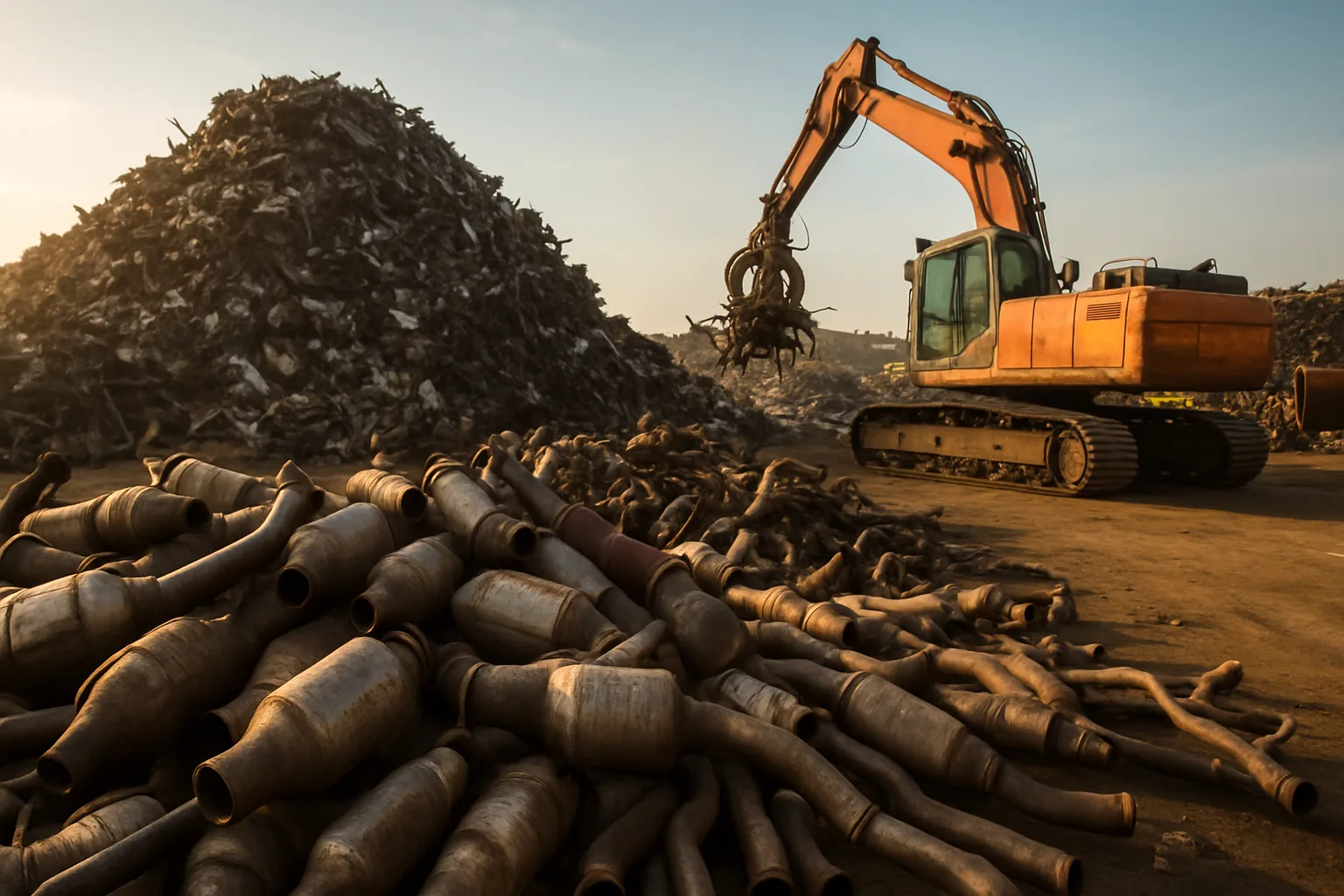
Most people know catalytic converters contain precious metals. Far fewer understand what actually happens to those metals after the converter leaves the vehicle. From the exhaust manifold to a refinery furnace, the journey is longer — and more valuable — than most sellers realize. If you're sitting on a pile of spent cats in Long Beach, that journey starts the moment you call the right buyer.
This guide breaks down every stage of the catalytic converter lifecycle. Understanding the process makes you a smarter seller. It explains why pricing varies so dramatically, why documentation matters, and why working with a transparent catalytic converter buyer in Long Beach changes your outcome.
Stage 1 — The Converter's Life on the Vehicle
A catalytic converter is an emissions control device installed in a vehicle's exhaust system. It uses a ceramic or metalite substrate coated with platinum, palladium, and rhodium — the three primary platinum group metals (PGMs) — to convert toxic exhaust gases into less harmful compounds. The converter sits between the engine and the muffler, enduring extreme heat cycles every time the vehicle runs.
Over time, the substrate degrades. The precious metal loadings decline. Heat cracks the ceramic. Oil contamination poisons the catalyst. By the time most converters reach end-of-life, they've logged somewhere between 100,000 and 200,000 miles, depending on vehicle type, driving conditions, and fuel quality. That degradation matters to recyclers — a clean, intact substrate with high PGM loading is worth considerably more than a cracked, oil-soaked one.
- OEM converters (original equipment, factory-installed) typically carry higher PGM loadings
- Aftermarket converters often contain lower precious metal content and bring lower scrap values
- Pre-emissions converters (very old vehicles) may have minimal or no recoverable PGM content
- Direct-fit vs. universal fit designs affect both the substrate volume and buyer pricing
This is also where the serial number or vehicle identification number becomes important. Knowing the make, model, year, and engine size of the donor vehicle lets experienced buyers — and platforms like SMASH — reference assay data and historical recovery values to price your load accurately. If you've ever wondered how much is my catalytic converter worth scrap by reg, the answer starts with the vehicle it came from.
Stage 2 — Removal, Collection, and the Critical First Assessment
Once a vehicle reaches end-of-life — whether through a collision, mechanical failure, or simply old age — the catalytic converter is removed during dismantling. Auto recyclers, salvage yards, and licensed dismantlers pull the cats, often alongside other non-ferrous metals. In busy markets like Long Beach and the broader California corridor, this generates significant volume fast.
This is the stage where sellers make their first big mistake: selling blind. Without knowing what type of converter they have, many sellers accept the first price offered — often from a single buyer with zero competition. The spread between the lowest and highest offers on the same converter can be wide. Real price discovery only happens when multiple vetted buyers see the same inventory.
What buyers assess at this stage:
- Converter type and OEM identification — serial number, end-cap markings, size
- Substrate condition — intact ceramic vs. cracked, shaken, or oil-contaminated
- Physical damage — crushed shells, cut pipes, missing endcaps reduce value
- Volume — single units vs. full loads change how buyers price and bid
- Photo documentation — buyers who can see the inventory bid with more confidence
If you're ready to get the best catalytic converter price today, proper documentation at this stage is your single biggest lever. Clear photos, accurate counts, and serial tracking make your load easier to price — and more competitive to bid on.
Stage 3 — Grading, Pricing, and Why the Catalytic Converter Scrap Metal Price Varies So Much
Here's the part most sellers don't see, and it explains almost everything about why catalytic converter scrap metal price fluctuates the way it does. Spent converters aren't priced as a commodity the way steel or aluminum is. They're priced based on expected PGM recovery — and that expectation is built from a combination of historical assay data, current spot prices for platinum, palladium, and rhodium, and the physical condition of the unit.
Rhodium is historically the most volatile of the three PGMs. Palladium has seen dramatic price cycles over the past decade tied to gasoline vehicle production volumes. Platinum tends to move with diesel converter demand. When any one of these metals swings significantly, the value of your converter stack moves with it. That's why a price quote from six months ago is worth nothing today.
Grading categories typically used in the industry:
- High-grade domestic — OEM, high PGM loading, excellent condition
- Mid-grade domestic — factory units with moderate loading or light damage
- Low-grade / aftermarket — lower PGM content, often universal-fit designs
- Foil / metalite substrate — different recovery process, different pricing
- DPF (diesel particulate filters) — separate category, priced on different PGM profiles
- Bead / loose substrate — lower value, harder to process
Sellers who understand these categories — and who verify their inventory before listing — consistently do better than those who sell blind. Read catalytic converter pricing guides to go deeper on grading and valuation before your next sale.
Stage 4 — The Recycling Process: From Spent Cat to Recovered Metal
Once a load of spent converters changes hands, the actual catalytic converter recycling process begins. This is a multi-step industrial process that most sellers never see — but understanding it explains why buyers need accurate grades and why damaged units return less.
The broad steps in converter recycling:
- Decanning — the metal shell is removed from the substrate, typically mechanically or by cutting
- Sampling — the substrate material is sampled for assay; this determines actual PGM content
- Milling — the ceramic substrate is ground into a fine powder for consistent assay sampling
- Smelting — the milled material goes through a high-temperature smelting process to collect PGMs into a collector metal
- Refining — the collector metal is chemically refined to separate platinum, palladium, and rhodium into individual pure metals
- Return to market — refined PGMs re-enter the commodity market, purchased by automotive manufacturers and industrial users
This is a capital-intensive process. The buyers who operate at scale — the ones connected to major refineries — can offer better pricing because they have lower per-unit processing costs. When you work with a vetted buyer network, you're more likely to reach buyers who operate at that level. Competition drives the price toward the true market. A single phone call to one buyer does not.
Stage 5 — How Sellers in Long Beach and California Can Get More From Every Load
The catalytic converter market in Long Beach is active. Southern California generates serious volume — dense population, aging vehicle fleet, high auto dismantling activity. That volume means buyers want your inventory. The question is whether you're letting them compete for it or handing it to the first caller.
Sellers who consistently get stronger outcomes share a few habits:
- They document everything — photos of each unit, serial numbers where visible, accurate counts
- They grade their load before listing, even roughly
- They get multiple offers instead of accepting one
- They track current PGM spot prices so they understand what's driving the market
- They use platforms that bring vetted buyers to them, instead of cold-calling
That last point is where platforms like find the best price for your scrap on SMASH come in. SMASH puts your documented inventory in front of multiple vetted buyers simultaneously. The auction format creates real competition. More buyers seeing the same load means better price discovery. No subscription fees. SMASH only wins when you win.
Whether you're moving a handful of cats from a single donor vehicle or selling a yard's full inventory of mixed grades, the process is the same: document, list, compete, close. Ready to check current catalytic converter prices before your next sale? Start there.
The Lifecycle Summary — What Every Seller Should Know
The path from vehicle to recovered precious metal is longer than most sellers expect. Every stage — from removal and grading to smelting and refining — affects the final return. Sellers who understand the journey make better decisions at every decision point along it.
Here's the lifecycle in brief:
- Converter installs on vehicle, accumulates mileage and heat exposure
- Vehicle reaches end-of-life; converter is removed during dismantling
- Converter is graded, documented, and prepared for sale
- Buyer competition drives price discovery toward true market value
- Converters are decanned, sampled, milled, smelted, and refined
- Recovered platinum, palladium, and rhodium re-enter global markets
The scrap metal doesn't disappear. It cycles. And every time it does, the sellers who understand the process capture more of the value it carries.
If you're in Long Beach or anywhere across California with spent cats ready to move, don't settle for a single phone call and a guessed number. Get competitive offers. Use documentation to your advantage. Work with buyers who can see what they're bidding on. That's how you extract real value from a real market. Get the best price for your catalytic converter — get a free quote at best-catalytic-converter-price.com.
Disclaimer: Catalytic converter prices fluctuate daily based on platinum, palladium, and rhodium spot prices. Always verify current rates before selling.
Frequently Asked Questions
Q: How do I find a reputable catalytic converter buyer in Long Beach?
Look for buyers who are transparent about their pricing process, ask for documentation, and can explain how they arrived at their offer. Platforms like SMASH connect sellers with vetted buyers who compete for your inventory — which removes the guesswork and single-offer risk from the equation.
Q: How much is my catalytic converter worth for scrap by reg (registration)?
The value depends on the make, model, year, and engine size of the vehicle the converter came from, combined with current PGM spot prices and the physical condition of the unit. Serial numbers and vehicle registration data help buyers reference historical assay values for accurate pricing. There's no single universal number — it varies by converter type and market conditions.
Q: What is catalytic converter recycling and why does the process affect my payout?
Recycling involves decanning the substrate, sampling for precious metal content, milling, smelting, and refining to recover platinum, palladium, and rhodium. Buyers price your converter based on expected recovery from this process. A damaged, cracked, or contaminated substrate recovers less metal — which is why condition directly affects your offer.
Q: Does California have specific regulations for selling scrap catalytic converters?
Yes. California has regulations governing the sale of used catalytic converters, including documentation requirements for sellers and buyers. Always verify current state requirements before transacting, particularly if you're selling in volume. Working with established, licensed buyers helps ensure you stay compliant.
Q: Why do catalytic converter scrap prices change so frequently?
Because converter value is tied directly to platinum, palladium, and rhodium spot prices — and all three metals trade on global commodity markets that move daily. Supply constraints, automotive production trends, and macroeconomic factors all influence PGM prices. Check current rates before every sale, not just once.
Stay current on scrap metal market trends and catalytic converter pricing — follow SMASH on LinkedIn at linkedin.com/company/scrap-metal-auction-sales-hub for industry insights and market updates.
```