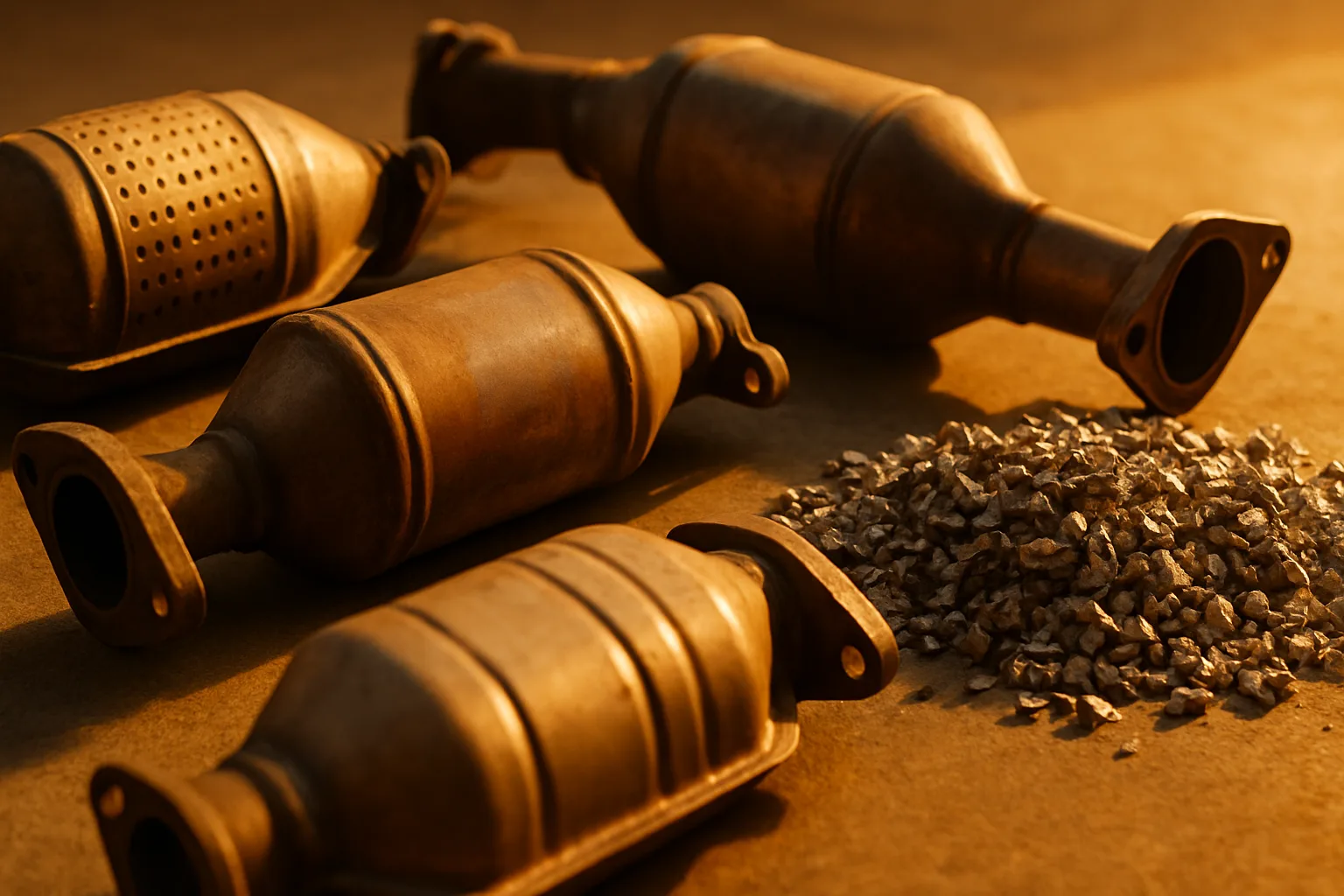
Why Emissions Rules Are Quietly Pushing Rhodium Prices Through the Roof
Most people selling a scrap catalytic converter think about weight and metal content. Few think about the Clean Air Act, Euro 7 standards, or what the EPA's 2026 light-duty vehicle rules mean for the platinum group metals sitting inside that converter. They should. Emissions regulations don't just clean the air — they set the floor on what your scrap cat is worth. If you want to understand the rhodium price today and why it moves the way it does, start here.
This article breaks down the connection between tightening emissions standards and surging demand for platinum, palladium, and rhodium — the three metals that make a catalytic converter worth selling. Whether you're an auto shop in St. Paul clearing out a pile of spent cats, or a collector trying to make sense of the catalytic converter price list by serial number, this context matters.
What Emissions Regulations Actually Demand From Catalytic Converters
A catalytic converter's job is to convert toxic exhaust gases — nitrogen oxides (NOx), hydrocarbons, carbon monoxide — into less harmful emissions before they leave the tailpipe. The tighter the emissions standard, the more efficiently that conversion has to happen. And more efficient conversion requires more platinum group metals (PGMs) loaded into the substrate.
The EPA's Tier 3 vehicle standards, now fully phased in, pushed automakers to use higher PGM loadings to meet NOx thresholds. California's CARB standards go further. The EU's Euro 7 framework — fully enforced in 2026 — has pushed European OEMs to dramatically increase rhodium and palladium content in their converters to hit stricter cold-start emission limits. What happens in European and Asian markets doesn't stay there. Global OEM demand for these metals moves in one direction: up.
- Rhodium is the primary catalyst for reducing NOx emissions. No substitute currently matches its performance at scale.
- Palladium handles hydrocarbon and CO oxidation in gasoline engines — still the dominant vehicle type globally.
- Platinum plays a larger role in diesel converters and is gaining renewed attention as hydrogen fuel cell adoption expands.
Stricter standards don't let automakers use less of these metals. They force them to use more. That structural demand is what underpins the rhodium price today — and it's why your scrap cat has real value beyond its steel shell.
Rhodium Price Today: Why This Metal Moves So Dramatically
Rhodium is one of the rarest elements on Earth. Global annual supply is measured in single-digit tonnes. South Africa produces roughly 80% of the world's rhodium, almost entirely as a byproduct of platinum mining. When platinum mine output drops — due to labor disputes, energy costs, or infrastructure problems — rhodium supply tightens automatically. The market has almost no ability to ramp production independently.
That supply constraint, colliding with regulatory-driven demand, is why rhodium hit historic highs in recent years and why it remains among the most volatile commodities in any asset class. A single gram of rhodium in your catalytic converter can swing significantly in value from one quarter to the next. That's not speculation — it's the mechanical result of a thin market being pulled by a demand driver (emissions compliance) that isn't going away.
For sellers, this creates both opportunity and risk. Timing your sale matters. Understanding what's inside your specific converter matters. That's why tools like a catalytic converter price list by serial number are worth using — they tie actual PGM assay data to specific OEM part numbers so you know what you're sitting on before you negotiate.
If you're in St. Paul and managing a stack of spent converters from fleet maintenance or shop turnover, checking current pricing benchmarks before you sell isn't optional — it's how you leave money on the table or don't. You can check current catalytic converter prices before committing to any buyer.
How OEM Catalytic Converter Value Differs From Aftermarket — and Why It Matters When You Sell
Not all cats are equal. An OEM catalytic converter — the unit installed by the original vehicle manufacturer — is engineered to meet specific emissions targets for a specific engine. That means it carries a predictable, often higher PGM loading than a direct-fit aftermarket replacement. The difference in scrap value can be significant.
Here's a practical comparison of how different converter categories typically stack up in terms of scrap value:
- OEM converters from luxury or high-performance vehicles — highest PGM loadings, highest scrap value. Think late-model European and Japanese OEM units.
- OEM converters from standard domestic vehicles — solid mid-range value. Volume is high, and buyers know exactly what they're getting.
- Direct-fit aftermarket converters — lower PGM content by design, lower scrap value. Don't expect OEM prices for these.
- Universal aftermarket converters — lowest PGM loading, minimal scrap value. Often not worth sorting separately.
- Diesel oxidation catalysts (DOCs) — primarily platinum-loaded. Value depends heavily on current platinum pricing.
- Diesel particulate filters (DPFs) — contain platinum and palladium. Increasingly valuable as diesel fleet turnover accelerates.
Knowing which category your inventory falls into is step one. Step two is finding a buyer who pays based on actual assay — not a flat rate that benefits them, not you. That's where competitive pricing through platforms like SMASH changes the outcome. More on that below.
5 Ways Emissions Regulations Are Increasing Scrap Cat Values Right Now
It's not just one regulation driving this. It's a convergence of several policy pressures hitting simultaneously in 2026. Here's how they stack up:
- EPA light-duty vehicle GHG rules (2026 model year compliance): Tighter CO2 and NOx limits for new vehicles require higher-efficiency catalysts, increasing per-unit PGM demand from automakers. That sustained OEM demand keeps floor prices elevated across the PGM market.
- Euro 7 full enforcement: European manufacturers now face the strictest cold-start emissions limits in history. Cold-start performance requires denser PGM washcoat loading — rhodium and palladium specifically. European OEM purchasing is pulling hard on global supply.
- China 6b standard (fully active): China's 6b emissions standard is now the law of the land across Chinese vehicle manufacturing. With China representing the world's largest vehicle market, the scale of PGM demand driven by this single regulation is enormous.
- Fleet electrification lag: EV adoption is real but slower than projections in commercial and fleet segments. ICE vehicles are staying on the road longer — meaning more cats going through the scrap cycle, and sustained secondary market demand.
- Hydrogen fuel cell expansion: Fuel cell vehicles use platinum-based catalysts. As hydrogen infrastructure builds out across North America, platinum demand from this segment adds a new demand layer that didn't exist at scale five years ago.
Each of these pressures operates independently. Together, they form a structural demand environment that keeps PGM prices supported. For anyone looking to sell catalytic converters in Minnesota or anywhere in the US, this isn't background noise — it's the market condition that determines what you get paid.
How to Sell Scrap Catalytic Converters Online and Actually Get a Fair Price
The old way to sell cats was simple: call one buyer, take what they offered, move on. The problem is that one buyer has no incentive to give you a competitive number. They have every incentive to buy low.
The better approach is competition. When multiple vetted buyers see your inventory and bid against each other, price discovery works the way it's supposed to. That's exactly what SMASH is built for. Whether you're a shop in St. Paul running through a steady stream of fleet cats, or a yard operator in greater Minnesota with a mixed load of OEM and aftermarket units, putting your inventory in front of multiple buyers changes the outcome.
SMASH supports photo documentation and serial tracking — which matters when you're selling OEM units where the serial number directly connects to published assay data. Documented inventory gives buyers more confidence, and confident buyers bid higher. You can get competitive bids for your scrap metal without cold calls, guesswork, or accepting the first number someone throws at you.
If you want to understand how to position your inventory before you list it, read catalytic converter pricing guides that break down what different converter types are worth and how PGM prices affect your payout. Knowledge before negotiation is always the right order.
Auto shops and scrap collectors across St. Paul and the broader Minnesota market are already using smarter tools to sell. The question is whether you're one of them. If you're ready to stop guessing and start selling with real price data behind you, get the best catalytic converter price today with a free quote.
Ready to get what your cats are actually worth? Get the best price for your catalytic converter — get a free quote at best-catalytic-converter-price.com.
Disclaimer: Catalytic converter scrap prices fluctuate based on live PGM spot prices for platinum, palladium, and rhodium. All pricing information should be verified against current market rates before any transaction.
Frequently Asked Questions
Q: What is the rhodium price today and how does it affect my catalytic converter's scrap value?
The rhodium price today is set by global spot markets and fluctuates based on supply from South African platinum mines and regulatory-driven demand from automakers. Because rhodium is the primary catalyst for NOx reduction in gasoline engines, tighter emissions standards directly increase OEM demand — which supports prices. Your specific converter's rhodium content, tied to its serial number, determines how much of that spot price you capture when you sell.
Q: How do I find the catalytic converter price list by serial number for my units?
Most professional cat buyers and online platforms maintain serial number databases that match OEM part numbers to known PGM assay ranges. The serial number or part number stamped on your converter identifies the vehicle application and converter generation, which corresponds to a specific substrate loading. Using a serial number lookup before you sell helps you verify that any offer you receive is in the right range for what you actually have.
Q: Where can I sell scrap catalytic converters in St. Paul, Minnesota?
Sellers in St. Paul have access to both local scrap yards and online platforms that reach buyers across the US. Online auction platforms like SMASH allow you to list documented inventory and receive competitive bids without being limited to what local buyers are willing to pay on any given day. For volume sellers — auto shops, fleet operators, scrap collectors — the online route typically produces better price discovery than a single local transaction.
Q: Why are OEM catalytic converters worth more than aftermarket units when scrapping?
OEM converters are engineered to meet specific emissions performance requirements for a defined engine and model year, which means they carry predictable and often higher PGM loadings. Aftermarket converters are built to meet minimum compliance thresholds at lower cost, which typically means less platinum, palladium, and rhodium per unit. When scrapping, you're paid on PGM content — so higher loadings mean higher payouts.
Q: Do emissions regulations in other countries affect what I get paid for scrap cats in Minnesota?
Yes, directly. Global OEM demand for platinum, palladium, and rhodium is driven by emissions regulations in every major vehicle market — the US, EU, China, and others. When Euro 7 or China 6b standards force automakers to increase PGM loadings in new vehicles, that demand pulls on the same limited global supply that determines spot prices. Higher spot prices mean higher scrap values for cats in St. Paul just as much as anywhere else. The PGM market is global; your payout reflects it.
Follow SMASH on LinkedIn for scrap metal market updates, PGM pricing insights, and industry news that actually matters to yard operators and sellers across North America.