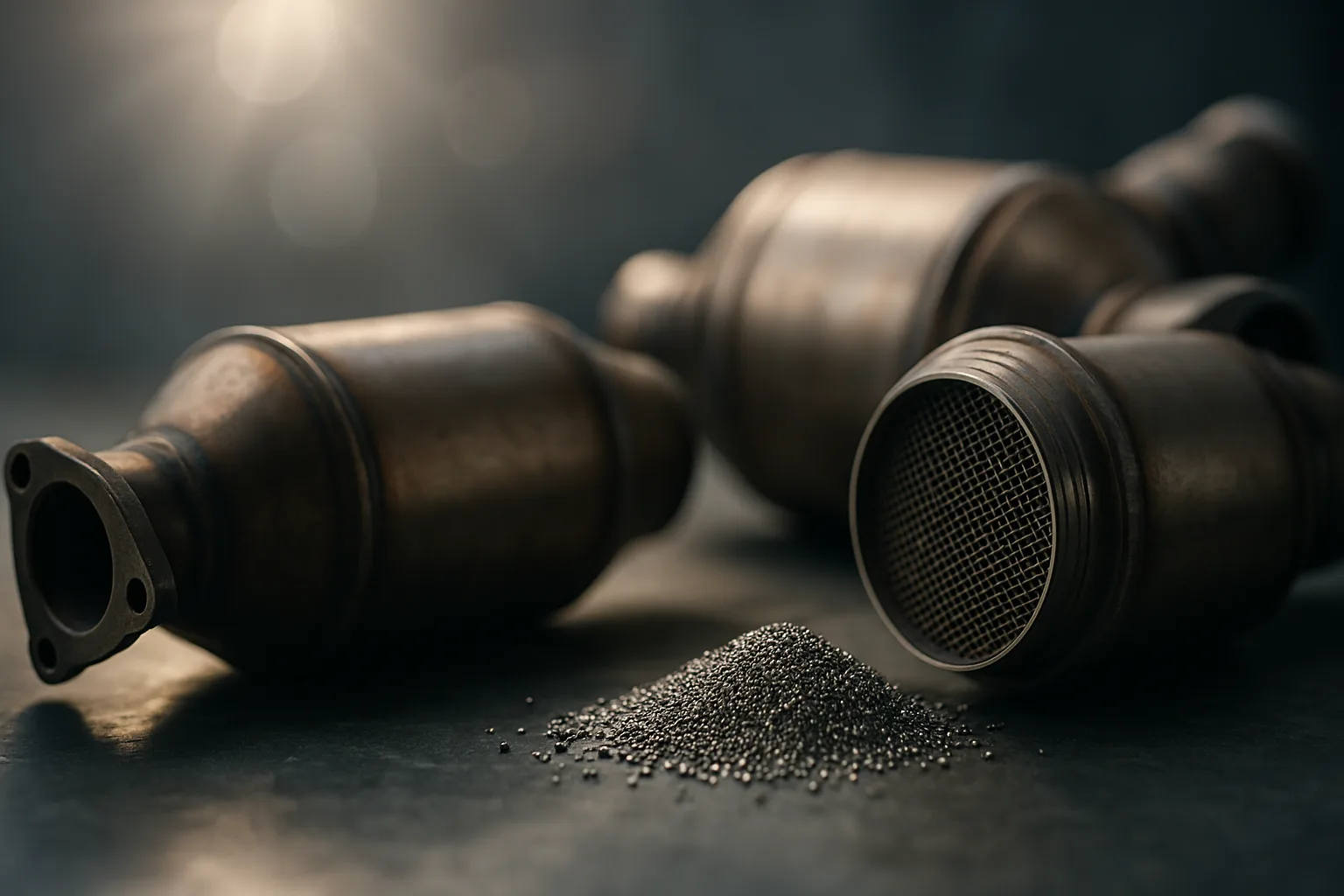
Emissions regulations don't just clean the air — they drive the value of every scrap catalytic converter sitting in your yard. If you've watched catalytic converter prices today swing without understanding why, the answer is usually hiding inside a government regulation database. Tighter rules mean more platinum group metals (PGMs) loaded into each new converter. More PGMs per unit means higher OEM catalytic converter value when those parts eventually hit the scrap market. That's not a coincidence. That's policy becoming price.
This piece breaks down exactly how emissions standards shape PGM demand — and what that means for your bottom line in 2026, whether you're an auto shop in Raleigh, a scrap collector working North Carolina routes, or a recycling yard managing inventory at scale.
---Why Emissions Standards Directly Control Platinum Group Metal Demand
Catalytic converters exist because governments forced automakers to put them there. The three-way catalyst that neutralizes hydrocarbons, carbon monoxide, and nitrogen oxides requires platinum, palladium, and rhodium to do its job. There is no substitute that works at the same efficiency under real-world operating conditions — not in 2026, not yet.
When regulators tighten the permissible limits on tailpipe emissions, engineers respond by loading more catalyst material into each converter. The loading determines the scrap value. A heavy-duty diesel truck converter built to meet current EPA Tier 4 Final and CARB standards carries far more PGM content than a unit from a decade ago. That difference shows up directly when you check current catalytic converter prices on any reputable pricing platform.
- Stricter NOx limits push higher palladium and rhodium loadings in gasoline converters
- Particulate matter rules require denser substrate designs that retain more catalyst per unit volume
- Cold-start regulations (a growing focus in 2026) demand additional front-end catalyst bricks — more metal, more value
- Fleet-wide compliance targets mean even mid-range vehicles carry premium converter specs
The result: the average OEM catalytic converter rolling off a North American assembly line today contains more recoverable PGM content than at any point in the history of emissions compliance. For scrap sellers, that's a structural tailwind — not a temporary blip.
---The 5 Regulatory Drivers Behind Higher OEM Catalytic Converter Value in 2026
Understanding which regulations actually move the needle helps you anticipate value shifts before they show up in spot prices. Here are the five most significant drivers active in the U.S. market right now.
-
EPA Light-Duty Vehicle Greenhouse Gas Standards (Phase 3)
The most recent phase of EPA light-duty standards pushed average fleet efficiency requirements to levels that force significant powertrain investment. Automakers keeping internal combustion engines in their lineup responded with higher-efficiency, tighter-toleranced exhaust systems — which require more precisely loaded catalysts to meet both efficiency and emissions targets simultaneously. -
CARB Advanced Clean Cars III
California Air Resources Board rules continue to set the pace for the rest of the country. States that adopt CARB standards — and there are now more than a dozen — require vehicles sold in those markets to meet tighter limits. This creates a bifurcated production environment where many automakers simply build to the stricter spec for all vehicles. More PGMs go into every unit as a result. -
EPA Heavy-Duty Phase 3 Trucking Rules
Heavy-duty diesel is where converter values get serious. Phase 3 heavy-duty rules finalized in recent years mandate near-zero NOx emissions from Class 7 and Class 8 trucks. The converter assemblies on compliant trucks are large, PGM-dense, and extremely valuable at end of life. If your yard handles commercial truck scrap, these units are among the highest-value cats you'll process. -
Off-Road Equipment Emission Standards (Tier 4 Final and Beyond)
Construction, agriculture, and industrial equipment has been under Tier 4 Final compliance for years, but enforcement and turnover of older equipment is accelerating. As pre-Tier 4 machines age out of fleets, compliant replacements arrive with substantial diesel oxidation catalysts and selective catalytic reduction systems. These aren't small parts. -
Global Harmonization Pressure
U.S. manufacturers build for global markets. Euro 7 standards in Europe — some of the strictest ever implemented — are influencing what gets engineered at the platform level. Even if a vehicle is sold only in the U.S., the underlying powertrain may have been designed to meet European limits. That engineering translates into higher PGM content and, ultimately, higher OEM catalytic converter value at scrap.
You can read catalytic converter pricing guides to understand how these regulatory drivers translate into current market pricing for specific makes and models.
---What This Means for Catalytic Converter Prices Today — Especially in Raleigh
Raleigh and the broader North Carolina market see a diverse mix of vehicle types — domestic trucks and SUVs, import sedans, and a growing commercial fleet presence tied to the region's construction and logistics sectors. That mix matters when you're evaluating converter values, because the regulatory history of each vehicle class determines how much PGM content ends up in the scrap unit.
Full-size domestic trucks — F-Series, Silverado, Ram — have been under aggressive emissions compliance pressure for years. Their converters reflect that. Import vehicles, particularly Japanese and Korean brands, often carry high palladium loadings because palladium is the preferred catalyst for gasoline engines. European imports tend toward platinum-heavy formulations. Knowing which type you're holding is the first step to knowing what it's worth.
For Raleigh sellers specifically, proximity to major interstates means commercial truck traffic — and commercial truck converters cycling through local scrap channels. A single heavy-duty diesel cat can carry substantially more PGM value than several standard passenger car units. Don't let those pass through your hands without getting a competitive price. Connecting with Raleigh scrap metal services that specialize in catalytic converter valuation puts you in a better position before you sell.
---Scrap Metal Inventory Management: Why Documentation Drives Better Bids
Here's where a lot of sellers leave money on the table. The buyer on the other end of your transaction is trying to estimate PGM yield before they commit to a price. The more information you give them — make, model, year, VIN, photos — the more confidence they have in their number. More confidence means tighter spreads and better offers. Less information means the buyer discounts for uncertainty, and that discount comes out of your pocket.
Proper scrap metal inventory management for catalytic converters means treating each unit as a documented asset, not just a pile of parts. Serial numbers on OEM converters are traceable. VIN lookups can confirm the original vehicle spec and help identify the converter type. Photo documentation of the substrate condition — intact vs. rattled, clean face vs. contaminated — changes what a buyer is willing to pay.
- Document the make, model, and year for every converter
- Use VIN lookup tools to confirm converter type when the part number isn't legible
- Photograph both ends of the unit and the substrate face
- Separate OEM units from aftermarket — they carry very different values
- Note whether the unit is intact or has visible damage to the substrate
Platforms that handle this documentation systematically — like SMASH — create a record that buyers can trust. That trust translates into competition, and competition translates into price discovery that actually reflects the market instead of one buyer's best guess.
---How SMASH Turns Regulatory Demand Into Real Price Discovery for Scrap Sellers
The old way of selling cats: call one buyer, take their number, move on. That model made sense when converter values were relatively flat and PGM content was predictable. It makes no sense today, when a single heavy-duty unit can swing hundreds of dollars depending on who's bidding and what their current processing capacity looks like.
SMASH is a scrap metal auction platform built for exactly this environment. Instead of one buyer setting the price in a phone call, you get competitive bids from vetted buyers who know what they're looking at. The auction format means buyers compete against each other — which is how you find out what your load is actually worth instead of what one buyer wants to pay for it. You can compare scrap metal bids from verified buyers and see the difference competition makes.
For sellers in North Carolina managing mixed loads — passenger car cats alongside commercial truck units and off-road equipment converters — SMASH's inventory tools handle the documentation that supports higher bids. VIN lookup, serial tracking, photo documentation, auto-invoicing. No subscription fee. The platform only works when you win.
If you're sitting on a load of converters and wondering whether your current buyer relationship is giving you market price, the answer is: find out. Put your inventory in front of multiple vetted buyers and let them tell you. That's what get the best catalytic converter price today actually means in practice — not a wishful marketing line, but a process that uses competition to reveal real value.
Emissions regulations aren't slowing down. PGM demand isn't dropping. The converters sitting in your yard right now carry value that stricter standards helped create. Make sure you're capturing it.
---Frequently Asked Questions
Q: How do emissions regulations affect OEM catalytic converter value at scrap?
Tighter emissions limits require automakers to load more platinum, palladium, and rhodium into each converter to meet legal standards. More PGM content per unit means higher recoverable value when the converter reaches end of life. Regulations that tightened over the past decade are a primary reason OEM converter values are substantially higher today than they were fifteen years ago.
Q: Where can I find catalytic converter prices today for my specific unit?
Pricing varies by make, model, year, and current PGM spot prices on the commodities market. The best approach is to use a platform that connects you with multiple vetted buyers — competitive bids give you a real market price rather than a single buyer's offer. You can also read catalytic converter pricing guides for general reference, keeping in mind that prices fluctuate with PGM markets. Disclaimer: Catalytic converter prices change daily based on platinum, palladium, and rhodium spot prices. Always verify current rates before selling.
Q: Are OEM catalytic converters worth more than aftermarket units at scrap?
Yes, in most cases. OEM converters are built to meet manufacturer and regulatory specifications, which typically means higher PGM loadings than aftermarket replacement units. Aftermarket cats are designed to be affordable replacements — they contain enough catalyst to pass emissions tests, but not necessarily the same loading density as the original factory part.
Q: How do I find catalytic converter buyers near me in Raleigh?
Local scrap yards and metal recyclers are a starting point, but they may not offer competitive pricing on high-value units. For better price discovery, look for platforms that bring multiple vetted buyers to your inventory rather than locking you into a single local relationship. Sellers in Raleigh can connect with specialized Raleigh scrap metal services or use auction-based platforms like SMASH to access a broader buyer network.
Q: Does the type of vehicle matter when determining catalytic converter scrap value?
Significantly. Heavy-duty diesel trucks carry substantially higher-value converter assemblies than standard passenger cars due to the volume of catalyst required to meet commercial emissions standards. Among passenger vehicles, domestic trucks and SUVs, Japanese imports, and European brands all carry different PGM formulations — platinum, palladium, and rhodium ratios vary by manufacturer and powertrain type. Identifying what you have before selling is always worth the time.
---If you're holding converters and want to know what they're actually worth in today's market, the best move is straightforward: get a real quote based on competitive bids, not a single buyer's word. Get the best catalytic converter price today — the market is there, and so is the competition to find it.
Follow SMASH on LinkedIn for scrap metal market updates, PGM price movement, and insights from across the recycling industry.
```