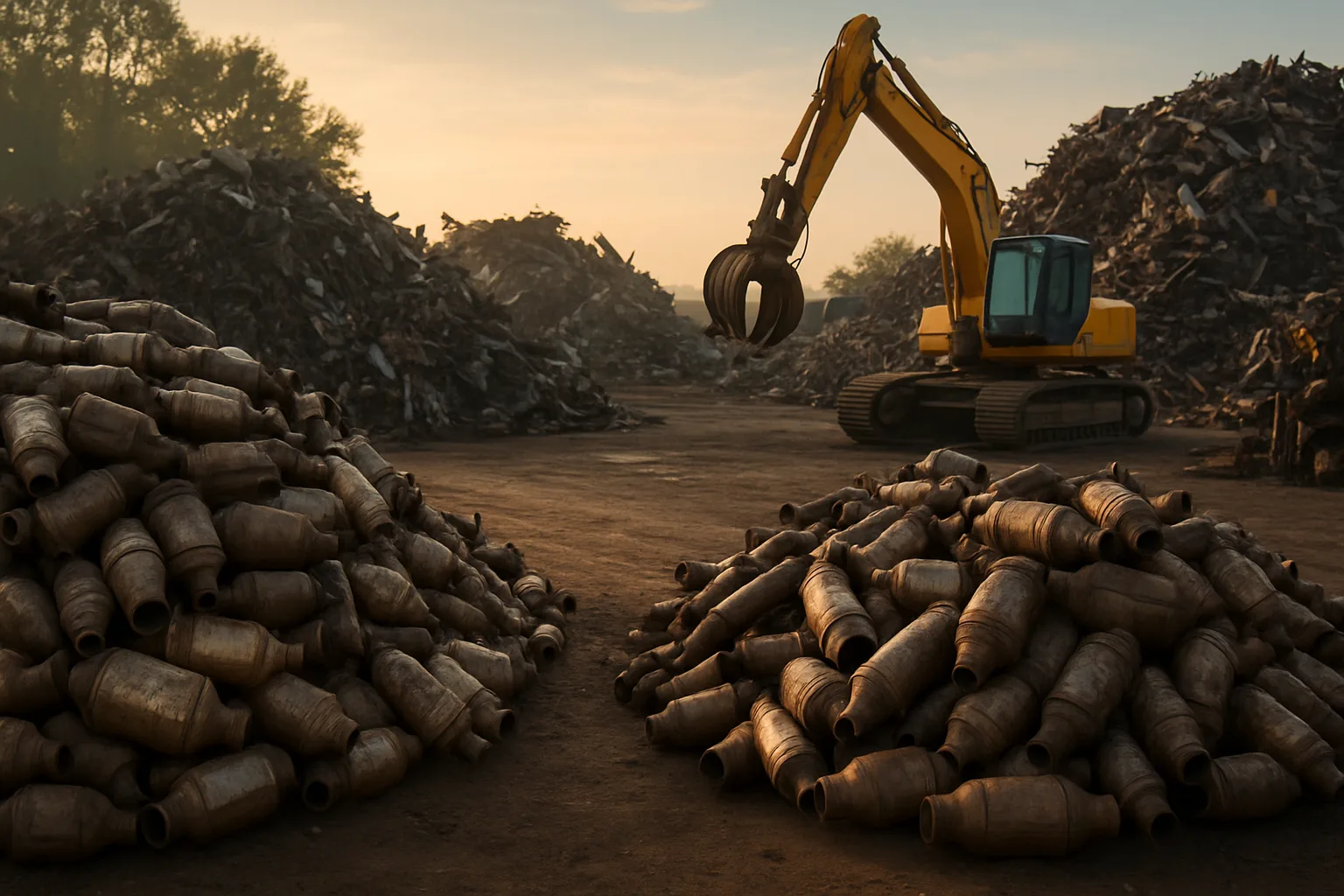
Most people selling scrap cats think of one thing: the honeycomb ceramic brick inside. But not every catalytic converter uses that design. Foil and bead style converters exist — and if you don't know what you're looking at, you could be undervaluing your load or getting lowballed by a buyer who's counting on your confusion. Understanding how these converter types differ, and how the palladium price today affects their value, puts real money back in your pocket.
This guide breaks down both styles clearly. Whether you're a Texas scrap yard pulling cats from domestic vehicles, an Austin auto shop clearing out a backroom pile, or an independent collector building inventory, this is the kind of information that separates a good sale from a great one.
---What Are Foil-Style Catalytic Converters?
Foil-style cats use a metallic substrate instead of the familiar ceramic honeycomb. Inside, you'll find thin corrugated metal foil — typically a high-temperature stainless alloy — wound into a tight cylinder. The platinum group metals (PGMs) — platinum, palladium, and rhodium — are applied directly to the surface of that foil.
The metallic substrate handles heat better than ceramic in some applications, which is why foil-style converters show up frequently in high-performance vehicles, diesel applications, and certain European makes. They're also more resistant to physical shock, meaning they survive rough roads without cracking the way a ceramic brick sometimes does.
From a recycling standpoint, foil substrates behave differently during assay and processing. The metal-on-metal construction means smelters can recover PGMs through a different process than they'd use for ceramic. That doesn't make foil cats less valuable — but it does mean some buyers aren't set up to process them efficiently, which affects the price they'll offer you.
**Key characteristics of foil-style converters:**- Metallic, corrugated foil substrate (not ceramic)
- Lighter weight than comparable ceramic units
- Common in European vehicles, performance applications, and some heavy-duty diesel equipment
- Higher heat tolerance; more vibration-resistant
- PGM loading varies significantly by application and manufacturer
What Are Bead-Style Catalytic Converters and Why Do They Matter for Scrap Cat Value?
Bead-style converters take a completely different approach. Instead of a substrate the exhaust gas flows through, bead cats contain loose ceramic or alumina beads coated with platinum group metals. The exhaust passes over and around those beads as they sit packed inside the converter shell.
Bead-style units were more common in older domestic vehicles — think late-1970s through mid-1980s GM and Chrysler products. You'll also encounter them in some industrial and off-road applications. If you're working in Austin or elsewhere in Texas where older trucks and classic American iron still circulate in decent numbers, you've probably seen bead cats without necessarily knowing what they were.
The bead construction gives recyclers a practical advantage: you can often pour or shake the beads out directly from the shell, making separation straightforward. But the PGM loading on bead-style cats from older vehicles tends to be lower than what you'd find in a modern ceramic or foil unit. That matters when you're calculating catalytic converter scrap metal value against today's metal prices.
**Key characteristics of bead-style converters:**- Loose ceramic or alumina beads coated with PGMs
- Common in pre-1990s domestic American vehicles
- Beads can be separated from the shell easily
- Lower PGM loading typical of older emissions-era designs
- Often found in GM A-body, B-body, and F-body vehicles from the late 1970s and early 1980s
How the Palladium Price Today Affects Foil and Bead Converter Prices
Here's where it gets real. The palladium price today — along with platinum and rhodium — drives the dollar value of every cat converter you sell. Foil and bead cats are no exception. But the math isn't the same across converter types, because PGM loading varies dramatically.
A foil-style converter from a late-model European performance vehicle can carry a meaningful palladium load, especially if it's an OEM unit from a manufacturer known for high-spec emissions hardware. A bead cat from a 1981 pickup? The loading will be significantly lower, and the assay yield reflects that. Neither is worthless — but pricing them the same way is a mistake buyers hope you'll make.
Platinum group metals recycling involves a smelting and assay process that determines the actual PGM recovery from each converter type. Foil cats, because of their metallic substrate, often go through a separate processing stream. Bead cats may be processed by separating the beads and assaying the bead fraction independently from the shell. Understanding this helps you ask better questions when a buyer quotes you a price.
Palladium in particular has seen meaningful price movement over the past several years, with supply chain dynamics — including mining output from South Africa and Russia — continuing to influence spot pricing in 2026. Disclaimer: PGM prices fluctuate daily. Always check current catalytic converter prices before committing to a sale.
---Scrap Catalytic Converter Prices in Austin: Getting What Your Cats Are Worth
Austin is a growing market. The metro has expanded significantly, the auto recycling ecosystem has matured, and yards across Central Texas are processing more cats than ever. That's good news — but more volume doesn't automatically mean more competition for your material. A lot of sellers in Austin still rely on a single buyer relationship, take the first number they're quoted, and move on.
That's the old way. It leaves money on the table. Austin scrap metal services work best when you come in with documented inventory and a clear understanding of what you have. Knowing the difference between a foil cat from a BMW and a bead cat from a 1983 Chevy Silverado means you're not letting a buyer blend them into a flat per-unit price that benefits only one side of the transaction.
If you're moving volume — say, a mixed lot of 50+ converters — scrap metal inventory management becomes critical. Sorting by converter type, photographing each unit, noting make/model/VIN where available, and tracking the substrate type (ceramic, foil, or bead) gives buyers the documentation they need to bid accurately. Better documentation leads to better price discovery. That's not an opinion — it's basic market logic.
Platforms like find the best price for your scrap on SMASH were built around exactly this dynamic. When your inventory is documented and your lot goes in front of multiple vetted buyers simultaneously, competition does the work. You're not guessing at value. You're letting the market tell you what your material is worth today.
---How SMASH Helps Sellers Move Foil and Bead Converters at Market Value
Most sellers of specialty converter types — foil, bead, diesel, or otherwise — run into the same problem: their local buyer may not process those types regularly, so the quote reflects uncertainty rather than actual market value. One buyer, no competition, no transparency. That's a pricing environment that favors the house.
SMASH changes that by putting your documented lot in front of multiple vetted buyers in a competitive auction format. Buyers who specialize in foil processing, or who have established relationships with smelters that handle bead-style material, can bid accurately because they actually know what they're buying. The photo documentation, substrate identification, and VIN/serial tracking that SMASH supports gives those buyers the confidence to bid at or near full market value.
There are no subscription fees. SMASH only wins when the seller wins. If you're in Texas and you've been sitting on a pile of mixed cats — ceramic, foil, and bead — wondering if your current buyer is giving you the full story, it's worth finding out. Get the best catalytic converter price today by starting with a documented inventory and real market competition.
For yards and collectors working through Austin and across Texas, the difference between a negotiated single-buyer price and a competitive auction result can be significant — especially on a lot that contains high-PGM foil material a general buyer may be discounting. Don't leave that spread on the table.
---Tips for Sorting and Selling Foil and Bead Cats Effectively
Before you call a buyer or list a load, do the work on your end. A sorted, documented lot always commands more attention than a mystery pile. Here's how to approach it:
- Identify the substrate type. Cut open a representative sample if needed. Foil cats have a metallic, corrugated look. Bead cats will rattle and pour loose beads when shaken.
- Separate by type. Don't mix ceramic, foil, and bead in the same lot unless you're pricing them as unsorted — and know that unsorted pricing will reflect the buyer's uncertainty.
- Document with photos. Photograph the exterior, the cut end showing the substrate, and any visible markings. Include a ruler or common object for scale.
- Record make, model, and year where possible. VIN lookup helps buyers verify OEM specs and expected PGM loading.
- Check live PGM pricing before you sell. The palladium price today matters. A lot priced on last week's quote can undervalue material if palladium has moved.
- Use platforms that support competitive bidding. SMASH was designed for exactly this — documented lots, multiple vetted buyers, no guesswork.
Want deeper context on how to value your converters beyond the shell type? Read catalytic converter pricing guides to understand how OEM specs, PGM loading estimates, and market conditions all feed into the final number.
---If you've been treating foil and bead cats like generic scrap, you've probably been leaving real value behind. These converter types have real PGM content — the market just requires you to understand what you have before you can price it right. Know your material, document it properly, and get it in front of buyers who can actually value it. That's how you get the best price for your catalytic converter. Get a free quote at best-catalytic-converter-price.com and see what competition can do for your next load.
---Frequently Asked Questions
Q: What is the palladium price today and how does it affect my catalytic converter value?
Palladium is one of the three primary platinum group metals recovered from catalytic converters, alongside platinum and rhodium. Its spot price changes daily based on global supply and demand — and because palladium is the dominant PGM in many gasoline engine converters, its price directly impacts what a buyer will pay for your cats. Always check live PGM pricing before committing to a sale, especially on larger lots.
Q: Are foil-style catalytic converters worth more than ceramic?
Not necessarily — value depends on PGM loading, not substrate type alone. A foil converter from a high-spec European vehicle may carry strong palladium content. A ceramic converter from a modern domestic truck may carry more overall PGM value. The substrate affects how the converter is processed, which can influence buyer pricing, but the PGM content is always the primary driver of value.
Q: Where can I sell bead-style catalytic converters in Austin, Texas?
Bead cats are a specialty item that not every buyer handles confidently. In the Austin area, your best approach is to sort and document your bead cats separately, then get them in front of multiple buyers rather than relying on a single local quote. Platforms like SMASH connect sellers with vetted buyers who specialize in different converter types, including older bead-style units.
Q: How do I know if my catalytic converter is foil or bead style?
If you shake a converter and hear loose rattling material, it's likely a bead-style unit. Foil converters feel more solid and won't rattle. If you cut the shell, foil converters show a metallic corrugated cylinder; bead converters will contain loose spherical or irregular pellets. When in doubt, document both ends with photos and let a specialist buyer assess the type.
Q: Does scrap catalytic converter prices in Austin differ from national averages?
Local market conditions, buyer competition, and transportation costs can all influence what you're offered in Austin versus national benchmarks. In an active market like Austin, Texas, there's enough buyer activity to support competitive pricing — but only if you're actually engaging multiple buyers. A single-buyer quote in any market tends to reflect that buyer's margin, not the full market rate.
---Follow SMASH on LinkedIn for industry updates, PGM market insights, and scrap metal news that actually matters to recyclers and yard operators.