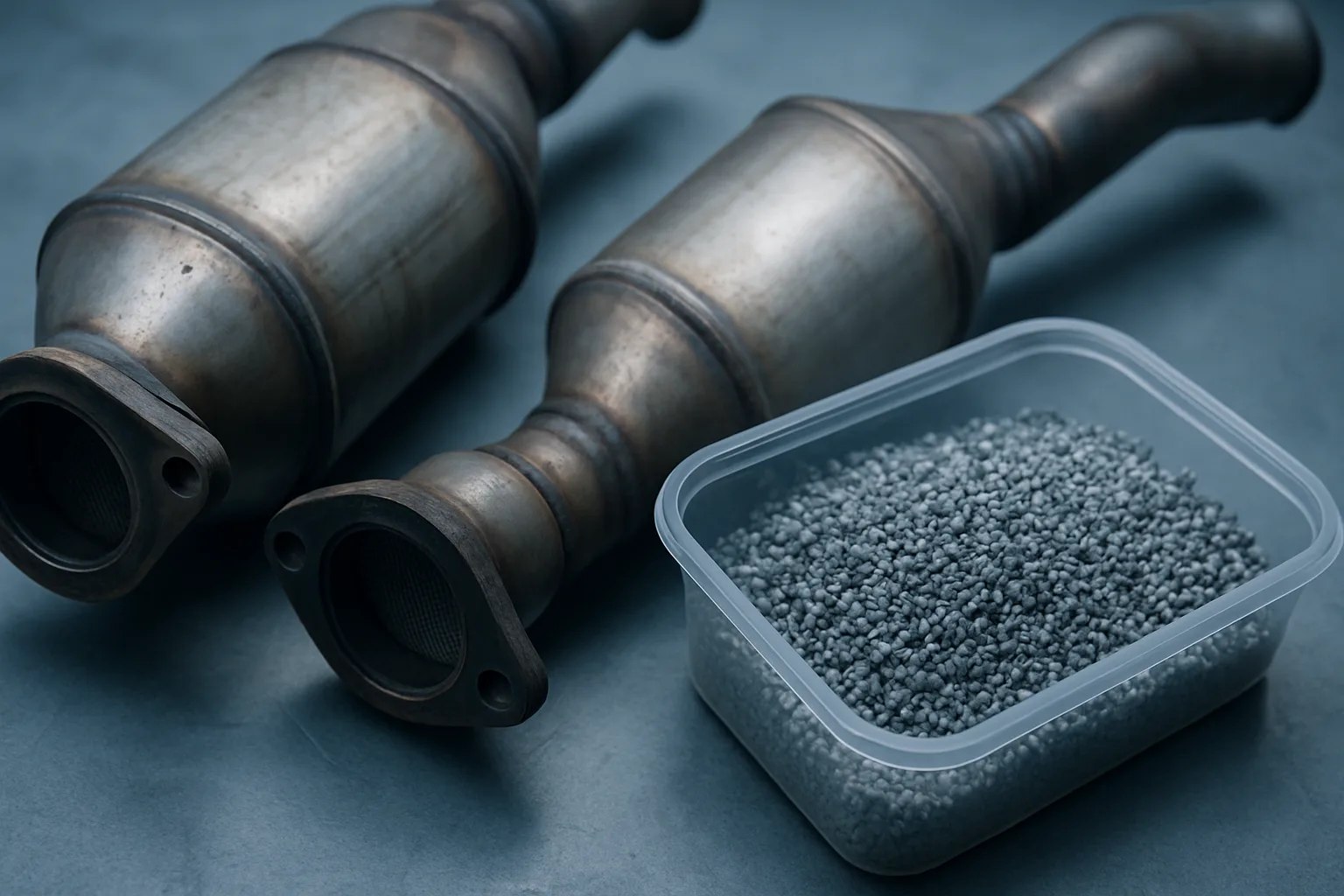
Most scrap yards give you a number. Very few explain where that number comes from. If you've ever walked away from a catalytic converter sale feeling like you left money on the table, there's a good reason for that. The scrap catalytic converter market is driven by three precious metals — platinum, palladium, and rhodium — and their prices swing hard. Understanding how those metals set your payout is the difference between accepting whatever a buyer offers and knowing what your load is actually worth.
This week's market recap breaks down exactly how cat converter prices are determined, why they move, and what sellers in Grand Rapids and across Michigan can do to make sure they're not giving metal away.
The Three Metals That Set Your Catalytic Converter Scrap Value
Every catalytic converter contains a ceramic or metalite substrate coated with a blend of platinum group metals (PGMs) — primarily platinum, palladium, and rhodium. These aren't evenly distributed, and the exact blend depends on the vehicle make, model, engine type, and year of manufacture. When you sell a cat, you're really selling access to those metals.
Here's the simplified version of how each metal contributes:
- Platinum (Pt): Typically found in diesel converters. It drives the oxidation of carbon monoxide and hydrocarbons. Platinum prices track industrial demand globally — particularly from Europe's diesel fleet and the hydrogen sector.
- Palladium (Pd): The dominant metal in gasoline catalytic converters. Palladium demand is tied directly to passenger vehicle production. For most of the converters coming off cars in Michigan, palladium is the biggest value driver.
- Rhodium (Rh): The rarest and most volatile of the three. Rhodium handles NOx reduction (nitrogen oxides). Even trace amounts add meaningful value. Rhodium prices have historically spiked sharply and dropped just as fast — it's the metal that makes converter prices feel unpredictable.
When buyers quote you a price for a scrap catalytic converter, they're working backward from current PGM spot prices, the specific converter type, and their refinery's assay data. That's a lot of information you typically don't have access to — unless you're working with a platform that shows you the market.
Why Cat Converter Prices in Grand Rapids Move Week to Week
If you've been checking catalytic converter scrap value and noticed the numbers shifting, that's not random. PGM prices trade daily on commodity exchanges. A supply disruption in South Africa — where the majority of the world's platinum and rhodium comes from — can move prices within hours. Automotive production slowdowns affect palladium demand. Currency exchange rates matter too, since PGMs are priced in USD globally.
For sellers in Grand Rapids and across Michigan, this creates a real practical problem: the price you got quoted last month may have nothing to do with what your cats are worth today. Scrap metal prices today are a moving target, and a single buyer with no competitive pressure has every incentive to quote you last week's number — or worse.
The weekly swings aren't always dramatic, but they add up. A converter worth $180 one week might fetch $210 the next if rhodium ticks up. That's real money, especially if you're moving volume. The safest move is to verify current rates before you sell — not after.
Want to see how these price movements translate to actual payout? check current catalytic converter prices before your next sale — and know what the market is actually offering.
How Buyers Actually Calculate What They'll Pay You
Here's what happens after you hand over a converter. The buyer — whether a local catalytic converter scrap yard near me or a regional processor — identifies the unit using a serial number, VIN lookup, or physical characteristics. They match it to a database of known assay values for that specific converter type. Then they apply a spread: the difference between what the refined metals are worth at spot price and what they'll pay you at the door.
That spread is where most sellers lose money. It exists for legitimate reasons — processing, refining, logistics, and margin. But the size of that spread varies significantly between buyers. A buyer with no competition quoting you a price has zero incentive to tighten that spread. A buyer competing against five other vetted offers? Different story entirely.
This is the core problem that platforms like North America's B2B scrap metal auction platform SMASH are built to solve. When your inventory goes to auction and multiple buyers compete for the load, the spread tightens naturally. You don't have to negotiate — the market does it for you.
Key factors that affect what a buyer will pay:
- Converter type: OEM converters from late-model vehicles typically carry higher PGM loadings than aftermarket units. OEM converter price reflects that difference clearly.
- Physical condition: Cracked, crushed, or tampered substrates reduce recovery. Photo documentation matters — it protects you and builds buyer confidence.
- Serial number / VIN data: Converters with confirmed identity pull better bids. Mystery units get discounted.
- Lot size: Volume moves the needle. A single cat and a pallet of 50 are priced differently.
- Current PGM spot prices: Everything else is downstream of this.
OEM vs. Aftermarket: Why It Matters for Your Payout
Not all catalytic converters are created equal, and savvy catalytic converter buyers near me know the difference immediately. OEM (original equipment manufacturer) converters are factory-installed units. They contain PGM loadings engineered to meet strict emissions standards for the life of the vehicle — typically higher loadings than aftermarket replacements.
Aftermarket converters — the bolt-on replacements installed after the original fails — are designed to meet legal emissions thresholds at the lowest possible manufacturing cost. That usually means less platinum, palladium, and rhodium per unit. The scrap value reflects that directly.
For sellers in Michigan pulling cats from salvage yards or end-of-life vehicles, knowing whether you have OEM or aftermarket units changes your expectations significantly. A domestic OEM converter from a late-model truck can be worth multiples of a generic aftermarket replacement from the same vehicle year. If you're not sure what you have, serial tracking and photo documentation help buyers give you an accurate quote — rather than lowballing the whole lot to hedge their uncertainty.
For a deeper breakdown of how converter type affects payout, read catalytic converter pricing guides that walk through the major categories and what to expect from each.
What Grand Rapids Sellers Should Do Before Every Sale
Michigan has a robust auto industry ecosystem — there are a lot of catalytic converters moving through the region. That also means there are a lot of buyers competing for those units, which is good for sellers who know how to work the market. Here's a practical checklist before you sell your next load:
- Check today's PGM spot prices. Platinum, palladium, and rhodium prices are publicly available. Know where the market is before you walk into any conversation.
- Identify your converters. Serial numbers, VIN lookups, and photos are your leverage. Documented inventory sells for more. Unidentified units get averaged down.
- Don't call one buyer. One call is one number with no pressure behind it. Get competitive quotes. The difference between one offer and four can be significant on the same load.
- Know OEM from aftermarket. Mixing them without flagging it hurts your credibility and your payout. Sort your lot before you sell.
- Understand the spread. Ask buyers how they're pricing — spot minus what percentage? The more transparent the quote, the more trustworthy the buyer.
- Use platforms that document the transaction. Auto-invoicing and packing lists protect you after the sale, not just during it.
Sellers in Grand Rapids who move volume regularly know that one relationship with one buyer is a comfort zone — not a strategy. SMASH was built specifically to replace that single-buyer model with a competitive, documented auction process. No subscription fees. You only pay when you sell.
How SMASH Helps You Capture the Real Market Price
The core promise of SMASH is straightforward: more buyers competing for your load means better price discovery. That's not a slogan — it's basic market mechanics. When vetted buyers see documented, identified inventory, they bid with confidence. When they bid with confidence, they bid higher.
SMASH brings structure to a market that has historically rewarded opacity. VIN lookup, serial tracking, photo documentation, and auto-invoicing aren't just features — they're tools that shift the information balance back toward the seller. You stop guessing what your converters are worth. You find out what the market will actually pay.
For anyone in Michigan regularly moving scrap catalytic converters — whether you're running a shop, a salvage yard, or building a side business buying cores — the old way of selling (one phone call, one number, take it or leave it) is leaving real money behind. Get the best catalytic converter price today by bringing competition back into the equation.
If you're ready to stop guessing and start selling with the market behind you, get a free quote at best-catalytic-converter-price.com. Know what your cats are worth before you commit to any number.
Disclaimer: Catalytic converter prices fluctuate daily based on platinum, palladium, and rhodium spot markets. All pricing references in this article are general in nature. Always verify current rates before selling.
Frequently Asked Questions
Q: What determines cat converter prices in Grand Rapids?
The primary drivers are the current spot prices for platinum, palladium, and rhodium — the precious metals inside every catalytic converter. Converter type (OEM vs. aftermarket), physical condition, and whether the unit is properly identified also affect what buyers will pay. In Grand Rapids and across Michigan, buyers use the same global PGM pricing data, but their spreads and margins vary — which is why getting competitive quotes matters.
Q: How do I know if I'm getting a fair price for my scrap catalytic converter?
The most reliable way is to check current PGM spot prices yourself and compare multiple buyer quotes on the same load. A single offer with no competition is rarely the best offer. Platforms like SMASH put your documented inventory in front of vetted buyers so the market — not one buyer's margin target — sets your price.
Q: Why does rhodium make catalytic converter scrap value so unpredictable?
Rhodium is extremely rare — most global supply comes from a handful of mines in South Africa. Any supply disruption, refinery issue, or shift in automotive emissions standards can move rhodium prices dramatically in a short period. Because even small amounts of rhodium add significant value, those swings ripple directly into your converter's scrap value.
Q: Is there a catalytic converter scrap yard near me in Grand Rapids that pays market price?
Grand Rapids has multiple buyers operating in the area, but paying "market price" depends on which market they're referencing and how competitive their offer is. Rather than assuming the closest yard pays the best, get your converters documented and quoted through a multi-buyer platform — you'll quickly see whether your local options are pricing competitively or not.
Q: Does it matter if my catalytic converter is OEM or aftermarket when I sell it?
Absolutely. OEM converters carry higher PGM loadings than aftermarket replacements and consistently command higher scrap prices. If you're selling a mixed lot without identifying OEM vs. aftermarket units, buyers will often average down to protect their margins. Sorting and documenting your inventory before you sell protects your payout.
Follow SMASH on LinkedIn for weekly scrap metal market updates and industry insights: linkedin.com/company/scrap-metal-auction-sales-hub
```