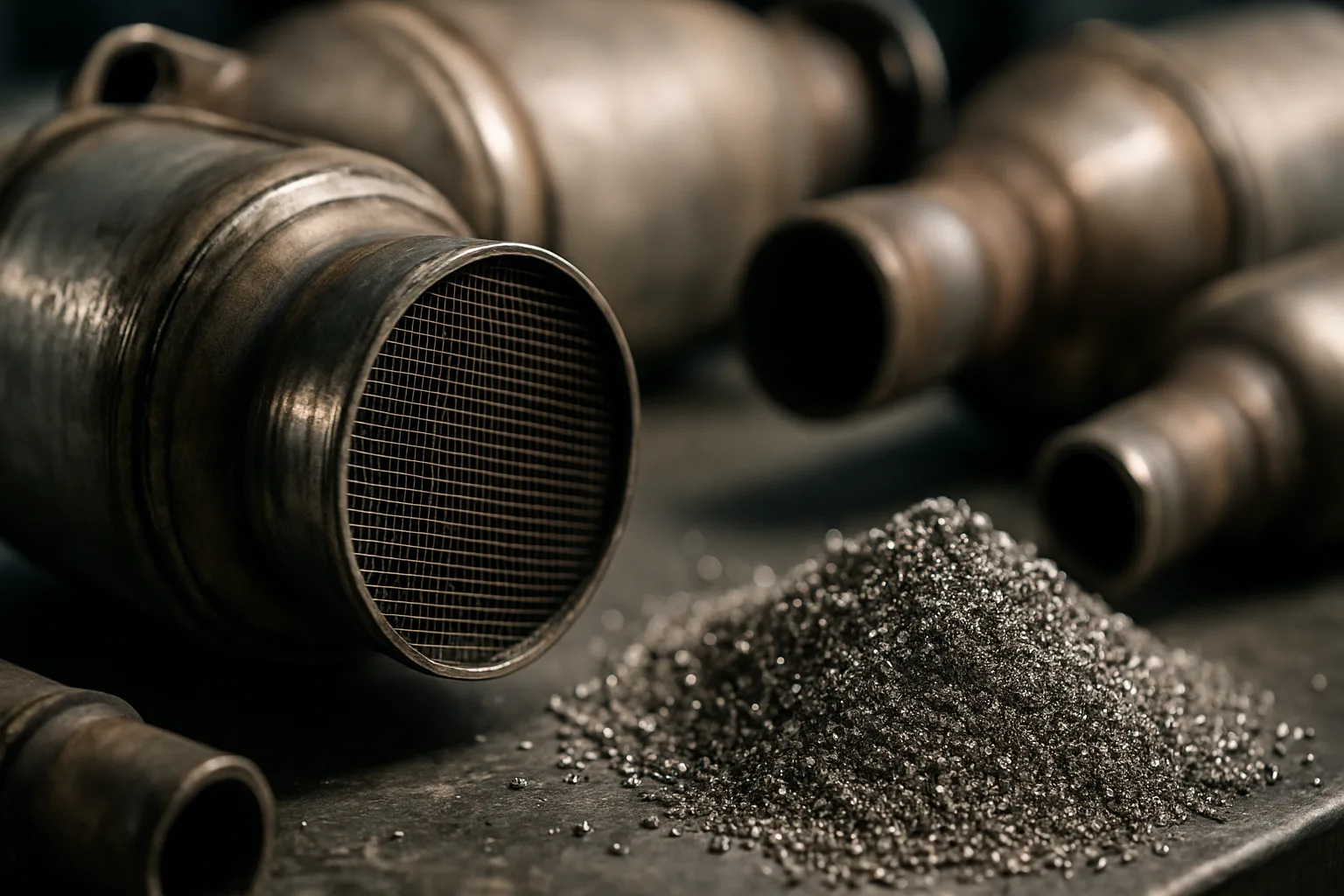
Hybrid vehicles are quietly sitting on some of the most valuable scrap in the recycling business — and most sellers have no idea. If you're pulling converters off hybrid cars and treating them the same as a standard gas engine cat, you're likely leaving real money on the table every single time.
Here's why that matters if you want to sell catalytic converters online and actually get what they're worth: hybrid cats are built differently, loaded with more platinum group metals (PGMs), and priced in a completely different tier. Understanding the difference isn't just useful — it's the difference between a good day and a great one at the yard.
Why Hybrid Catalytic Converters Carry More Precious Metals
In a conventional gas vehicle, the engine runs continuously and gets the exhaust system up to operating temperature fast. The catalytic converter reaches its light-off temperature quickly, and the chemical conversion process runs efficiently at sustained heat. The amount of platinum, palladium, and rhodium required to do the job is calibrated for that consistent thermal environment.
Hybrid vehicles operate differently — and that changes everything for the converter. In a hybrid, the gas engine cycles on and off repeatedly. Every time the engine shuts down and restarts, the catalytic converter cools and reheats. To compensate for these constant temperature swings and maintain emissions compliance across that start-stop cycle, manufacturers load hybrid converters with a higher concentration of platinum, palladium, and rhodium. More PGMs means more consistent conversion performance even during those cold restart windows. It also means more value sitting inside that shell.
- Platinum (Pt): Helps oxidize hydrocarbons and carbon monoxide, especially effective during cold starts
- Palladium (Pd): Handles hydrocarbon oxidation and is often loaded more heavily in hybrids due to its cold-start efficiency
- Rhodium (Rh): Reduces nitrogen oxides — one of the most expensive metals in the converter by weight
The substrate inside a hybrid cat is also often engineered with a finer cell structure, increasing the surface area available for catalytic reactions. More surface area requires more PGM coating to be effective. All of that adds up to a converter with significantly higher scrap metal value compared to a standard OEM unit.
What This Means for Scrap Cat Converter Value — and Platinum Price Today
The precious metals market fluctuates constantly. Rhodium alone has swung from hundreds of dollars per troy ounce to well over ten thousand in recent market cycles. Palladium and platinum follow their own curves, responding to mining supply, automotive production volumes, and broader commodity trading. The platinum price today affects every hybrid cat you pull — not abstractly, but directly in the offer you'll receive when you go to sell.
This is exactly why hybrid converters don't belong in a pile with standard cats waiting for a flat-rate offer from a single buyer. The PGM content in a Toyota Prius, Ford Escape Hybrid, Honda Insight, or similar vehicle's converter can put it in a completely different pricing category. A buyer who isn't assaying properly or who doesn't differentiate by vehicle type is going to offer you a generic number. That generic number is almost never the right number for a hybrid unit.
Getting accurate value starts with accurate identification. That means knowing the make, model, year, and ideally the OEM part number stamped on the converter shell. A documented, identified converter gives buyers the data they need to make a real offer — not a guess. Platforms like smashscrap.com are built around exactly this kind of documentation-first approach, where inventory detail drives better price discovery rather than a cold call to one buyer who sets the number unilaterally.
Scrap Metal Inventory Management: Don't Let Hybrid Cats Get Buried in a Mixed Load
Here's a mistake that happens at yards across Tennessee and the rest of North America more often than anyone wants to admit. A load of cats comes in — some domestic, some import, a few hybrids mixed in. They get counted, tossed in a bin, and quoted as a blended load. The buyer averages across the pile and offers a price that works fine for the standard units but significantly undervalues the hybrids.
Good scrap metal inventory management separates hybrid converters at intake. That means:
- Identify on arrival — use VIN data or part numbers to flag converters from known hybrid platforms before they go into general inventory
- Document with photos — capture the shell, serial, and any visible markings; this matters when buyers are bidding remotely
- Store separately — keep hybrid units physically separated so they go to market as their own lot, not blended into a general load
- Track by category — your inventory tool should let you sort by converter type, not just by count or weight
When you treat hybrid cats as a distinct inventory category, you open the door to getting them in front of buyers who specifically want them and will pay accordingly. That's where SMASH comes in. The platform's inventory and documentation tools are designed to let you build out proper lot descriptions — serial tracking, photo documentation, vehicle-level detail — so that when a load goes to auction, buyers have the confidence to bid competitively. More buyer confidence means better price discovery on the loads that deserve it most.
Finding the Right Buyers: Memphis, Tennessee and the Broader Market
If you're searching for catalytic converter buyers near me prices or catalytic converter scrap yards near me in the Memphis area, you already know the local buyer pool is limited. Memphis has active scrap infrastructure, no question. But for high-value hybrid converters, the right buyer isn't always the closest one — it's the one who understands PGM content and prices accordingly.
The Tennessee scrap market, like most regional markets, has buyers who specialize in different material streams. A general ferrous yard and a dedicated non-ferrous cat buyer are operating with completely different pricing models. A buyer who processes hundreds of hybrid units a month has much tighter data on PGM yields and will bid sharper than a generalist who sees a handful a year.
This is why selling online matters so much for hybrid converter inventory. When you get the best catalytic converter price today, you're not limited to whoever answered the phone in your zip code. You're putting your documented inventory in front of a vetted pool of buyers who compete for it. That competition is the mechanism that surfaces real market value — especially for converters with above-average PGM content like hybrids. Memphis sellers connected to that broader network aren't settling for local guesses. They're getting market-based offers.
The Memphis scrap metal services page has more detail on how local sellers in this market are using online platforms to access better buyer reach for their converter inventory.
How SMASH Helps You Get Accurate Value for High-PGM Converters
The auction model is specifically well-suited to high-value converter categories. When a hybrid cat lot is documented properly — vehicle source, OEM part reference, serial numbers, photos — it becomes a real asset a buyer can evaluate from anywhere. They're not guessing at the PGM content. They're bidding based on data they trust.
SMASH connects sellers with vetted buyers and runs competitive auctions for scrap catalytic converters. There are no subscription fees. The platform only earns when a sale closes, which means the incentive is aligned: get you the best price, not just any price. For a yard in Memphis or anywhere across North America running a mix of standard and hybrid inventory, that alignment matters. You're not paying to list and then hoping for the best.
The platform's VIN lookup and serial tracking features are particularly valuable for hybrid converter documentation. Instead of describing a lot as "ten cats, mixed," you're presenting verified, vehicle-level data. Buyers pay more for certainty. That's not a pitch — that's how commodity markets work. Documented inventory gives buyers more confidence, and buyer confidence drives competitive bidding. To check current catalytic converter prices and understand where your hybrid units sit in today's market, starting with accurate identification is non-negotiable.
Want to go deeper on how converter pricing works across different vehicle types? Read catalytic converter pricing guides to get a clearer picture before your next sale.
The Bottom Line on Hybrid Converter Value
Hybrid catalytic converters represent one of the higher-value categories in the scrap cat market right now. The engineering reason is straightforward: start-stop operation demands more PGMs to maintain emissions performance. The business reason is equally clear: more precious metal content means a higher scrap value — but only if you identify it correctly, document it thoroughly, and sell it to buyers who recognize the difference.
Don't treat a hybrid converter like a standard domestic cat. Don't let it disappear into a blended load where the average drags down its value. Separate it, document it, and put it in front of buyers who will compete for it. If you're in Memphis or anywhere across Tennessee with hybrid inventory sitting in your yard right now, that's money waiting to be claimed at the right price. Get a free quote at best-catalytic-converter-price.com and find out what your hybrid converters are actually worth in today's market.
Disclaimer: Catalytic converter prices fluctuate based on platinum, palladium, and rhodium spot prices, as well as converter type, condition, and buyer demand. Always check current rates before selling.
Frequently Asked Questions
Q: Why are hybrid catalytic converters worth more than standard ones?
Hybrid vehicles cycle their engines on and off repeatedly, which means the catalytic converter must perform efficiently across constant temperature changes. To meet emissions standards under those conditions, manufacturers load hybrid converters with higher concentrations of platinum, palladium, and rhodium. More precious metal content means a higher scrap value compared to standard gas-engine converters.
Q: Can I sell catalytic converters online from Memphis, Tennessee?
Yes. Online platforms like SMASH allow sellers in Memphis and across Tennessee to list documented converter inventory and reach vetted buyers across North America. You're not limited to local buyers, which is especially important for high-value hybrid converters where specialized buyers will pay more competitively.
Q: How does platinum price today affect what I get for my scrap cat?
The spot price of platinum, palladium, and rhodium directly influences what buyers will pay for your converter. When precious metal prices rise, cat values follow. When they fall, offers reflect that too. Checking current PGM spot prices before you sell gives you a realistic baseline for evaluating any offer you receive.
Q: What information do I need to sell a hybrid catalytic converter for the best price?
At minimum, you want the vehicle make, model, and year the converter came from, the OEM part number or serial stamped on the shell, and clear photos of the unit. This documentation lets buyers assess PGM content accurately and bid with confidence rather than discounting for uncertainty.
Q: Are there catalytic converter buyers near me in Memphis who specialize in hybrid units?
There are general scrap buyers in the Memphis area, but not all of them specialize in high-PGM hybrid converters. For the best price discovery on hybrid inventory, reaching buyers through an online auction platform gives you access to specialists who process hybrid cats regularly and bid accordingly — rather than settling for a generalist quote from the nearest yard.
Follow SMASH on LinkedIn for scrap metal market insights, PGM price updates, and industry news relevant to yards and buyers across North America.