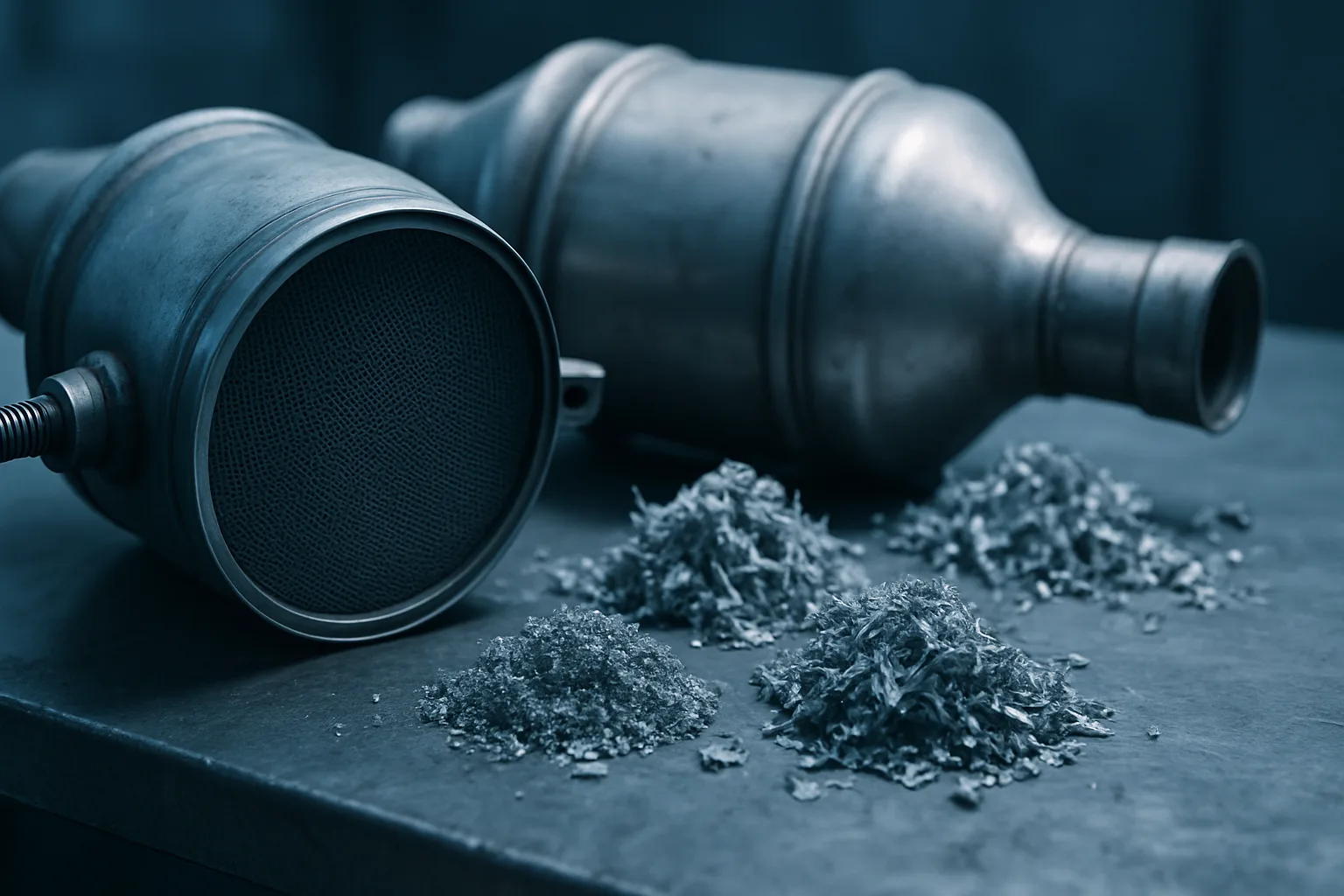
OEM vs. Aftermarket Catalytic Converters: Why the Scrap Value Gap Is Bigger Than You Think
Pull two catalytic converters off the shelf — one OEM, one aftermarket — and they might look nearly identical. Same shape. Same heat shield. Same bolt pattern. But hand them to a scrap buyer, and you could get offers that are hundreds of dollars apart. If you're trying to maximize scrap catalytic converter prices in Atlanta, understanding why that gap exists isn't optional. It's the difference between getting paid what your metal is actually worth and leaving money on the table.
The core issue comes down to what's inside. Catalytic converters aren't valuable because of their steel shells. They're valuable because of the platinum group metals — platinum, palladium, and rhodium — loaded into the ceramic substrate. And OEM converters carry significantly more of those metals than most aftermarket units. That's the whole story, but the details matter a lot when you're pricing loads.
What Makes OEM Catalytic Converters So Much More Valuable as Scrap
OEM stands for Original Equipment Manufacturer. These are the converters that came off the factory line, installed directly on the vehicle by the automaker or their certified supplier. Automakers build converters to meet strict EPA emissions standards across a vehicle's full useful life — often 150,000 miles or more. To hit those targets reliably, OEM converters are loaded with higher concentrations of platinum, palladium, and rhodium.
That loading density is what drives scrap value. When a recycler or processor assays an OEM converter, they're measuring actual precious metal content. A strong OEM unit from a full-size truck or V8 SUV can carry a substrate with meaningful PGM concentrations. Aftermarket converters, built to a price point rather than a longevity spec, often use lower catalyst loading. Some use alternative base metal washcoats that produce significantly lower returns at assay.
Here's what that means practically when you're selling:
- OEM converters from domestic trucks, luxury vehicles, and SUVs consistently rank at the top of any catalytic converter price list with pictures
- High-mileage OEM units still typically outperform new aftermarket units on scrap value
- Aftermarket converters — especially low-cost universal-fit units — can be worth a fraction of the OEM equivalent
- OEM Honda, Toyota, GM, and Ford converters are among the most commonly traded in yards across Georgia
How Serial Numbers and Vehicle Identification Separate Winners from Losers
Walk into a scrap yard without documentation and you're guessing. Walk in with a serial number — or better yet, a VIN — and you're negotiating with data. This is one of the most overlooked differences between sellers who consistently get strong cat converter prices in Atlanta and those who accept low first offers.
OEM converters are manufactured to spec and tracked by part number. Those part numbers tie directly to documented PGM loading data that processors use to price them. When a buyer can confirm the serial number on your converter matches a known OEM spec — say, a Toyota Prius front converter or a Ford F-250 diesel cat — they can price it with confidence. Confidence means higher offers. When a converter has no identifiable serial number, or the number traces back to a generic aftermarket supplier, buyers discount hard to protect their margin.
Platforms like SMASH Scrap — where verified buyers bid on your metal use VIN lookup and serial tracking tools so buyers can assess what they're bidding on before the auction closes. That transparency isn't just convenient — it actively helps sellers get better price discovery on documented OEM material. More buyer confidence means more competitive bidding.
If you're selling a mixed load — some OEM, some aftermarket — separate them. Mixing high-value OEM units with low-grade aftermarket converters drags your average price down. Sort by type, document by serial number, and you give buyers the information they need to pay you more.
The Aftermarket Trap: When New Doesn't Mean Valuable
This catches a lot of sellers off guard. A brand-new aftermarket catalytic converter — fresh out of the box, never installed — can be worth less as scrap than a worn OEM unit with 100,000 miles on it. That's not a typo. The scrap value of a converter is entirely about PGM content, not age or condition.
Many aftermarket converters are designed and priced for the replacement parts market, not for longevity or high catalyst loading. Some manufacturers use palladium-heavy blends; others use platinum-heavy formulations; some use cheaper configurations that process out at much lower returns. There's no single standard, which is why you can't assume aftermarket means junk — but you can't assume it means value, either.
The categories that consistently disappoint at scrap:
- Universal-fit converters with no vehicle-specific tuning
- Budget-tier aftermarket units from unknown manufacturers
- Converters with ceramic substrate that's been rattled loose internally — even on OEM units, physical damage hurts value
- Small-displacement foreign aftermarket units with minimal PGM loading
And the categories that consistently perform:
- OEM converters from full-size domestic trucks (F-series, Silverado, Sierra, RAM)
- Toyota Prius, Lexus, and Acura OEM units
- Large V8 and V10 diesel converters
- Converters with clearly legible serial numbers that trace to known high-PGM specs
Scrap Catalytic Converter Prices in Atlanta: What the Local Market Looks Like
Atlanta's scrap market reflects national PGM commodity prices, but local dynamics play a role too. The Atlanta metro area generates significant converter volume — busy auto shops, a dense used car market, fleet operators, and auto dismantlers all contribute supply. That volume means local buyers are active and competitive, which is generally good for sellers.
But active buyers don't automatically mean maximum prices. If you're selling to a single yard without shopping your load, you're pricing by negotiation, not by competition. A yard that knows you're not calling anyone else has little incentive to offer top dollar. That's true whether you're in Atlanta or anywhere else in Georgia.
The better move is to get the best catalytic converter price today by letting multiple buyers see your inventory at once. Auction-style competition — where vetted buyers bid against each other — is how you find the actual market price, not just one buyer's offer. It's the same principle that makes any commodity market work: more buyers, better price discovery.
For sellers moving higher volumes of OEM material through Atlanta scrap metal services, documented loads with photo evidence and serial number tracking consistently attract more competitive bids than undocumented mixed loads. The documentation investment takes maybe 20 minutes per load. The return can be significant.
How to Know What You Have Before You Sell: Price Lists, Photos, and Serial Numbers
The single best thing you can do before selling converters is identify what you're holding. A catalytic converter price list with pictures gives you a visual reference — you match your converter to a known unit, confirm the serial number, and know the general tier before you open negotiations. That's basic preparation, and it shifts the power dynamic in your favor.
Here's a practical pre-sale checklist:
- Photograph every converter — top, bottom, and serial number stamp. Good photos mean remote buyers can assess accurately.
- Record the serial number — even partial numbers help. Full numbers are better. A VIN from the donor vehicle helps most of all.
- Sort OEM from aftermarket — keep them in separate lots. Don't let low-value units drag down your OEM pricing.
- Check current market conditions — rhodium and palladium prices shift. What your converter was worth three months ago may not reflect today's market.
- Get multiple offers — this is non-negotiable if you want to know the real market value.
SMASH's platform is built specifically for this kind of documented inventory workflow. Serial tracking, photo uploads, and a vetted buyer network mean your documented OEM units go in front of buyers who can actually pay for what they're worth. You can read catalytic converter pricing guides to get deeper on identifying converter types before your next sale.
Getting Maximum Value: Why Auction Format Beats Single-Buyer Deals
Let's be direct about how most converter sales happen today. A seller calls one buyer — maybe a local yard, maybe a national processor — describes the load, and accepts or walks away from a single number. That's not price discovery. That's a coin flip weighted toward the buyer.
Auction format flips that. When multiple catalytic converter buyers in Georgia see the same documented load and compete in real time, the price reflects actual demand. One buyer's offer becomes the floor, not the ceiling. You don't have to be an expert negotiator — competition does the work for you.
No subscription fees. No guessing. When you're ready to move your converters, check current catalytic converter prices and see what a competitive process can do for your returns.
Price disclaimer: Catalytic converter scrap values fluctuate based on real-time platinum, palladium, and rhodium commodity prices. The information in this article reflects general market dynamics as of July 2026. Always verify current rates before selling.
Frequently Asked Questions
Q: Why is my aftermarket catalytic converter worth so much less than an OEM unit?
Aftermarket converters are typically built to a cost target, not a longevity spec. They carry lower concentrations of platinum, palladium, and rhodium than OEM units — and those precious metals are what drive scrap value. An OEM converter from a full-size truck can outperform a brand-new aftermarket unit by a wide margin at assay.
Q: How do I find out how much my catalytic converter is worth by serial number?
Locate the serial number stamped on the converter body — often near the weld seam or on the heat shield. That number traces to a manufacturer spec with documented PGM loading. Platforms that offer serial tracking and VIN lookup give buyers the data they need to make confident, competitive offers. Unidentified converters typically receive discounted bids to account for buyer uncertainty.
Q: What are scrap catalytic converter prices like in Atlanta right now?
Atlanta-area prices track national PGM commodity markets — primarily platinum, palladium, and rhodium spot prices. Local competition among buyers is generally healthy given the volume of converters moving through the market. Your best move is to document your load and get multiple bids rather than accepting the first offer from a single yard.
Q: Does it matter if the catalytic converter is still in good condition when selling as scrap?
Physical condition matters, but not in the way most sellers expect. A rattled substrate — where the ceramic honeycomb has broken loose inside the shell — reduces the recoverable PGM content and will lower your offer. Externally clean converters with intact substrates command better prices. Age and mileage matter far less than substrate integrity and PGM loading.
Q: How can I get the best price for catalytic converters in Georgia without being lowballed?
Sort your material by type, photograph everything, document serial numbers, and use a platform that puts your load in front of multiple vetted buyers simultaneously. Single-buyer negotiations put you at a disadvantage by design. Competitive bidding — like what SMASH offers — lets the market set the price, not one buyer's margin calculation.
Ready to stop guessing what your converters are worth? Get a free quote and let verified buyers compete for your material at best-catalytic-converter-price.com.
Follow SMASH on LinkedIn for scrap metal market updates, PGM price movements, and industry insights delivered straight to your feed.