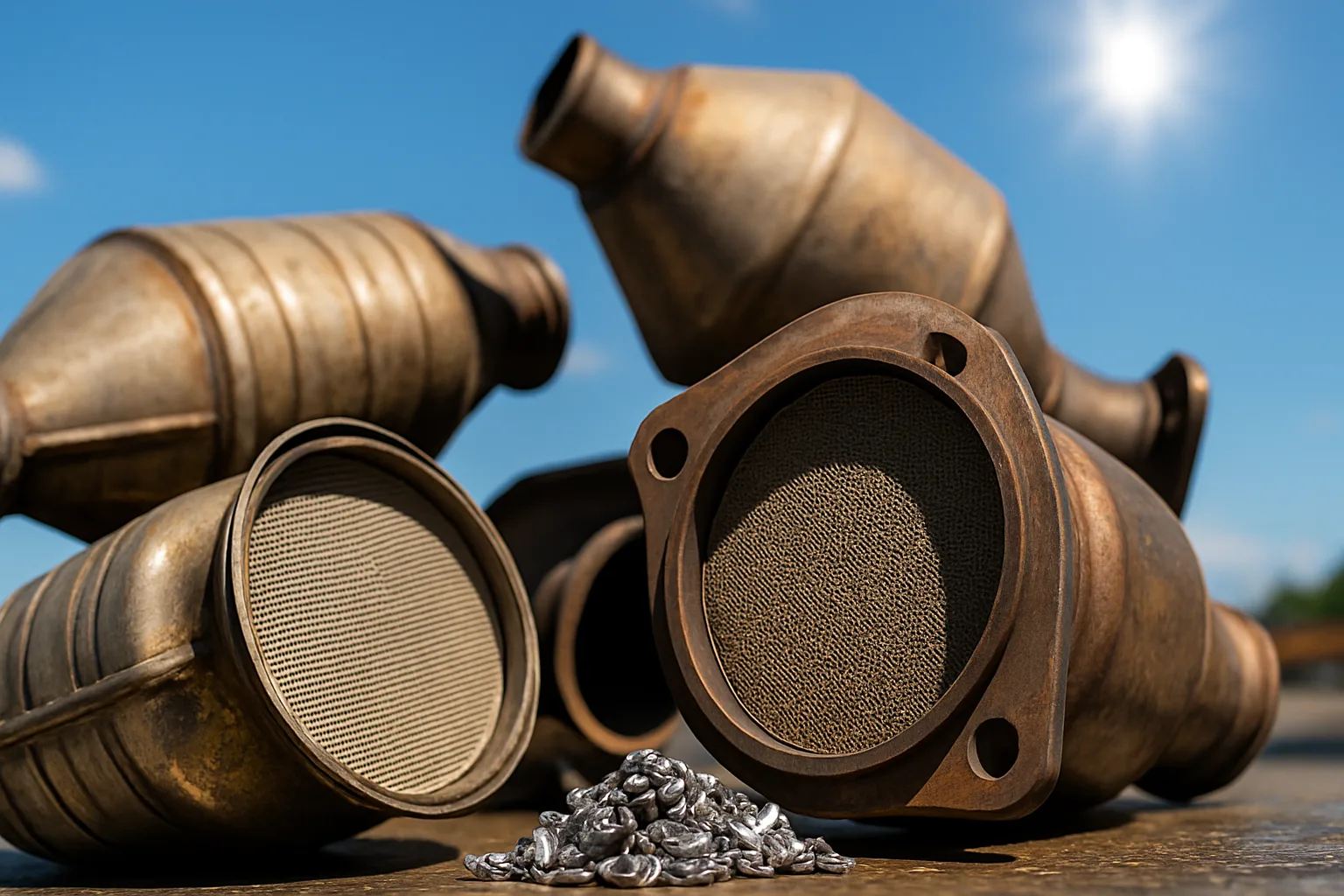
Why the Palladium Price Today Keeps Scrap Yards Paying Attention to Emissions Policy
Most people selling a scrap catalytic converter think about weight and metal content. Fewer think about the clean air rules that made those metals valuable in the first place. That's a mistake — because emissions regulations are the single biggest driver of platinum group metal demand, and what happens in Washington (or Brussels, or Beijing) directly affects the palladium price today and what you get paid at the scale.
If you're sitting on cats in Columbus or running a shop in Ohio that pulls converters regularly, understanding this connection puts money in your pocket. Here's how the regulatory story translates to real dollars at the end of the chain.
How Emissions Standards Create Demand for Platinum, Palladium, and Rhodium
Catalytic converters exist because of regulations — full stop. The U.S. EPA's emissions standards require automakers to reduce hydrocarbons, carbon monoxide, and nitrogen oxides from vehicle exhaust. The only proven, scalable way to do that at the engine level is with a catalyst. And the most effective catalysts use platinum, palladium, and rhodium — the platinum group metals (PGMs) that make your scrap converter worth real money.
As emissions rules tighten, automakers load more PGMs into each converter. More catalyst loading per unit means higher raw material demand. Higher demand — against a constrained mining supply — pushes prices up. That pressure flows directly into the scrap catalytic converter prices recyclers pay, because secondary recovery (your used converter) competes with primary mining to fill that supply gap.
- Palladium dominates gasoline engine converters — most passenger vehicles on the road use palladium-heavy formulations
- Platinum is heavier in diesel converters and is gaining ground as hybrid systems evolve
- Rhodium handles nitrogen oxide reduction and is used in smaller quantities, but its price sensitivity is extreme — small shifts in supply move the market fast
When regulators raise the bar, every vehicle on the production line needs a more effective converter. That means more metal per car. The recycling market feels that pressure in real time through daily spot prices — which is exactly why the palladium price today matters to anyone sitting on a load of cats.
Where U.S. Emissions Policy Stands in 2026 — and Why It Matters for Scrap
The federal emissions framework in 2026 continues to push stricter tailpipe standards across light-duty and medium-duty vehicle classes. Simultaneously, the transition toward hybrid and plug-in hybrid platforms — rather than a clean break to full battery EVs — has kept PGM demand stronger than many analysts predicted five years ago. Full battery EVs don't use catalytic converters. But hybrids do, and in some cases they use more PGM loading per converter than a standard combustion vehicle because their engines run in cold-start conditions more frequently.
That cold-start dynamic matters. Converters do most of their work when an engine first warms up — before the catalyst hits operating temperature. Hybrid engines cycle on and off constantly, meaning more cold starts, meaning more stress on the catalyst, meaning engineers load more platinum and palladium to compensate. The result: the average PGM content per unit in newer-model converters is trending up, not down.
For scrap sellers and recyclers in Ohio, this means the units coming off the road in 2026 — especially late-model hybrids from the 2019–2024 build years — may carry more recoverable value than older inventory. Knowing what you have before you sell is not optional. It's how you avoid leaving money on the table.
Scrap Catalytic Converter Prices in Columbus — What Shapes Local Market Value
The scrap catalytic converter prices Columbus yards and shops see aren't set locally — they're pegged to global PGM spot prices, then adjusted for assay results, lot quality, and buyer competition. A converter's scrap value comes from three variables: which vehicle it came from, the current PGM spot market, and who's buying it.
That third factor — who's buying — is where most sellers lose money without knowing it. Calling one buyer and taking their offer is the old way. It's also the way that consistently undervalues your load, because a single buyer has no incentive to sharpen their number when there's no competition.
The better approach is what platforms like the SMASH scrap metal auction marketplace are built for: bringing vetted buyers into direct competition on documented lots. More buyers means better price discovery. Documented inventory — photos, serial tracking, VIN lookup where applicable — gives buyers more confidence, and confident buyers bid higher. That's not a theory. That's how competitive markets work.
Columbus is a strong market for this. Auto recyclers, dismantlers, and shops across central Ohio generate consistent converter volume. Connecting that volume to a broader buyer pool through a B2B scrap metal marketplace changes the math on every transaction. If you're searching for catalytic converter recycling near me and coming up empty on fair pricing, the problem usually isn't geography — it's access to real competition.
Reading a Catalytic Converter Scrap Price Chart Without Getting Burned
PGM prices move daily. Sometimes hourly. A catalytic converter scrap price chart gives you a snapshot, but the number you care about is the one on the day your lot settles — not last week's chart. This is why timing and process both matter when you're moving inventory.
Here's how to use price data without getting burned:
- Track the trend, not just the number. Is palladium moving up or down over the past 30 days? A rising market rewards patience. A falling market rewards speed.
- Understand your converter mix. A load of domestic cats from American-made trucks pays differently than a load of foreign OEM units from Honda or Toyota. Know what you have before you price it.
- Don't anchor on last month's price. PGM markets can shift 10–20% in a matter of weeks on macro news, policy changes, or supply disruptions. Today's palladium price today is the only price that matters for today's deal.
- Use documented lots to compete for better bids. Buyers discount for uncertainty. Serial tracking, photos, and accurate categorization remove that uncertainty — and that discount disappears with it.
If you want to check current catalytic converter prices before you move your inventory, do it. Don't guess. Don't rely on a number someone gave you three weeks ago. The market doesn't hold still, and neither should your information.
How to Get the Best Catalytic Converter Price in Columbus
Getting the best price for a scrap catalytic converter in Columbus, Ohio comes down to three things: knowing what you have, documenting it properly, and selling into competition — not away from it.
Auto shops and dismantlers who run volume should be thinking about this as a system, not a one-off transaction. A repeatable process — consistent documentation, consistent access to vetted buyers, consistent price discovery — compounds over time. The shop that sells 20 loads a year into a competitive auction format will consistently outperform the shop that calls one buyer and takes whatever they're offered.
SMASH was built for exactly this. No subscription fees. The platform only wins when the seller wins. Vetted buyers, auction format, auto-invoicing, photo documentation — the tools that make a professional sale possible without requiring a PhD in commodities trading. For Columbus scrap metal services, SMASH connects local volume to a buyer pool that extends well beyond what any one yard or regional dealer can offer.
The regulatory pressure that drives PGM demand isn't going away. If anything, it's building. Every new round of emissions standards that automakers have to meet means more platinum, palladium, and rhodium in new vehicles — and eventually, more value in the scrap market when those vehicles reach end of life. Getting ahead of that curve means building the right process now.
For deeper reading on how converter values are calculated and what factors move the market, read catalytic converter pricing guides that break down the variables in plain language.
If you're ready to stop guessing and start selling into a real market, get the best catalytic converter price today — the process is straightforward, the buyers are vetted, and you'll know what your inventory is actually worth before you commit to anything.
Disclaimer: Catalytic converter prices fluctuate daily based on PGM spot markets. Always check current rates before finalizing any sale. Nothing in this article constitutes a guaranteed price or offer.
Frequently Asked Questions
Q: What drives the palladium price today, and how does it affect what I get for a scrap catalytic converter?
Palladium is priced on global commodity markets and moves based on supply, demand, and macro factors like mining output and automotive production rates. Because palladium is the dominant PGM in gasoline engine catalytic converters, its spot price directly determines a significant portion of your converter's scrap value. When palladium is high, buyers pay more. When it drops, payouts follow. Always check current palladium spot pricing before you sell.
Q: Are scrap catalytic converter prices in Columbus competitive with other Ohio markets?
PGM-based converter prices are largely set by national and global spot markets, so base values don't change much by geography. What does vary locally is buyer competition — the more buyers competing for your lot, the better your final price. Columbus has solid industrial volume, but accessing buyers beyond the local market is how you close the gap between a fair price and the best price.
Q: Do hybrid vehicle catalytic converters pay more at scrap than standard converters?
Often, yes — but it depends on the specific vehicle and model year. Hybrid converters frequently carry higher PGM loading due to cold-start operating patterns, which means more recoverable platinum and palladium per unit. Late-model hybrids from major OEMs are worth identifying and categorizing separately before you sell, because lumping them into a general lot can cost you money.
Q: How do I know if I'm getting a fair scrap price for my catalytic converters near Columbus?
The clearest signal is competition. If you received one offer from one buyer, you don't know if it's fair — you just know it's the only offer you got. Running your lot through a competitive auction format, with documented inventory and vetted buyers, gives you a real market signal. Platforms like SMASH are built specifically for this kind of price discovery in the B2B scrap space.
Q: Will tighter emissions regulations in the U.S. keep catalytic converter scrap prices high?
Stricter emissions standards generally support PGM demand by requiring higher catalyst loading in new vehicles, which keeps the secondary recycling market relevant. However, the long-term shift toward full battery EVs — which don't use converters — introduces uncertainty further out. In 2026, the hybrid transition is keeping PGM demand firm, but sellers should watch regulatory and automotive industry developments over the next several years.
Follow SMASH on LinkedIn for industry updates, scrap metal market insights, and PGM pricing commentary — useful whether you're moving one load or a hundred.
```