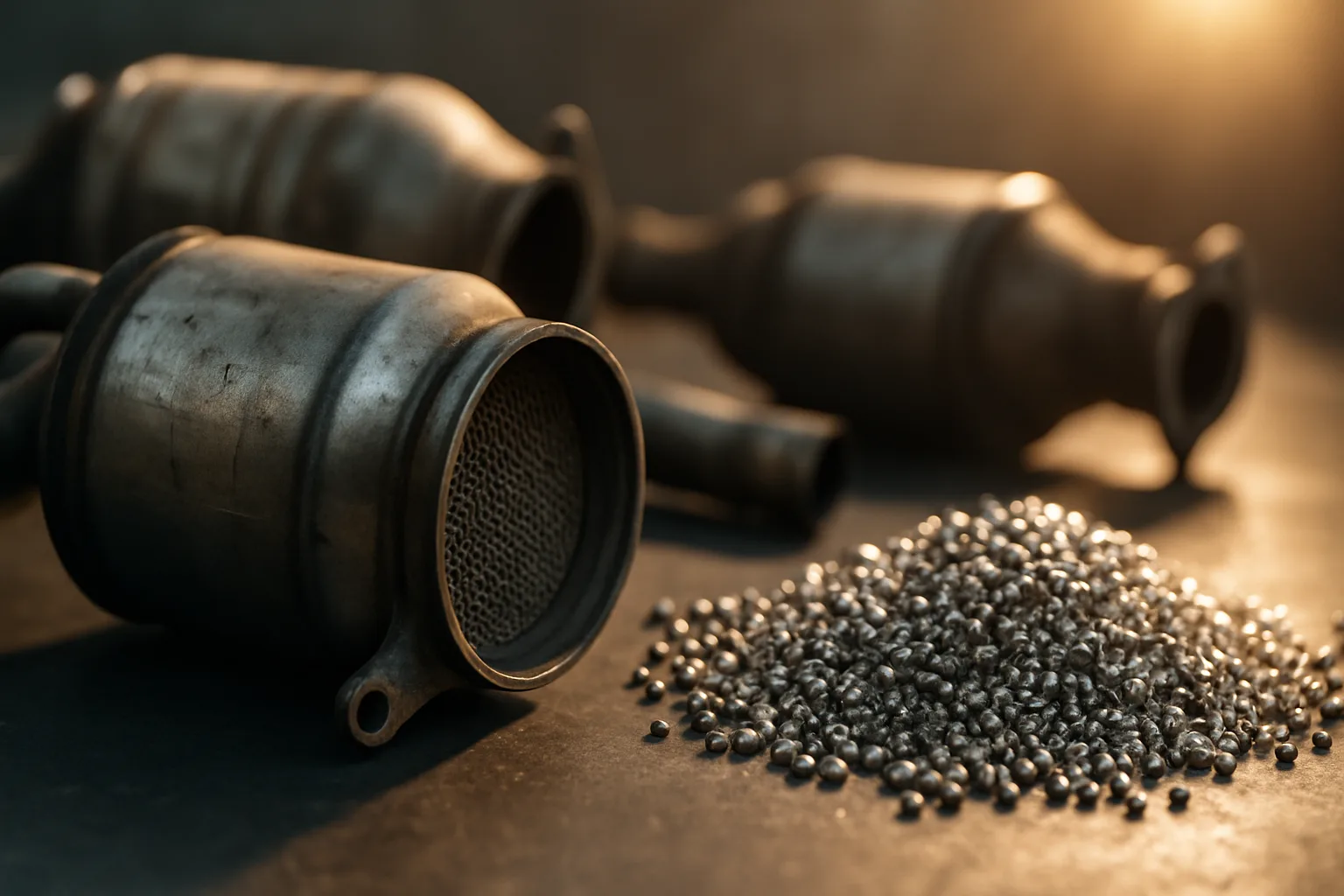
Why Platinum, Palladium, and Rhodium Prices Determine What You Get Paid for Your Cats
Most people selling scrap catalytic converters focus on the converter itself — the make, the model, whether it's OEM or aftermarket. What they miss is the real driver of cat converter value: the spot prices of three precious metals trading on global commodity exchanges right now. Platinum, palladium, and rhodium don't care where your yard is located. They move based on mining output in South Africa, automotive demand in Asia, and currency shifts in Europe. If you want to sell catalytic converters online and actually understand what you're being offered, you need to understand what's happening in those markets first.
This week's roundup breaks down how global precious metal markets connect directly to what your cats are worth — and what you can do to make sure you're not leaving money on the table when you sell.
The Three Metals Inside Every Cat: Platinum, Palladium, and Rhodium
Every catalytic converter contains a ceramic or metallic substrate coated with a precise blend of platinum group metals (PGMs). These metals act as catalysts — they trigger chemical reactions that convert harmful exhaust gases into less harmful emissions. Without them, the converter doesn't work. Without understanding their value, you don't know what your scrap is worth.
Here's a quick breakdown of what each metal does and why its price matters to you:
- Platinum: Found in diesel converters and many older gasoline units. Platinum prices respond heavily to industrial demand, auto sector cycles, and emerging hydrogen fuel cell applications. When demand in one sector drops, other sectors can partially offset it — but price swings are real.
- Palladium: Dominant in gasoline-powered vehicles. For years palladium ran higher than platinum due to tight mining supply concentrated in Russia and South Africa. Ongoing supply chain pressures continue to make this metal volatile.
- Rhodium: The wildcard. Rhodium is rarer than platinum and palladium combined, and its price can move dramatically on relatively small supply disruptions. A single converter might contain only a fraction of a gram — but at rhodium's current pricing, that fraction matters.
The exact loading of each metal varies by vehicle manufacturer, engine type, and emissions standard the converter was designed to meet. An OEM converter from a late-model light truck will look very different on assay than an aftermarket replacement from a mid-2000s economy car. That's why knowing your serial numbers and having proper documentation matters when you go to sell.
How Global Market Swings Hit Scrap Cat Prices in Real Time
When platinum prices move on the London Platinum and Palladium Market (LPPM) or on NYMEX futures, scrap processors reprice their buy lists — sometimes within hours. If you called a buyer on Monday and platinum has dropped 4% by Thursday, the offer you got Monday likely doesn't stand. This isn't the buyer playing games. It's direct pass-through from global commodity markets to your payout.
A few factors driving PGM price movement in 2026 that every cat seller should be watching:
- South African mining output: The majority of the world's platinum and rhodium comes from South Africa. Power grid instability, labor actions, and regulatory changes there ripple directly into global supply — and into scrap prices here in the U.S.
- Electric vehicle adoption rates: As EV penetration grows, some analysts forecast a long-term decline in demand for palladium-heavy gasoline converters. Others point to the transition period as a time when hybrid vehicle demand keeps PGM consumption elevated. The direction isn't settled.
- Currency and inflation dynamics: PGMs are priced in USD globally. A strong dollar can suppress precious metal prices in USD terms even when physical demand stays steady. Watch the DXY index if you want context for why the platinum price today might be moving in a direction that seems counterintuitive.
- Recycling supply volumes: As older vehicles with higher PGM-loaded converters get scrapped, secondary supply from recycling increases. This can dampen the price premium on those specific units over time.
For yards and collectors in Baltimore and across Maryland, this means the same load of cats can generate meaningfully different revenue depending on when you sell and who you sell to. Timing matters. So does having access to competitive buyers.
Why Single-Buyer Deals Leave Money on the Table
Here's the part most sellers don't want to hear: if you're calling one buyer and accepting their number, you have no idea whether that number is fair. You don't know what their margin is. You don't know if a competitor across town — or a processor in another state — would pay significantly more for that same load today.
The traditional model in scrap is built on information asymmetry. The buyer knows the current PGM assay values. The buyer knows what the refiner is paying. You know what the buyer tells you. That gap is where margin disappears for sellers.
This is exactly the problem that a B2B scrap metal marketplace like SMASH is built to address. When your load goes in front of multiple vetted buyers simultaneously, the guessing stops. Competition does the work. Sell your scrap metal on the SMASH marketplace and let buyers compete for your inventory — that's price discovery the way it's supposed to work.
For anyone running volume — auto shops, dismantlers, or collectors who accumulate cats over time — the difference between one buyer and several competing buyers on a single load isn't trivial. It compounds over time.
Documentation, Serial Tracking, and Why Buyers Pay More for Clean Inventory
Global PGM prices set the ceiling on what your cats are worth. Your documentation determines how close to that ceiling you actually get.
Buyers price risk. When a load shows up with no photos, no serial numbers, and no clear inventory breakdown, the buyer prices in uncertainty. They assume the worst-case assay. When you show up with documented inventory — photos, serial numbers, vehicle sourcing information, clean packing lists — buyers have confidence in what they're bidding on. That confidence translates into stronger offers.
Platforms like SMASH build this documentation into the process. Serial tracking, photo documentation, and structured inventory listings mean your load is presented professionally to every buyer who sees it. You're not asking buyers to trust your word. You're showing them the data. Whether you're operating out of Baltimore, Maryland or anywhere else in the country, that documentation standard is the same.
For first-time sellers, the process is more straightforward than it sounds. Pull the serial numbers off your units, photograph each converter clearly, log the vehicle makes and years where you know them. That's the foundation. If you want to get the best catalytic converter price today, the paperwork is as important as the metal content.
Using Market Timing to Your Advantage When You Sell Catalytic Converters Online
You can't predict PGM markets with certainty — nobody can. But you can be strategic about when you move inventory and how you position yourself to capture stronger prices when conditions favor sellers.
A few practical approaches worth building into your process:
- Watch PGM spot prices weekly. You don't need to become a commodities trader. Spending five minutes each week checking platinum and palladium prices gives you enough context to know whether you're selling into a strong or weak market. When prices have pulled back significantly from recent highs, holding a load an extra week or two may be worth considering — depending on your cash flow situation.
- Don't lock in prices too far in advance. Some buyers will offer to lock a price days ahead of pickup. That can work in your favor or against you depending on market direction. Know the tradeoff before you agree.
- Sell in volume when possible. A larger, well-documented load attracts more serious buyers and can support stronger per-unit pricing. If you're accumulating cats over time, there's often an advantage to batching them into a single auction rather than moving single units opportunistically.
- Use competitive platforms. This is the single most reliable way to improve your realized price without relying on market timing. Check current catalytic converter prices and see what competitive bidding looks like before you commit to any single buyer.
Baltimore-area sellers have access to major scrap processing infrastructure across Maryland — but local access doesn't mean local buyers are offering the best price. The best buyer for your load might be operating out of a different region entirely. That's why online platforms built for this market matter more than ever in 2026.
If you want to go deeper on pricing strategy and converter grading, read catalytic converter pricing guides that break down the specifics by converter type, vehicle manufacturer, and market conditions.
Sellers in Baltimore who connect with Baltimore scrap metal services through platforms like SMASH get their inventory in front of buyers who are actively competing — not just waiting for calls. That's the structural advantage that changes your outcome.
If you're ready to stop guessing and start selling into a competitive market, the path is straightforward. Document your inventory, understand the metals you're holding, and put your load in front of multiple buyers at once. When you're ready to make your move, get the best price for your catalytic converter — get a free quote at best-catalytic-converter-price.com.
Disclaimer: Catalytic converter prices fluctuate based on daily PGM spot markets. Always verify current rates before finalizing any sale.
Frequently Asked Questions
Q: How do platinum and palladium prices affect what I get paid for my scrap catalytic converters?
PGM spot prices — platinum, palladium, and rhodium — are the primary input processors use to calculate scrap converter values. When these metals trade higher on global commodity markets, scrap cat prices follow. When they drop, buy prices drop with them. Checking the platinum price today before you sell gives you a baseline for evaluating any offer you receive.
Q: Is it better to sell catalytic converters online or through a local yard?
Local yards offer convenience, but they're typically a single buyer — which means no competition and no price discovery. Selling through an online B2B platform like SMASH puts your load in front of multiple vetted buyers simultaneously, which is the most reliable way to understand what your inventory is actually worth in the current market. Many Baltimore-area sellers use both — local for convenience on smaller loads, online for volume and competitive pricing.
Q: What information do I need to sell catalytic converters online?
At minimum: photos of each unit, serial numbers where visible, the quantity and general type (OEM vs. aftermarket), and vehicle sourcing information if available. The more documentation you provide, the more confidence buyers have — and buyer confidence supports stronger offers. Platforms like SMASH guide you through this process when you list your inventory.
Q: How often do catalytic converter prices change?
Prices can change daily based on PGM spot market movements. In volatile periods, some processors update their buy lists multiple times per week. This is why it's worth checking current pricing close to when you plan to sell rather than relying on a quote you received days or weeks earlier.
Q: Can I sell catalytic converters from Baltimore, Maryland on a national online platform?
Yes. Platforms like SMASH operate across North America, which means your Baltimore or Maryland-based inventory is visible to buyers nationwide — not just local processors. This geographic reach is one of the core advantages of selling through a B2B scrap metal marketplace versus relying solely on local contacts.
Follow SMASH on LinkedIn for weekly scrap metal market updates, PGM pricing insights, and industry news that helps you sell smarter.