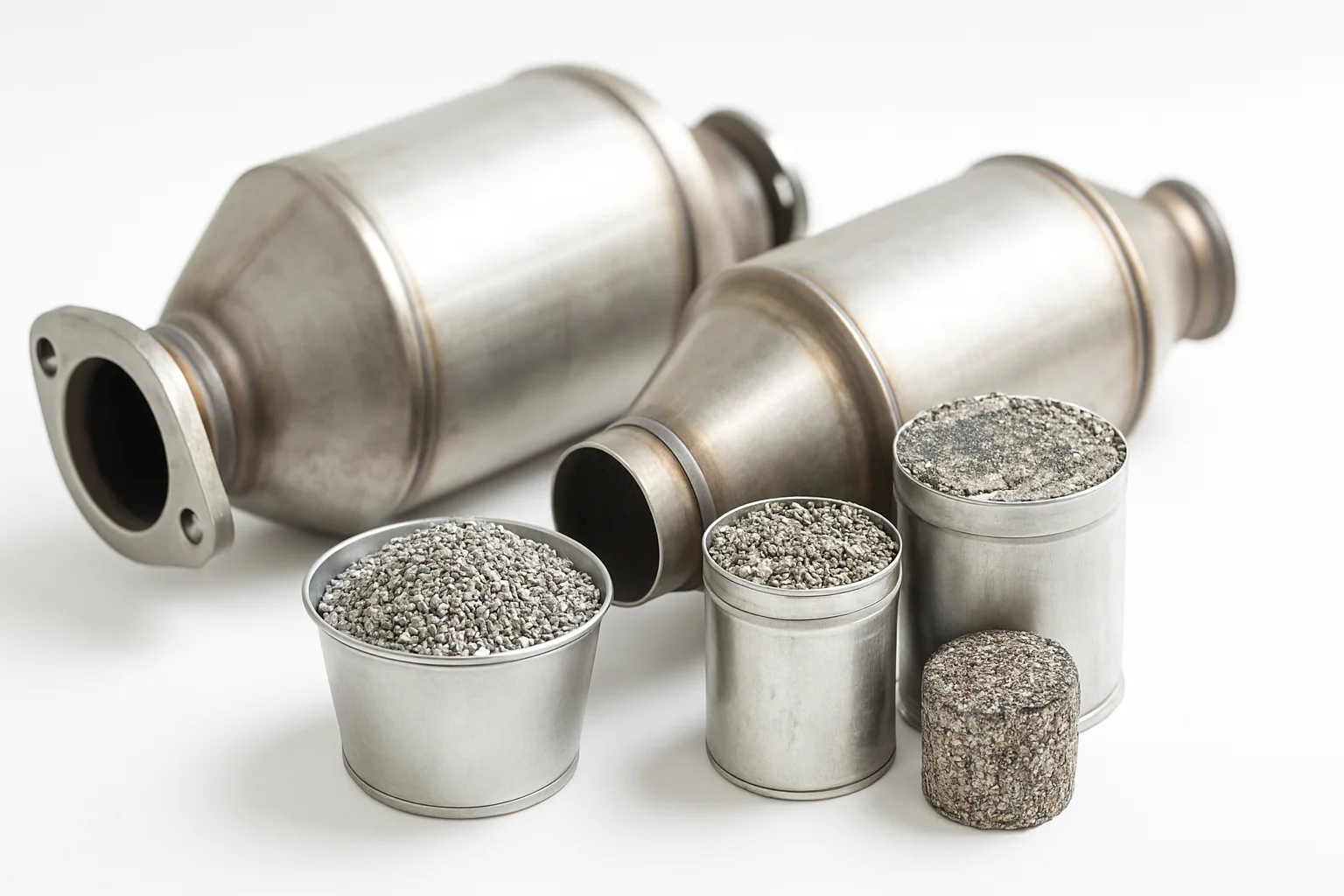
Most people selling a scrap catalytic converter have no idea what makes one worth $40 and another worth $400. The difference isn't random. It comes down to three metals — platinum, palladium, and rhodium — and understanding how their prices move is the fastest way to stop leaving money on the table. If you're in Colorado Springs trying to get the best catalytic converter price, this is the market intel you need before you sell.
This week's market recap breaks down exactly how cat converter values are calculated, what's driving precious metal prices right now in mid-2026, and how to use that knowledge to sell smarter — not just faster.
---The Three Metals That Determine Your Cat Converter's Value
Every catalytic converter contains a ceramic or metallic substrate coated with a washcoat loaded with precious metals. Those metals — platinum (Pt), palladium (Pd), and rhodium (Rh) — are the sole reason scrap cats carry real value. Strip them away and you've got a steel shell worth almost nothing.
Each metal plays a different chemical role inside the converter. Platinum handles oxidation of carbon monoxide and hydrocarbons. Palladium is highly effective at converting hydrocarbons and carbon monoxide, particularly in gasoline engines. Rhodium is the workhorse for reducing nitrogen oxides. Most converters use a blend of all three, though the ratio varies dramatically by vehicle type, engine size, and manufacturer.
- Platinum (Pt): Common in diesel converters and older gasoline cats. Generally more stable in price over time, though still subject to industrial demand swings.
- Palladium (Pd): Dominant in modern gasoline catalytic converters. Historically the most volatile of the three — it ran to extreme highs in the early 2020s and has since recalibrated.
- Rhodium (Rh): The rarest and most price-volatile of the three. Even a small swing in rhodium price today can shift what a single converter is worth by dozens of dollars.
When a buyer or processor quotes you a price, they're working backward from the current spot prices of these three metals, the converter's estimated loading (how much of each metal it contains), and their processing costs. The more precious metal a converter holds — and the higher the spot price — the more it's worth.
---How Platinum, Palladium, and Rhodium Prices Move — and Why It Matters for Sellers
These aren't stable commodities like scrap copper or aluminum. Platinum group metals (PGMs) trade globally, and their prices respond to forces that have nothing to do with your local scrap yard. Understanding those forces helps you time your sale and evaluate whether the quote you're getting actually reflects the market.
Here are the main drivers pushing PGM prices up or down in 2026:
- Mining supply from South Africa and Russia: Over 70% of the world's platinum and rhodium comes from South Africa. Any disruption — labor strikes, energy shortages, or geopolitical friction — tightens supply fast and pushes prices up.
- Automotive production rates: The auto industry is the single largest consumer of PGMs. When vehicle production accelerates, demand for virgin PGMs rises, pulling spot prices with it.
- EV transition pace: Battery electric vehicles don't use catalytic converters. As EV market share grows, long-term PGM demand from automakers is projected to decline. Markets are pricing in that transition gradually.
- Secondary market recycling volumes: More scrap cats being processed means more recovered PGMs — which can soften spot prices at the margin.
- Currency and inflation dynamics: PGMs price in USD. A stronger dollar generally pressures metal prices; a weaker dollar can lift them.
The practical takeaway: scrap metal prices today for PGMs can shift week over week. A converter you hold for three weeks might be worth more — or less — than it is right now. Checking current market data before you sell isn't optional. It's how you protect your margin.
Want to stay on top of pricing trends? Read catalytic converter pricing guides updated regularly so you're working with current numbers, not stale data.
---OEM vs. Aftermarket Converters: The Price Gap Is Real
Not all catalytic converters are created equal — and the scrap value gap between OEM (original equipment manufacturer) and aftermarket units is significant. If you're sorting through a pile of cores in Colorado Springs, knowing the difference can change your total payout considerably.
OEM converters come directly from the vehicle manufacturer. They're engineered to meet specific emissions standards and are loaded with a precise blend of PGMs calibrated for that engine. Higher-end OEM cats — particularly those from luxury vehicles, trucks, and larger SUVs — carry substantial precious metal content. These are the converters that command top dollar at auction.
Aftermarket converters are designed to meet legal minimums at minimum cost. They use less precious metal than OEM units and are built to a price point. Scrap processors know this, and aftermarket cats are typically valued at a significant discount to comparable OEM units.
- A large truck OEM cat from a Ford F-Series or GM truck can carry significant PGM loading.
- A small aftermarket cat from a compact car may contain a fraction of that loading.
- High-value OEM converters from certain vehicles are well-documented in the industry — experienced buyers recognize them on sight.
If you're selling multiple units, separating OEM from aftermarket before you quote is basic due diligence. Mixing them together and accepting a blended price almost always costs you money.
---How the SMASH Auction Model Connects to Your Converter's True Market Value
Here's the problem with calling one local buyer and accepting their number: you have no way to know if it's right. One quote is not price discovery. It's one data point from someone whose job is to buy low.
Competitive auctions fix this. When multiple vetted buyers compete for your inventory — whether that's a single high-value OEM cat or a pallet of mixed cores — the bids reflect actual market demand, not one buyer's margin target. That's the core idea behind North America's B2B scrap metal auction platform, SMASH.
The SMASH scrap metal auction model is built for exactly this scenario. Sellers list their inventory with photo documentation, serial tracking where applicable, and accurate descriptions. Vetted buyers see the same information and bid competitively. The result is price transparency that a single phone call to a local yard can't replicate.
For sellers in Colorado Springs and across Colorado, this matters because your local market may not reflect what buyers in other regions are willing to pay. A buyer in a different market might value your specific converter type more highly than anyone within driving distance. With a competitive auction format, that demand reaches you — without you having to make thirty cold calls.
No subscription fees. SMASH only wins when you win. That alignment is what makes the model work for sellers who are tired of guessing.
---What Processors Actually Look At When They Price Your Cat
Understanding the calculation processors use gives you leverage. When a buyer looks at your converter, they're estimating several variables simultaneously:
- Converter identification: OEM part numbers, VIN-linked data, and visual recognition tell experienced buyers which vehicle it came from and what PGM loading to expect.
- Current spot prices: Live platinum, palladium, and rhodium spot prices — updated throughout the trading day — set the ceiling on what any converter can be worth.
- Processing and refining costs: Smelting, assaying, and refining PGMs from the substrate costs money. Processors build this into their offer. The more efficient the processor, the better price they can pass on.
- Yield assumptions: Processors estimate what percentage of the theoretical PGM content they'll actually recover. Higher-quality documentation on your end — photos, accurate descriptions, condition notes — gives buyers more confidence in their yield estimate, which can improve your offer.
- Volume and consistency: Selling one converter gets you a retail-style offer. Selling consistent volume — same types, well-documented, reliable supply — gets you closer to wholesale pricing. Relationship and volume matter.
If you want to understand what your specific converter might be worth before you sell, check current catalytic converter prices and use available reference data to calibrate your expectations before you pick up the phone.
---Selling Catalytic Converters in Colorado Springs: What the Local Market Looks Like
Colorado Springs sits in a strong position for scrap metal activity. The region has a dense automotive services ecosystem — independent shops, dealerships, fleet operators — that generates a steady supply of end-of-life converters. That supply is valuable, and competitive buyers know it.
But volume alone doesn't guarantee a good price. Sellers in Colorado Springs who rely on a single local relationship often don't know what the broader market would pay. Local buyers set prices based on their own margin needs and local competition — not necessarily on what national and regional processors are bidding.
This is where platforms like SMASH create real leverage for Colorado sellers. Instead of being limited to what's geographically convenient, your inventory gets visibility with vetted buyers across North America. That competition — not geography — is what drives price discovery. Searching for catalytic converter buyers near me prices is a starting point, but it's not the finish line. The finish line is the highest competitive bid, wherever that buyer is located.
Ready to stop guessing and start selling with real market data behind you? Get the best catalytic converter price today — submit your inventory, get competitive offers, and know your converter's actual market value before you commit to a sale.
---Frequently Asked Questions
Q: How do I find out how much my catalytic converter is worth?
The value of your catalytic converter depends on the vehicle it came from, whether it's OEM or aftermarket, and current platinum, palladium, and rhodium spot prices. A how much is my catalytic converter worth calculator can give you a rough baseline, but getting actual competitive bids from multiple buyers is the only way to confirm real market value. Use a platform like SMASH to expose your inventory to vetted buyers rather than relying on a single quote.
Q: Why does the rhodium price today affect my catalytic converter so much?
Rhodium is the rarest of the three precious metals in catalytic converters, and it's also the most price-volatile. Even small shifts in the rhodium spot price can move your converter's value by a meaningful amount — especially for high-loading OEM units from trucks or luxury vehicles. Checking rhodium spot prices before you sell is a smart habit.
Q: Are there good catalytic converter buyers in Colorado Springs?
Yes, Colorado Springs has active scrap and recycling infrastructure. However, limiting yourself to local buyers only means you're pricing based on local competition, not the broader North American market. Platforms that connect you with vetted buyers across the country — like SMASH — can help you find stronger offers than a single local yard might provide.
Q: Does it matter if my converter is OEM or aftermarket when selling for scrap?
Absolutely. OEM converters carry significantly more precious metal loading than aftermarket units and are typically worth more at scrap. If you're selling multiple converters, separating OEM from aftermarket before negotiating is standard practice and almost always results in a better total payout.
Q: How often do catalytic converter scrap prices change?
PGM spot prices update throughout each trading day, and scrap cat prices follow those movements — sometimes significantly from week to week. There's no single "locked-in" price. Timing your sale and working with buyers who price based on current spot rather than stale reference sheets can make a real difference to your bottom line.
---Disclaimer: Catalytic converter prices fluctuate based on live precious metal spot prices and market conditions. All prices and values referenced in this article are for general informational purposes. Always check current catalytic converter prices before selling.
Follow SMASH on LinkedIn for weekly scrap metal market updates, PGM price insights, and industry news that keeps you ahead of the market.