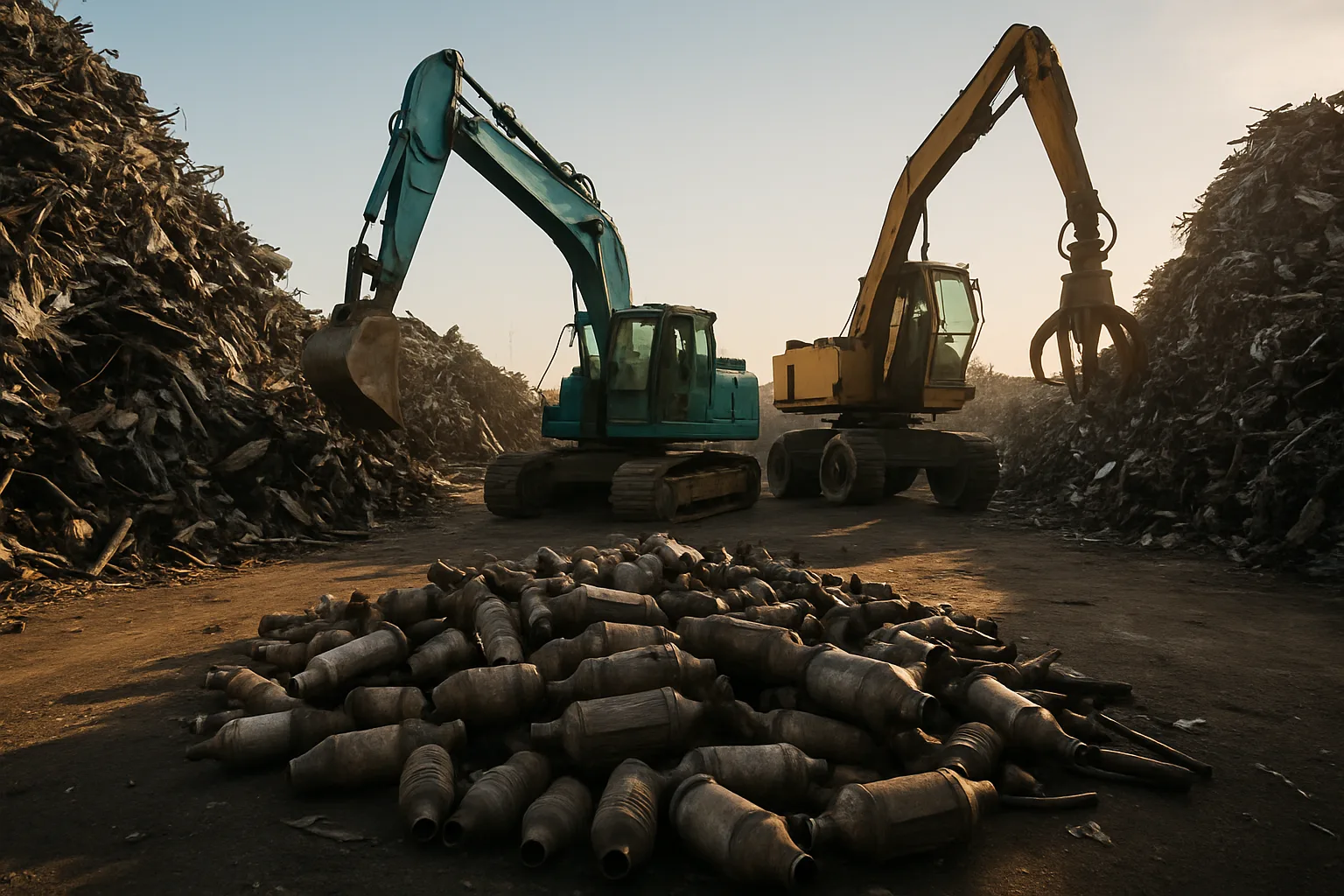
Rhodium hit a seven-year price swing cycle in mid-2026 — and most people selling scrap catalytic converters have no idea it's happening. If you're sitting on a pile of cats and waiting for the "right time" to sell, the global precious metals market is already making that decision for you. Whether you're an auto shop in San Diego clearing out a back room, or a collector moving loads across California, understanding what drives converter prices can mean the difference between a good payout and leaving real money on the table.
What Drives the Rhodium Price Today — and Why It Matters for Your Scrap Cats
Rhodium, palladium, and platinum are the three metals inside every catalytic converter. They're what buyers are actually paying for when they quote your load. Of the three, rhodium price today is the most volatile and, historically, the most dramatic mover. Rhodium is scarcer than gold. Most of the world's supply comes from a handful of mines in South Africa and Russia, meaning any disruption — political, logistical, or geological — sends the spot price swinging hard.
Palladium and platinum follow their own supply-demand curves. Palladium is particularly tied to gasoline engine production, while platinum skews toward diesel applications and industrial use. In 2026, the ongoing global shift toward hybrid vehicles has created a mixed picture: fewer pure ICE vehicles being manufactured means reduced new demand for these metals, but the enormous existing fleet of gas-powered vehicles keeps the scrap supply — and buyer interest — strong.
Here's the key takeaway: when rhodium climbs, even modestly, the scrap value of converters that contain meaningful rhodium content can jump noticeably. The same load that quoted at one price in January might quote significantly differently by June. That's not guesswork — that's how the market works.
How OEM Catalytic Converter Value Is Calculated in the Real Market
Not all cats are created equal. OEM catalytic converter value — meaning original equipment manufacturer converters, the ones that came with the vehicle from the factory — tends to be significantly higher than aftermarket units. The reason is simple: OEM converters load more precious metal into the substrate to meet emissions standards reliably over the vehicle's lifespan. Aftermarket replacements often use lower loadings to hit a lower price point.
When a buyer assays a load, they're looking at the concentration of platinum, palladium, and rhodium in the substrate honeycomb. An OEM unit from a full-size truck or an older luxury vehicle can carry substantially more metal than a small aftermarket unit. That's why VIN-based lookup tools matter. Knowing what vehicle a converter came off of helps establish what you should reasonably expect for that unit — not just a blind quote.
The variables that affect OEM converter value include:
- Vehicle make and model — Some manufacturers historically loaded more precious metal than others
- Engine size — Larger displacement engines typically require larger, higher-loaded converters
- Converter position — Front or primary converters generally carry more metal than secondary units
- Condition of the substrate — A blown-out or melted substrate recovers less metal
- Age and emissions generation — Older pre-OBD2 vehicles had different loading standards than modern SULEV converters
If you're selling in San Diego and you're not using a VIN lookup or serial tracking tool before you quote, you're potentially leaving value on the table every single time. Platforms like SMASH use documented inventory tools, including serial tracking and photo documentation, to give buyers the data they need to bid confidently — and that confidence shows up in your payout.
The San Diego Scrap Market in Mid-2026: What Local Sellers Should Know
San Diego sits in a strong position for scrap converter sales. The region's density of auto repair shops, dealerships, and dismantlers creates a consistent flow of used converters — both OEM and aftermarket. California's strict emissions standards mean vehicles tend to run converters longer and replace them more frequently than in less regulated states, which keeps supply moving.
The flip side: California also maintains some of the tightest scrap metal transaction regulations in the country. Sellers need proper documentation — valid ID, vehicle documentation where required, and in many cases, records showing how you came to possess the converters you're selling. This isn't optional and it isn't new. But in 2026, enforcement has sharpened across Southern California counties, so make sure your documentation is in order before you move a load.
For anyone accessing San Diego scrap metal services, working with a platform that handles documentation and creates a clear paper trail isn't just good business — it's a practical necessity in this regulatory environment. SMASH's photo documentation and inventory tracking features are built for exactly this kind of compliance-aware selling.
If you're ready to move your load and want to see what the current market is offering, check current catalytic converter prices before you accept any single-buyer offer.
Why Selling Scrap Metal Online Beats the One-Buyer Phone Call
The old model is simple: you call one buyer, they give you a number, you take it or leave it. Most sellers take it because they don't have another number to compare it to. That's not price discovery — that's guessing with extra steps.
When you sell scrap metal online through a competitive auction format, multiple vetted buyers see your load simultaneously. They're bidding against each other, not just quoting into a vacuum. That competition is what surfaces the real market value for your material. More buyers means better price discovery. It's not a complicated concept, but most yard operators and individual sellers have never actually experienced it.
SMASH is built around this model. No subscription fees — SMASH only wins when the seller wins. You list your load with documentation: photos, serial numbers, VIN lookups where applicable. Vetted buyers bid. You see the offers. Auto-invoicing handles the paperwork. It strips out the friction that used to make selling a phone game.
Whether you're moving a single cat or a full pallet, the process is the same. And if you want to get the best catalytic converter price today, having multiple buyers compete for your material is the most direct path to knowing you got fair market value.
Platinum, Palladium, and Rhodium: Reading the Market Signals
You don't need to be a commodities trader to use precious metal market data. You just need to know what to watch and how to connect it to your selling decision. Here's a practical framework:
- Watch weekly spot prices for all three metals. Rhodium, palladium, and platinum move independently. A week where palladium jumps while rhodium stays flat affects different converters differently. Higher-palladium units (common in Japanese and domestic gasoline vehicles) will move more on a palladium spike.
- Pay attention to mining news. South African power grid issues, Russian export policy shifts, or labor disruptions at major PGM mines can move markets within days. These aren't rare events — they happen every cycle.
- Track the spread between spot and scrap payout. Buyers discount spot price to account for processing, refining, and risk. The question is whether that discount is fair. Competitive bidding compresses that spread because buyers can't pad margins when they're competing directly.
- Don't panic-sell on a down week. Markets move both directions. If you have the ability to hold and document your inventory, sometimes a short wait is worth it. But don't guess — use data.
For a deeper breakdown of how these metals affect your specific converter types, read catalytic converter pricing guides that break down loadings by vehicle category and metal composition.
How SMASH Brings Transparency to a Market That's Historically Been Opaque
The scrap catalytic converter market has always had an information problem. Buyers know what they're paying for. Sellers often don't know what they're selling. That gap is where margin disappears for sellers and accumulates for buyers.
SMASH is built to close that gap. The platform gives sellers the tools to document their inventory properly — photos, serial tracking, VIN lookups — so that buyers are bidding on real, verified data rather than blind estimates. Documented inventory gives buyers more confidence, and that confidence translates into stronger bids. Everyone wins except the single buyer who used to be the only phone call you knew to make.
For sellers across California — from San Diego to Sacramento — the combination of market transparency and competitive auction format represents a structural shift in how converter loads get priced. It's not about technology for technology's sake. It's about getting paid what your material is actually worth.
If you want to get competitive bids for your scrap metal, SMASH puts your load in front of vetted buyers who have to earn your business — not just receive it by default.
The market for platinum, palladium, and rhodium won't stay flat. It never does. What you can control is whether you're positioned to capture value when it moves — or whether you're still relying on a single phone call and hoping for the best. Get the best price for your catalytic converter and start with a free quote at best-catalytic-converter-price.com.
Price disclaimer: Catalytic converter scrap prices fluctuate based on live precious metal spot prices, converter type, condition, and buyer demand. Always check current rates before committing to a sale.
Frequently Asked Questions
Q: What is the rhodium price today and how does it affect my catalytic converter value?
Rhodium spot prices change daily based on global supply and demand. Because rhodium is one of the three primary precious metals in a catalytic converter substrate, a rise in rhodium price directly increases the scrap value of converters with significant rhodium content. Check live spot prices before you sell — even a modest swing can meaningfully change your payout on a full load.
Q: Where can I sell catalytic converters in San Diego?
San Diego has multiple scrap buyers, but your best outcome typically comes from exposing your load to multiple vetted buyers simultaneously rather than calling one shop. Platforms like SMASH allow you to list your converters online with documentation and receive competitive bids from buyers across the market. Make sure you have proper documentation in hand — California requires it for scrap metal transactions.
Q: What's the difference between OEM and aftermarket catalytic converter scrap value?
OEM catalytic converters carry higher precious metal loadings than most aftermarket units, which means they typically yield a higher scrap price. Using a VIN lookup or serial tracking tool helps identify whether a converter is OEM and what vehicle it came from — data that directly affects how buyers bid on your material.
Q: How do platinum and palladium prices affect scrap cat prices differently from rhodium?
All three metals contribute to converter value, but they move on different supply-demand curves. Palladium is closely tied to gasoline engine production volumes, platinum skews toward diesel and industrial applications, and rhodium is the rarest and most volatile of the three. A load heavy in palladium-rich converters (common in Japanese domestic market vehicles) will respond more to palladium price movements than to rhodium swings.
Q: Is it better to sell catalytic converters locally in California or through an online platform?
Online competitive auction platforms expose your load to more buyers, which generally means better price discovery than a single local quote. That said, local context matters — California's documentation requirements apply regardless of where you sell. The strongest approach is using a platform like SMASH that handles documentation, serial tracking, and invoicing while still giving you competitive market exposure.
Follow SMASH on LinkedIn for weekly scrap metal market updates, precious metal pricing insights, and industry news that affects what you get paid for your loads.
```