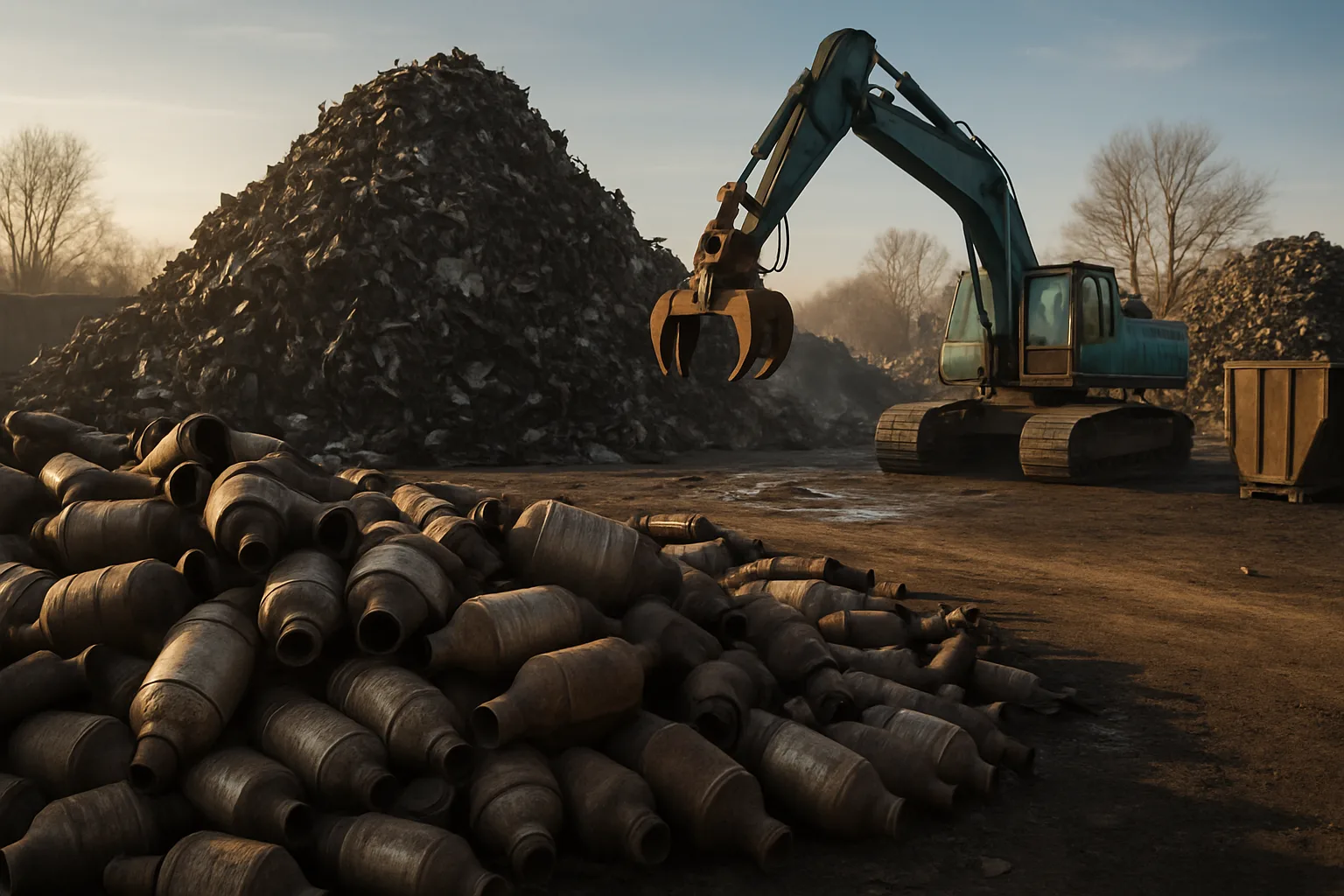
If you've tried selling scrap catalytic converters in Seattle recently, you already know the market can feel like a minefield. Prices swing based on platinum, palladium, and rhodium spot rates. Every buyer seems to quote a different number. And some of those buyers are actively trying to rip you off. Scrap catalytic converter prices in Seattle vary enough on their own — you don't need a shady middleman making it worse. This week's roundup breaks down the most common scams in the catalytic converter buying market and exactly how to protect yourself.
---Why the Catalytic Converter Market Attracts Scammers
Catalytic converters sit in an unusual position in the scrap world. They're small, easy to transport, and contain platinum group metals (PGMs) — platinum, palladium, and rhodium — that can be worth hundreds of dollars per unit depending on the make and model. That combination of portability and high value makes cats a target for shady operators at every level of the supply chain.
For sellers in Seattle and across Washington state, the problem compounds because the local market has a mix of legitimate recyclers, regional brokers, and opportunistic buyers who show up with cash and low offers. Without a clear price reference, sellers often don't know what their load is actually worth. That information gap is exactly what scammers exploit.
- High PGM content makes converters worth more than most sellers realize
- Complex grading systems (OEM vs. aftermarket, full vs. defective, domestic vs. foreign) give dishonest buyers room to misrepresent value
- Lack of price transparency leaves sellers guessing
- Cash transactions leave no paper trail and no recourse
Understanding why the scams happen is the first step to avoiding them. Now let's look at how they actually work.
---The Most Common Scams in Catalytic Converter Buying
1. The Low-Ball Flip
A buyer offers you a price that sounds reasonable — until you find out they turned around and sold your load for significantly more the same afternoon. This isn't technically illegal, but it's predatory. It works because most sellers don't have a reliable price reference. When you're guessing at cat converter value, any offer feels like a data point.
The fix: get multiple bids before you commit. A platform like SMASH Scrap — where verified buyers bid on your metal puts competition into the process. Instead of one buyer quoting you one number, you get real market interest from vetted buyers. That's how price discovery actually works.
2. Grading Manipulation
Not all converters are worth the same, and legitimate grading differences do exist. OEM converters from full-size domestic trucks carry more PGM content than small aftermarket units. Buyers know this. Dishonest ones use this knowledge to deliberately misgrade your inventory — calling your high-value foreign cats "aftermarket" or flagging clean units as "defective" to justify a lower payout.
This scam is particularly effective on sellers who bring in mixed loads without documentation. If you can't prove what you have, a crooked buyer can tell you whatever they want about your inventory. Photo documentation and serial tracking change that dynamic completely.
3. The Fake Assay Scam
Some buyers claim to perform their own assay (laboratory analysis of PGM content) and then present you with results that conveniently show lower metal content than the actual converter should contain. You have no way to verify their numbers. You accept the low payout because you don't have the resources to run your own assay.
Legitimate processors who perform assays will provide documented results and allow sellers to verify against independent sources. If a buyer is vague about their assay process or won't share documentation, that's a red flag.
4. Bait-and-Switch Pricing
A buyer quotes you a strong price over the phone or via text. You show up with your load. Suddenly the price drops — "the market moved," "these aren't as clean as I expected," "I can only do this much today." By that point, you've already hauled your material in. Many sellers take the lower offer rather than walk away empty-handed.
This is one of the most common complaints from sellers in the Seattle area. The solution is to get the best catalytic converter price today through a documented, competitive process — not a handshake deal that can change the moment you arrive.
5. The "We Need More Volume" Stall
Some buyers tell smaller sellers they can't process loads under a certain quantity — pushing you to accumulate more inventory before selling. This delays your payout and gives the buyer leverage later. Meanwhile, your unsold converters are sitting in your shop, not earning you anything. If a buyer is creating artificial barriers to your sale, look elsewhere.
---What Legitimate Catalytic Converter Buyers Actually Look Like
The scam patterns above share one common thread: a single buyer with unchecked pricing power. When there's only one number on the table, that number almost always favors the buyer. Legitimate buyers operate differently. They're transparent about grading, they provide documentation, and they don't resist competition.
When evaluating a buyer, ask yourself:
- Do they give you a written price before you commit?
- Can they explain how they graded your converters?
- Are they willing to have their assay results verified independently?
- Do they pay on a documented, traceable basis — not just cash on the spot?
- Are they vetted by anyone, or are they just a guy with a truck?
Platforms like SMASH connect sellers with verified buyers who operate within a documented process. When buyers have to compete, the incentive to manipulate pricing drops significantly. The audit trail also matters — auto-invoicing and photo documentation protect sellers and buyers alike.
For anyone selling in Seattle or the broader Washington state market, working with Seattle scrap metal services that operate transparently isn't just a preference — it's how you protect your margins.
---How to Protect Your Load Before the Sale — Practical Steps
The best defense against scams is preparation. Before your catalytic converters ever leave your yard or shop, take these steps seriously.
- Photograph everything. Every converter, every serial number, every identifier. Do this before the buyer arrives and before the load leaves your possession. Photo documentation is your evidence if something goes wrong.
- Use VIN lookup and serial tracking tools. SMASH's inventory tool lets you document your load with serial tracking and photo records before listing. That information gives buyers confidence — and gives you leverage.
- Know your grades. Spend an hour learning the difference between domestic, foreign, and aftermarket cats. Know what full converters look like versus defectives. Basic knowledge closes the information gap that scammers exploit.
- Get multiple bids. Never sell to the first buyer who calls. A single quote is not a market price — it's one person's offer. A competitive process is the only way to see what your load is actually worth.
- Demand written documentation. A legitimate buyer has no reason to avoid a paper trail. If someone only wants to deal in cash with no invoice, that's a signal.
- Check current rates before you negotiate. Rhodium, platinum, and palladium prices move constantly. Before any negotiation, check current catalytic converter prices so you're working with real data, not a buyer's word.
These aren't complicated steps. They're the basics that separate sellers who consistently get fair value from sellers who get taken advantage of repeatedly.
---A Note on Cross-Border Price Confusion
One thing worth flagging in this week's recap: sellers occasionally encounter price quotes that seem to reference international benchmarks — including markets like used catalytic converter prices in India or catalytic converter scrap prices from Canadian cities like Edmonton. These references can be used to confuse or misdirect domestic sellers about what the U.S. market actually pays.
If you're selling in the United States, your reference point is the U.S. market. PGM spot prices are globally traded, but processing fees, logistics, and buyer competition all affect what you actually net. A buyer citing international pricing to justify a lower domestic offer is almost certainly manipulating the conversation. Stick to comparable U.S. data, and use a catalytic converter auction format to let actual domestic buyers set the price through competition — not a single buyer's narrative.
For a deeper look at how converter prices are calculated and what factors actually drive your payout, read catalytic converter pricing guides that break down the math in plain language.
---The Bottom Line on Scrap Catalytic Converter Prices in Seattle
The catalytic converter market isn't going to get less complicated. Rhodium prices fluctuate. Grading standards shift. New buyers enter the market constantly, not all of them operating honestly. Scrap catalytic converter prices in Seattle — like everywhere else — are a moving target.
What you can control is your process. Document your inventory. Get multiple bids. Work with vetted catalytic converter buyers in Washington who operate transparently. Use platforms built to create competition rather than eliminate it. And never accept a price without knowing what drives it.
The old way — one buyer, one call, one number — consistently costs sellers money. You deserve better than that. If you're ready to find out what your load is actually worth, get the best price for your catalytic converter by requesting a free quote at best-catalytic-converter-price.com.
Disclaimer: Catalytic converter prices fluctuate based on platinum, palladium, and rhodium spot rates. Always verify current market rates before selling. The information in this article reflects general market conditions as of July 2026.
---Frequently Asked Questions
Q: How do I know if a catalytic converter buyer in Seattle is legitimate?
Legitimate buyers provide written price quotes, explain how they grade converters, and don't pressure you to accept an offer immediately. They should also be willing to provide documentation of any assay results. If a buyer avoids paper trails or resists a competitive bidding process, treat that as a red flag.
Q: Why do scrap catalytic converter prices in Seattle vary so much between buyers?
Prices vary because of differences in how buyers grade converters, their processing relationships, and — in some cases — deliberate manipulation to maximize their margin at your expense. PGM spot prices set the ceiling; buyer competition determines how close you get to it. Getting multiple bids is the only reliable way to find the real market price.
Q: What is a catalytic converter auction and how does it help sellers?
A catalytic converter auction is a competitive bidding process where multiple verified buyers submit offers on your documented load. Instead of accepting one number from one buyer, you let the market speak. This format removes the information advantage that dishonest buyers rely on and gives sellers a transparent price discovery process.
Q: Can I sell just one catalytic converter, or do buyers require large loads?
Requirements vary by buyer. Some processors prefer larger volumes, but platforms designed for competitive bidding can work with a range of load sizes. Don't let an artificial volume requirement push you into holding inventory longer than necessary — that's sometimes a tactic to gain leverage over smaller sellers.
Q: How do platinum, palladium, and rhodium prices affect what I get paid for a cat in Washington state?
Catalytic converter payouts are directly tied to the PGM content of your specific converter and the current spot price of those metals. Rhodium in particular can swing dramatically in price. Check spot rates before any negotiation, and understand that the converter type — OEM domestic, foreign, aftermarket — determines how much of each metal your converter actually contains.
---Follow SMASH on LinkedIn for weekly scrap metal market updates, pricing insights, and industry news: SMASH on LinkedIn.