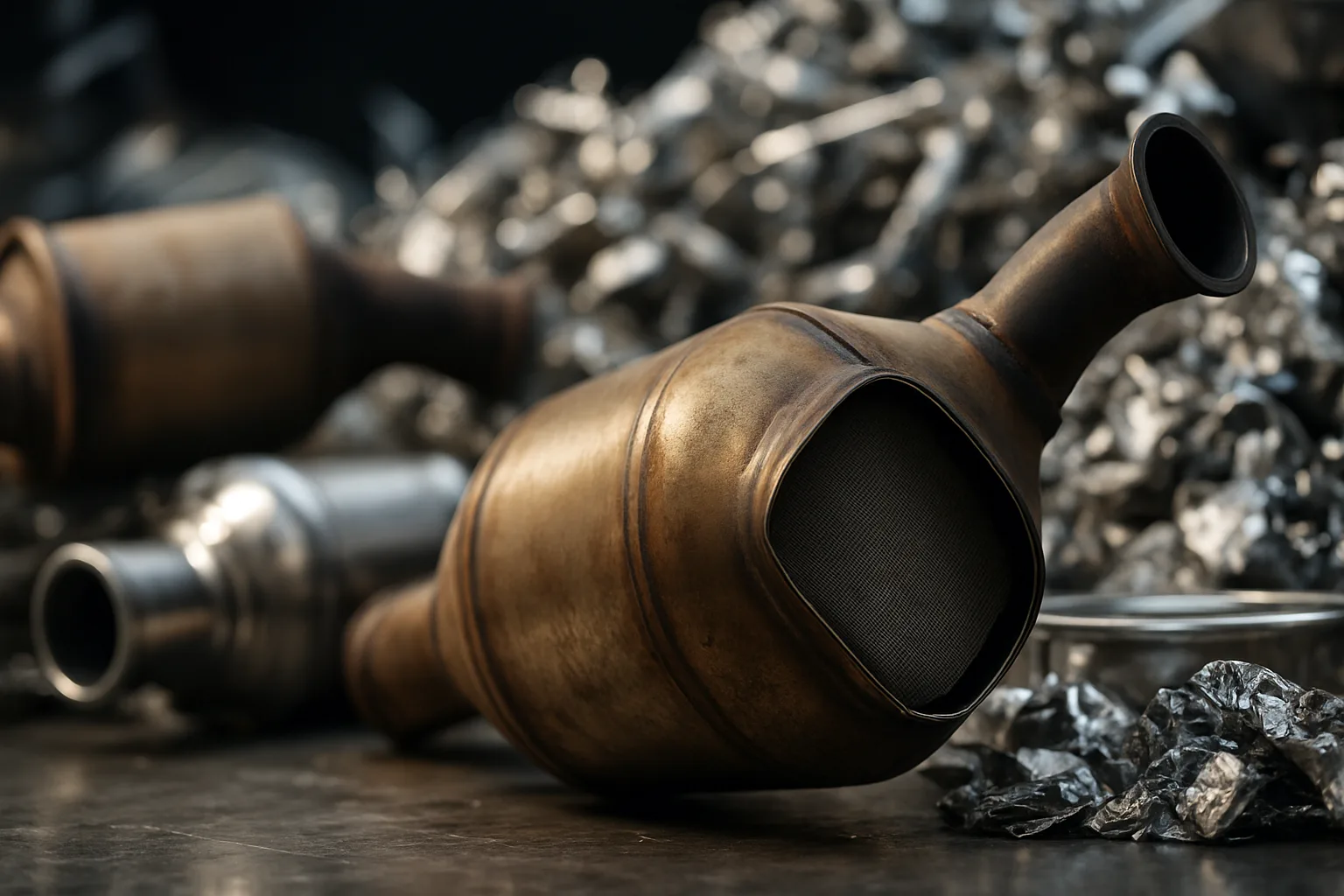
What's Actually Inside a Catalytic Converter — and Why It's Worth Real Money
Most people know catalytic converters are valuable. Fewer people know why. The answer isn't steel or aluminum — it's three metals that sit at the center of some of the most complex chemistry in your exhaust system. If you're sitting on a pile of spent cats in Grand Forks and wondering what they're actually worth, start here. Understanding what's inside changes how you sell.
Catalytic converter recycling in Grand Forks has grown more competitive as buyers across North America fight for access to platinum group metals (PGMs). That competition is your leverage — if you know how to use it.
The Three Precious Metals That Drive Catalytic Converter Value
Every catalytic converter contains a ceramic or metallic substrate coated with a precise combination of platinum, palladium, and rhodium. These are the platinum group metals — PGMs — and they're the entire reason a used cat is worth anything beyond scrap steel weight.
Here's what each one does and why it matters to your payout:
- Platinum (Pt): Handles oxidation reactions, converting carbon monoxide and unburned hydrocarbons into carbon dioxide and water. Platinum is dense, extremely heat-stable, and historically one of the most traded PGMs in recycling streams.
- Palladium (Pd): Works alongside platinum to treat hydrocarbons, especially in gasoline engines. Palladium has seen dramatic price swings over the past several years due to tight global supply and high automotive demand. It's often the highest-value metal in a gasoline engine cat.
- Rhodium (Rh): The rarest of the three. Rhodium handles the nitrogen oxide (NOx) reduction reaction — converting harmful NOx emissions into nitrogen and oxygen. Because rhodium is extraordinarily rare, even trace amounts in a converter can represent significant value. Its price per troy ounce has historically dwarfed both platinum and palladium.
The exact ratio of these metals varies by vehicle make, model, engine size, and manufacturer. An OEM converter from a full-size pickup truck carries a very different PGM loading than an aftermarket cat from a compact import. That's why two converters that look identical on the outside can fetch completely different prices at assay.
How PGM Content Determines Your Scrap Catalytic Converter's Price
When a recycler buys your cat, they're not guessing. Professional buyers use databases — sometimes called "cat books" — that map converter part numbers and serial numbers to known PGM loading estimates. The more accurately a buyer can identify your unit, the more confidently they can bid. That's why photo documentation and serial tracking matter.
The actual payout process typically works like this:
- Identification: The converter is identified by part number, OEM stamp, or dimensions. VIN lookup can help match a cat to the original vehicle and engine configuration.
- Grading: Buyers assess condition — whether the substrate is intact, crushed, rattling, or missing. A damaged substrate means lost PGM material and a lower offer.
- Market pricing: Current spot prices for platinum, palladium, and rhodium are applied against the estimated PGM loading. Prices fluctuate daily based on global commodity markets.
- Processing fee deduction: Refiners charge for processing and assay. The net return to the seller reflects gross PGM value minus those costs.
This is why it pays to check current catalytic converter prices before you accept any offer. The market moves, and yesterday's quote may not reflect today's reality.
OEM vs. Aftermarket: Why the Cat's Origin Matters for Recycling Value
Not all catalytic converters are created equal — and the gap between OEM and aftermarket units is significant when it comes to cat converter value.
OEM (original equipment manufacturer) converters are built to precise emissions standards. They contain specific, documented quantities of PGMs optimized for the vehicle's engine. Because their PGM content is well-documented and consistent, buyers can price them with confidence. High-value OEM cats from certain truck platforms, luxury vehicles, and SUVs are among the most sought-after units in the recycling market.
Aftermarket converters — often installed as cheaper replacements — typically contain significantly lower PGM loadings. Some contain very little rhodium at all. The cost difference at the parts counter reflects the same gap you'll see at the recycling counter. Selling a pile of aftermarket cats to a buyer expecting OEM units is a recipe for disappointment on both sides.
If you're in Grand Forks pulling cats from a fleet or a shop inventory, knowing which units are OEM before you list them lets you set realistic expectations and negotiate from a position of knowledge. Platforms like get competitive bids for your scrap metal — and when you document your inventory properly, buyers bid with more confidence, which can improve price discovery.
Platinum Group Metals Recycling: Why the Global Market Affects Your Local Payout
PGMs are mined in very few places on Earth — primarily South Africa and Russia. That geographic concentration makes supply inherently volatile. Political instability, energy costs at mining operations, and currency fluctuations all hit the spot price of platinum, palladium, and rhodium. When supply tightens, prices spike. When new supply hits the market, they can correct sharply.
For sellers in North Dakota and across the American Midwest, this matters because your payout is directly tied to those global commodity prices. A rhodium price surge that happens in Johannesburg shows up in your offer within days. Timing your sale during strong PGM markets — when possible — is a legitimate strategy.
It also means that holding cats in a yard for months without selling can cut both ways. You might benefit from a price run-up, or you might watch values erode while metal sits on a shelf. Read catalytic converter pricing guides to understand how to track these market cycles without becoming a full-time metals trader.
Platinum group metals recycling at the fine assay level is a sophisticated process. Refiners smelt and sample the substrate material, then run chemical assays to determine exact PGM content. The result is a settlement based on actual recovered metal — not an estimate. For large volumes, direct refinery settlement can outperform quick-sale offers. For smaller quantities, competitive bidding through an auction platform like SMASH can achieve similar results without the complexity of direct refinery relationships.
How to Sell Catalytic Converters in North Dakota and Maximize Your Return
If you're looking to sell catalytic converters in North Dakota, the single biggest mistake sellers make is accepting the first offer. Local buyers often operate on thin competition — one buyer, one phone call, one price. That's not a market. That's a guess weighted in the buyer's favor.
Here's a better approach:
- Document everything: Photograph each unit, capture the serial number or part stamp, and note any visible damage to the substrate. Good documentation attracts better bids.
- Group your inventory strategically: High-value OEM units from known makes and models should be listed separately from low-grade aftermarket cats. Mixing them dilutes your average.
- Use competition: Multiple buyers bidding on your inventory is how price discovery actually works. More buyers means more competitive offers — that's not a sales pitch, it's basic economics.
- Check timing: PGM markets fluctuate. If you're not under pressure to sell immediately, a quick check of current palladium and rhodium spot prices can tell you whether the market is running hot or cooling off.
- Know your volume: Larger loads give you more negotiating leverage. If you have ongoing production — an auto shop pulling cats regularly — establish a relationship with a platform that handles repeat volume, not just one-off transactions.
For sellers in the Grand Forks area looking to go beyond the local market, SMASH connects you with vetted buyers across North America who compete for your inventory. No subscription fees. The platform only benefits when you do. You can also explore Grand Forks scrap metal services for local options tailored to your area.
If you're ready to stop guessing and start getting market-based offers, get the best catalytic converter price today by putting your inventory in front of real buyers who compete for it.
Frequently Asked Questions
Q: How much are the precious metals in a catalytic converter actually worth?
It depends on the unit, the PGM loading, and current spot prices for platinum, palladium, and rhodium. A high-value OEM converter from a full-size truck can be worth significantly more than a low-grade aftermarket replacement. Because PGM spot prices fluctuate daily, always check current market rates before accepting an offer. Disclaimer: prices change frequently — verify current rates before selling.
Q: Does catalytic converter recycling in Grand Forks get affected by global metal prices?
Yes, directly. Platinum, palladium, and rhodium are globally traded commodities. A spike or drop in prices from mining disruptions in South Africa or Russia shows up in offers from North Dakota buyers within days. Tracking PGM spot prices gives you a real-time read on what your cats are worth before you negotiate.
Q: Can I sell catalytic converters online if I'm located in North Dakota?
Absolutely. Selling catalytic converters online is one of the most effective ways to access buyers beyond your local market. Platforms that facilitate competitive bidding — like SMASH — let vetted buyers across North America compete for your load. Better competition typically means better price discovery compared to a single local buyer.
Q: What's the difference between an OEM and an aftermarket catalytic converter for recycling purposes?
OEM converters carry higher and more consistent PGM loadings, which makes them easier for buyers to price confidently — and typically more valuable. Aftermarket converters often contain significantly lower PGM content, reflecting their lower manufacturing cost. When selling, separate your OEM units from aftermarket ones to avoid undervaluing your best inventory.
Q: Is it worth holding onto catalytic converters to wait for better prices?
It can be, but it carries risk. PGM markets are volatile — rhodium especially. Prices can spike and correct within weeks. If you have the storage capacity and aren't under cash flow pressure, monitoring the market makes sense. If you're holding a large volume and the market is running hot, that's often the right time to put your inventory in front of competitive buyers.
You've got precious metals sitting in those spent cats. The question is whether you're getting paid what they're actually worth. If you're in Grand Forks or anywhere across North Dakota, the path to a better return starts with documentation, competition, and market awareness — not a single phone call to a single buyer. When you're ready, get the best catalytic converter price today with a free quote and real buyer competition behind it.
Stay current on PGM markets and scrap metal trends — follow SMASH on LinkedIn for industry updates and catalytic converter market insights delivered straight to your feed.