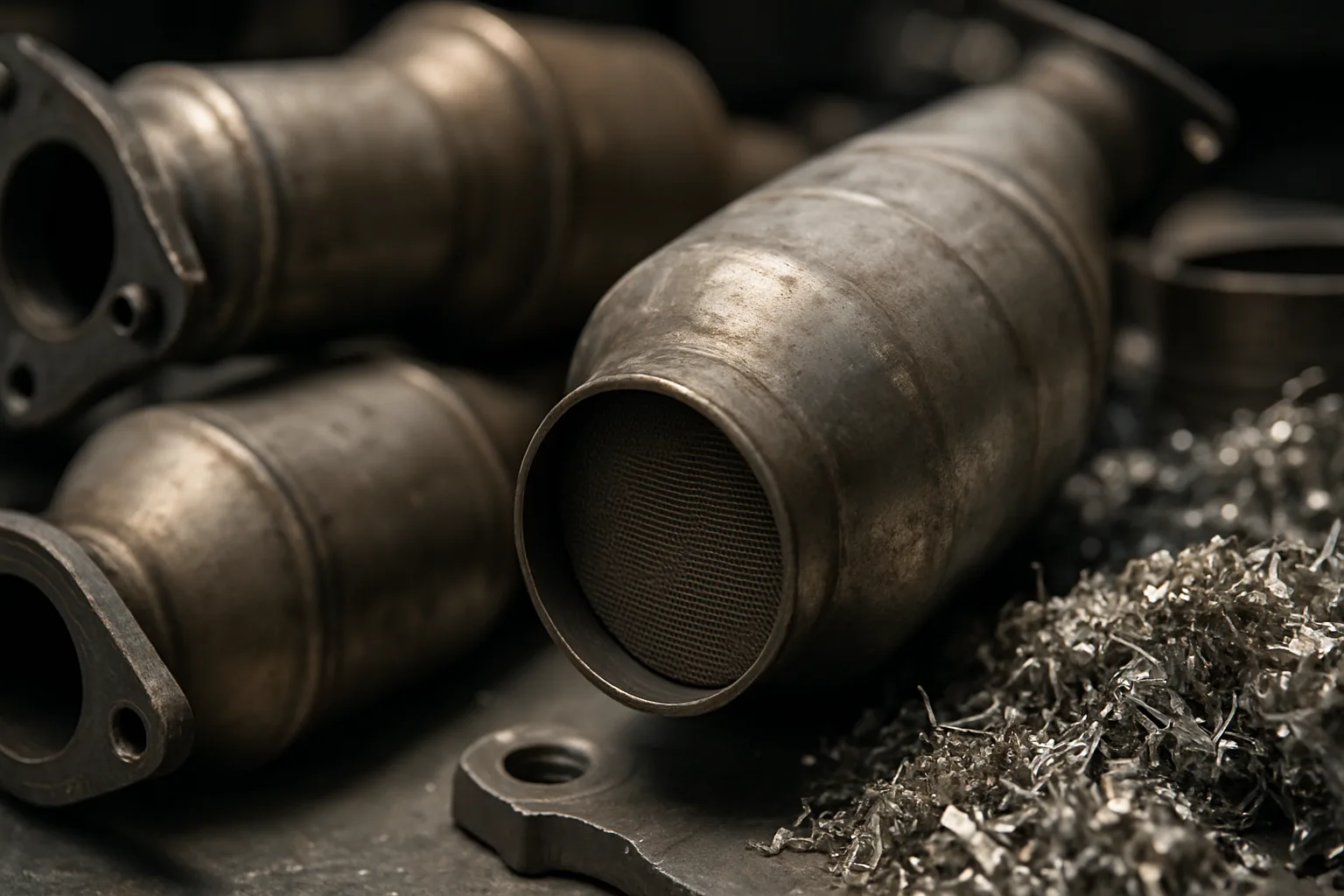
Why Catalytic Converter Prices Today Are Never the Same Twice
You pulled a cat off a vehicle this morning. By afternoon, the price your buyer quoted you looks nothing like what you expected. That's not a mistake — that's the market. Catalytic converter prices today move with the same volatility as the precious metals locked inside them, and if you're selling without tracking that movement, you're leaving money on the table.
Platinum, palladium, and rhodium drive the value of every catalytic converter you pull. These aren't stable commodities. They trade on global markets, respond to automotive production forecasts, mining output, and geopolitical pressure — all before your buyer even opens their mouth with a number. Understanding what's behind the price helps you stop guessing and start negotiating.
The Three Metals That Drive Your Cat Converter Value
Every scrap catalytic converter holds a washcoat — a thin ceramic substrate coated with platinum group metals (PGMs). The exact mix depends on the vehicle, the manufacturer, and the model year. But in every case, the value comes down to these three:
- Platinum (Pt): Used heavily in diesel converters and many domestic OEM units. Platinum prices respond to industrial demand, particularly from diesel vehicle manufacturing and hydrogen fuel cell development.
- Palladium (Pd): The dominant PGM in gasoline-engine converters. Palladium has been the most volatile of the three in recent years, with prices swinging dramatically based on automotive production rates and mine supply from South Africa and Russia.
- Rhodium (Rh): Present in smaller quantities but historically the highest-value metal per troy ounce of the three. A small shift in rhodium spot price can meaningfully change what a high-grade converter is worth.
When you look at a converter — whether it's a direct-fit OEM unit off a late-model truck or a foreign small off a compact import — you're looking at a combination of these three metals in concentrations that vary widely. A premium foreign large converter from a full-size SUV can be worth multiples of what a standard domestic unit brings. That spread matters when you're managing a yard or running a shop in Cincinnati that accumulates inventory across dozens of vehicle types.
The key takeaway: cat converter value isn't fixed. It reflects live PGM spot prices, the assay data behind the specific converter series, and the margin your buyer is building in. To get the best catalytic converter price today, you need visibility into all three.
What Makes Catalytic Converter Prices Fluctuate Daily
Price volatility isn't random. There are real forces driving daily movement in the scrap catalytic converter market, and tracking them gives you an edge over sellers who just take whatever price they're quoted.
PGM spot prices are the most direct driver. London Metal Exchange (LME) and NYMEX spot prices for platinum, palladium, and rhodium update throughout the trading day. A buyer pricing your lot at 8 AM is working from different numbers than one pricing the same lot at 3 PM. Most buyers update their buying prices daily — some more frequently on high-volatility days.
Automotive production data moves palladium and rhodium in particular. When major automakers announce production slowdowns or shutdowns, demand forecasts for new converters drop. That can soften prices for scrap cats too, even if it seems counterintuitive. The opposite happens when production ramps — PGM demand tightens, prices push higher.
Currency and macroeconomic signals matter because PGMs trade in USD globally. A strengthening dollar can suppress commodity prices. Inflation signals, interest rate decisions, and broader risk-off sentiment in financial markets all filter down into what your converter is worth on any given Monday morning.
Seasonal volume patterns in the scrap industry also play a role. High-volume months — typically spring and early summer when collision shops and junkyards turn over more inventory — can push buyer premiums tighter when supply is heavy. Ohio yards and Cincinnati-area shops that understand these cycles time their sales more strategically.
OEM Converter Prices vs. Aftermarket — Know What You're Holding
Not all catalytic converters are worth the same, and the biggest variable beyond PGM prices is the type of converter itself. OEM converters — original equipment manufacturer units that came on a vehicle from the factory — typically carry higher PGM loadings than aftermarket replacements. An aftermarket cat installed to pass an emissions test may have a fraction of the precious metal content of the OEM unit it replaced.
This matters enormously when you're sorting inventory. Selling a mixed lot of OEM and aftermarket converters without separating them can drag down your average price significantly. Buyers who know what they're looking at will pay accordingly — and if you don't know what you're holding, you're negotiating blind.
Serial number and VIN-based identification tools help close that knowledge gap. Platforms like SMASH support serial tracking and photo documentation so buyers are bidding on accurately described inventory — not making lowball offers to account for uncertainty. That documentation creates confidence, and confidence creates competition. When you read catalytic converter pricing guides, you'll consistently see accurate identification flagged as one of the most important steps to maximizing sale price.
Why Single-Buyer Quotes Fail You in a Volatile Market
Here's the problem with the traditional approach: you call one buyer, they quote you a price, you take it or leave it. In a stable market, that's merely inefficient. In a volatile PGM market, it can be genuinely costly.
Single-buyer pricing means you have no reference point. You don't know if the number you're being offered reflects today's spot price or last week's. You don't know what margin that buyer is building in. You don't know if another buyer in your region would pay meaningfully more for the same material.
That's the problem a scrap metal auction platform solves. When vetted buyers compete for your inventory, the price discovery happens in real time against actual market conditions. Competition can help reveal the market in a way that a single cold call never will. More buyers means better price discovery — that's not a sales pitch, that's basic economics.
SMASH brings that auction dynamic to scrap catalytic converter sales. Whether you're a Cincinnati yard moving weekly volume or an independent shop that pulls a handful of cats a month, the process is the same: document your inventory accurately, list it with SMASH, let vetted buyers compete. No subscription fees. SMASH only wins when you win.
For Ohio sellers looking to Cincinnati scrap metal services, that competitive bid environment can make a meaningful difference — especially on high-grade material where PGM content is significant and buyer margin assumptions vary widely.
How to Sell Smarter in a Fluctuating Market
Understanding market forces is step one. Acting on that understanding is step two. Here's a practical framework for sellers who want to stop leaving money behind:
- Track PGM spot prices daily. You don't need to become a commodities trader. A quick check of platinum, palladium, and rhodium spot prices before you sell tells you whether the market is moving in your favor or against it. Timing a sale on an upswing in palladium can meaningfully change your return.
- Identify your inventory accurately. Separate OEM from aftermarket. Use serial numbers where possible. Photograph your converters. The more confident a buyer is in what they're bidding on, the tighter their margin assumption — and the more competitive their offer.
- Get multiple bids. One quote is a guess. Multiple competing bids are price discovery. Use a platform that puts your inventory in front of vetted buyers simultaneously rather than working through one contact at a time.
- Don't hold inventory indefinitely waiting for a price spike. PGM markets can move against you as easily as they move in your favor. Selling into a competitive auction format on a day with solid spot prices is generally better than waiting for a theoretical peak.
- Document everything. BOLs, packing lists, photos, serial numbers. Clean documentation speeds up the transaction and protects you if disputes arise.
Sellers who work this way — in Cincinnati and across Ohio — consistently outperform those who rely on a single buyer relationship and a gut feeling about whether the price is fair. To check current catalytic converter prices and understand where today's market sits before you sell, use every tool available to you.
Getting the Best Catalytic Converter Price in Cincinnati and Across Ohio
The Cincinnati market is active. The area's density of auto shops, salvage yards, and industrial operations means there's consistent converter volume moving through the region. But active markets also mean buyers are sophisticated — they know what material is worth, and they'll price their offers accordingly if they think you don't.
Ohio sellers have access to a national buyer network through platforms like SMASH. That matters because catalytic converter buyers Ohio-wide aren't the only ones competing for your material. Buyers from across North America participate in SMASH auctions, which means your Cincinnati-area inventory gets exposure to demand that extends well beyond your local market.
The combination of accurate identification, documented inventory, and competitive bidding is the clearest path to the best catalytic converter price in any market condition. If you're ready to stop guessing and start getting paid what your material is actually worth, get competitive bids for your scrap metal through a platform built for exactly this.
The market moves every day. Your approach to selling should keep up with it. Get the best price for your catalytic converter — get a free quote at best-catalytic-converter-price.com.
Disclaimer: Catalytic converter prices fluctuate daily based on PGM spot prices and market conditions. Always check current rates before selling.
Frequently Asked Questions
Q: How often do catalytic converter prices change?
Prices can shift daily — or even within the same trading day. Because converter value is tied directly to platinum, palladium, and rhodium spot prices, any movement in those commodities filters through to what buyers will pay. Checking current rates before you sell is always worth doing.
Q: What makes one catalytic converter worth more than another?
The primary factors are the type of converter (OEM vs. aftermarket), the vehicle it came from, and the PGM loading of that specific unit. Foreign large converters from trucks and SUVs typically carry significantly more precious metal content than small domestic or aftermarket units. Accurate identification before you sell helps ensure you're paid for what you actually have.
Q: Where can I sell catalytic converters in Cincinnati, Ohio?
Several buyers operate in the Cincinnati area, but local options alone may not give you the best price. Using a platform like SMASH connects your inventory to vetted buyers across North America, which creates real competition for your material rather than a single take-it-or-leave-it offer. Visit the Cincinnati scrap metal services page for local options.
Q: How do I know if I'm getting a fair price for my catalytic converter today?
The clearest indicator is competition. If only one buyer has seen your material, you have no reference point for whether the number is fair. Getting multiple bids — ideally through a vetted auction platform — lets the market set the price rather than a single buyer's margin assumptions.
Q: Does it matter whether my converter is OEM or aftermarket when I go to sell?
Yes — significantly. OEM converters carry higher precious metal content and command better prices. Aftermarket units installed as emissions replacements often have minimal PGM content and are worth considerably less. Separating your inventory by type and documenting it accurately before selling protects your return on the high-grade material.
Stay current on scrap metal market trends and PGM price movements — follow SMASH on LinkedIn for industry updates and insights built for yards and buyers across North America.