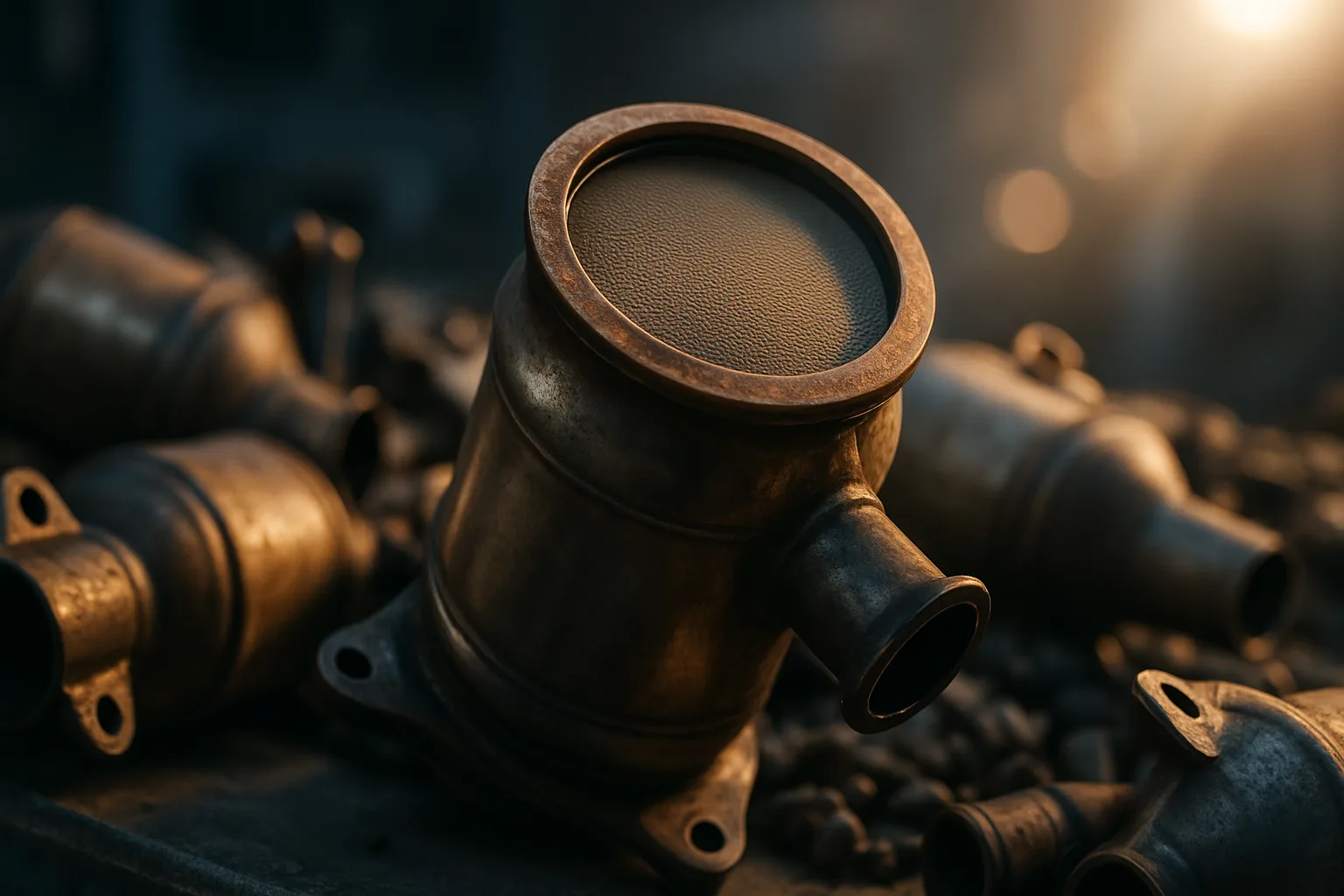
Most people leave money on the table before they even talk to a buyer — not because their cat is worth less, but because their photos are. A blurry shot of the wrong end of a catalytic converter can cut your quote before the conversation even starts. If you're trying to nail down your catalytic converter scrap value — whether you've got one unit or a pallet load — the photos you send are doing more work than you think.
This is especially true if you're selling online. Buyers can't hold your cat, tap it, or read the stamp in person. They're working entirely from what you show them. Get the photos right, and you give buyers the confidence to bid higher. Get them wrong, and buyers hedge — which means lower offers and slower sales.
This guide breaks down exactly how to photograph your catalytic converter to get the most accurate quote possible. It applies whether you've got a single OEM converter from a Charlotte shop or a mixed load of aftermarket units from across North Carolina.
Why Photos Directly Affect Your Catalytic Converter Scrap Value
Here's the reality: buyers pricing cats remotely are working backward from risk. If they can't confirm what they're buying, they build in a discount — a cushion for uncertainty. That cushion comes out of your price. Better documentation means less guesswork for the buyer, which means a more competitive offer for you.
Catalytic converter scrap prices are tied to the precious metals inside — primarily platinum, palladium, and rhodium. The mix and loading of those metals varies dramatically by vehicle make, model, year, and engine size. An OEM converter from a 2019 Ford F-150 contains a very different metal profile than an aftermarket replacement from the same year. Buyers need to identify your specific unit to price it correctly, and that starts with reading the markings on the shell.
With palladium price today fluctuating alongside rhodium and platinum markets, even a small misidentification can mean a significant pricing gap. Accurate photos eliminate that gap. They let buyers confirm the unit, cross-reference the serial or part number, and price with confidence rather than caution.
The Four Shots Every Catalytic Converter Listing Needs
You don't need a studio setup. You need four clear, well-lit photos taken with a steady hand. Here's exactly what to capture:
-
The stamp or serial number — close up, in focus.
This is the most important shot. The serial number, part number, or OEM stamping on the shell tells buyers what they're actually buying. Get within six to twelve inches. Make sure it's sharp — if you can't read it on your phone screen, buyers can't read it either. This is where your cat converter value gets confirmed or questioned. -
Both ends of the pipe — inlet and outlet.
Buyers want to see the honeycomb substrate or lack thereof. A missing or crumbled substrate changes the value significantly. A clean, intact substrate signals an undamaged unit. Shoot straight into each opening with your flashlight on. -
Full shell, both sides.
Damage, welding marks, cut lines, or signs of previous removal all affect value. Show both sides of the outer shell so there are no surprises on delivery. -
A group shot if you're selling multiple units.
If you've got a load, lay them out on the ground or a flat surface and photograph the full lot. This helps buyers understand quantity and gives context for your packing list or inventory documentation.
That's it. Four shots, shot well, beats twelve blurry photos every time. Platforms like SMASH make it easy to upload structured photo documentation alongside your unit details — so buyers see exactly what they're bidding on.
Lighting and Angle Tips That Actually Make a Difference
Bad lighting kills good cats. The most common mistakes are shooting in shadow, using flash at close range (which blows out the stamp), and taking the photo at an angle that makes the serial number unreadable. Here's how to avoid all three:
- Use indirect natural light. Overcast days are ideal — bright but diffused. Direct sun creates harsh shadows. If you're working indoors, a work light positioned to the side (not straight on) works well.
- Turn off the flash for close-ups. For the stamp shot, flash at close range washes out the text. Use your phone's flashlight app held at an angle to cast side-lighting across the surface instead — the contrast helps the numbers pop.
- Shoot perpendicular to the surface. Hold the camera directly over the stamp, parallel to the shell face. Angled shots distort and blur the characters.
- Wipe it down first. Grease, mud, and road grime don't just look bad — they obscure the numbers that determine your price. A quick wipe with a rag before you shoot takes thirty seconds and can meaningfully affect your quote.
- Check focus before moving on. Tap to focus on the serial number on your phone screen. Zoom in on the preview to confirm it's sharp before you move to the next shot.
If you're running a shop in Charlotte or selling from a yard anywhere in North Carolina, these habits make the difference between a fast, confident quote and a back-and-forth that stalls your sale.
What Buyers Look For When They Price Your Cat Converter
Understanding what a buyer sees in your photos helps you shoot better. When you sell catalytic converters online, a serious buyer is running through a mental checklist from your images:
- Is the unit OEM or aftermarket? OEM converters from the original vehicle manufacturer typically carry higher precious metal loadings. Aftermarket units are worth less — sometimes significantly. Buyers can often identify this from the shell design and markings alone.
- Is the substrate intact? A rattling, cracked, or missing substrate affects the assay. Photos of both openings confirm this quickly.
- Has it been tampered with? Welding beads, grind marks, or obvious cuts raise red flags. Buyers want to know the unit is as-removed, not modified.
- Can the serial number be cross-referenced? Buyers use databases to match stamped numbers to known precious metal profiles. If your stamp is unreadable, they can't confirm value — and they'll price conservatively.
- Does the condition match the description? If you describe it as "good condition" but the photos show crush damage, the quote dies and trust goes with it.
Vetted buyers on competitive platforms like sell your scrap metal on the SMASH marketplace use this information to price accurately and bid competitively. When your photos check every box, you're not just getting a quote — you're triggering real competition for your load.
How to Sell Scrap Metal Online and Get a Competitive Quote
Once your photos are ready, the process of getting an accurate quote is straightforward — if you're on the right platform. The old way was to call a single buyer, describe what you had over the phone, and hope the price they quoted was fair. There was no way to know. One buyer, one number, no leverage.
The better approach is to sell scrap metal online through a platform that creates real price competition. Upload your photos, provide the part numbers or VINs where applicable, and let vetted buyers bid. More buyers means better price discovery — especially for high-value units where platinum, palladium, and rhodium content can shift the price significantly based on current spot markets.
If you're in Charlotte or operating elsewhere in North Carolina, Charlotte scrap metal services can connect you with buyers already active in your region. That matters — local buyer networks mean faster pickups, cleaner logistics, and fewer delays between quote and payment.
For those managing volume — auto recyclers, shop owners, or collectors moving multiple units — structured documentation (photos plus a packing list, BOL, and serial tracking) makes the entire process faster and reduces disputes on delivery. Read catalytic converter pricing guides to understand how documentation affects your final settlement, especially when selling mixed loads.
Common Photo Mistakes That Cost You Money
These are the errors that show up again and again — and every one of them has a cost attached:
- Photographing the wrong side. Some units have stamps on both ends, others only on one. If you shoot the blank side, buyers have nothing to work with.
- Sending screenshots of screenshots. Every time an image gets compressed or screenshotted, quality drops. Send the original photo file.
- Using a photo from weeks ago in different conditions. Buyers want to see the current state of the unit. If it's been sitting outside since that photo, reshoot it.
- Including only one photo for a multi-unit load. One photo of twenty cats tells a buyer almost nothing. Photograph representative units from the lot and include a full group shot.
- Cutting off the serial number in the frame. The full stamp needs to be visible — not just part of it. If you're too close, back up slightly and reshoot.
Fixing these mistakes costs you nothing. Ignoring them costs you real money — especially when palladium price today and rhodium markets mean the spread between a confident quote and a hedged one can be meaningful.
Ready to put these photo tips to work? Get the best catalytic converter price today by uploading your documented photos for a fast, competitive quote. You've already done the hard part — don't leave the return on the table because the photos didn't show what you had. Check current catalytic converter prices and see what your load is actually worth in today's market.
Disclaimer: Catalytic converter scrap prices fluctuate with precious metal spot markets. Always check current rates before finalizing any sale.
Frequently Asked Questions
Q: What's the most important photo to take of a catalytic converter for a scrap quote?
The serial number or OEM stamp on the shell is the single most important image. Buyers use this to cross-reference the unit against known precious metal profiles for platinum, palladium, and rhodium content. Without a readable stamp, buyers can't confirm catalytic converter scrap value and will price conservatively to offset their risk.
Q: How many photos do I need to get an accurate online quote?
Four clear photos cover everything a buyer needs: the serial number close-up, both inlet and outlet openings, and the full shell (both sides). For multi-unit loads, add a group shot of the entire lot. Quality matters more than quantity — four sharp photos beat twelve blurry ones every time.
Q: Does the condition of my catalytic converter's substrate affect the scrap price?
Yes, significantly. An intact, undamaged substrate typically commands a higher price than a cracked, crumbled, or missing one, because the precious metal loading is tied to the ceramic or metallic substrate inside the unit. Photos of both openings let buyers assess substrate condition before making an offer.
Q: Where can I sell catalytic converters in Charlotte, North Carolina?
Charlotte has an active scrap metal buyer network, and several platforms allow you to sell catalytic converters online with competitive bidding. Submitting documented photos through a platform like SMASH connects your load with vetted buyers already active in the region, so you're not relying on a single quote from a single yard.
Q: How does palladium price today affect what I get for my catalytic converter?
Palladium is one of three primary precious metals recovered from catalytic converters, alongside platinum and rhodium. When palladium prices rise, converters with higher palladium content — typically those from gasoline-powered vehicles — are worth more at settlement. Checking current spot prices before you sell gives you a realistic baseline for what to expect from buyer offers.
Follow SMASH on LinkedIn for scrap metal market insights, pricing updates, and industry news: linkedin.com/company/scrap-metal-auction-sales-hub.
```