Most people selling a scrap catalytic converter have no idea they're leaving money on the table — not because they made a bad deal, but because they never understood how grading works in the first place. If you're in Chicago sitting on a pile of cats, that knowledge gap is costing you.
Catalytic converter scrap value isn't one number. It's a range — and where your converter lands on that range depends on grade, condition, precious metal content, and who's buying. This guide breaks down exactly how grading tiers work, what drives the price difference between a premium OEM unit and a foil-packed aftermarket piece, and how to make sure you're getting paid what your cats are actually worth.
Why Catalytic Converter Scrap Value Varies So Much
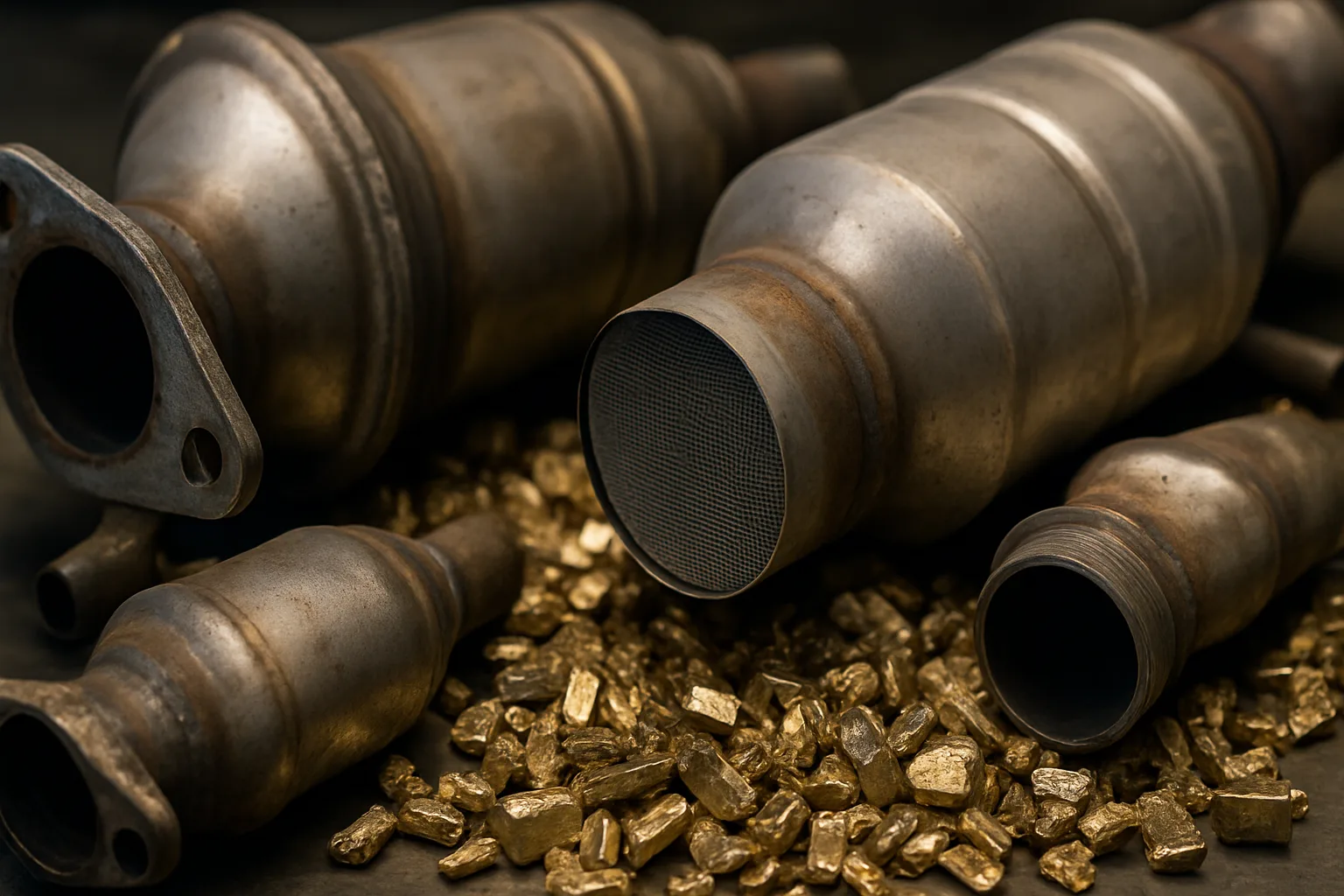
Two converters can look nearly identical from the outside and fetch completely different prices. That's not a scam — that's chemistry. The scrap value of a catalytic converter is determined almost entirely by the concentration of platinum, palladium, and rhodium inside the ceramic or metallic substrate. These are the precious metals that do the actual emissions work, and they're what buyers are really paying for when they buy your cats.
Palladium and rhodium prices in particular have been volatile through 2025 and into 2026. Rhodium, once sitting at record highs, has seen significant price corrections. Palladium has fluctuated based on automotive production cycles and shifts in battery electric vehicle adoption. The point: the palladium price today directly impacts what your converter is worth today — not last month, not last year. Market timing matters.
Beyond precious metal content, other variables move the needle:
- OEM vs. aftermarket: Original equipment manufacturer converters carry far more precious metal loading than cheaper aftermarket replacements.
- Vehicle make and model: High-emission or performance vehicles often require richer catalyst loadings.
- Substrate type: Ceramic (monolith) substrates are standard; metallic substrates appear in high-performance applications and grade differently.
- Physical condition: Cracked, blown-out, or melted substrates reduce recoverable metal content — and the buyer's bid.
- Foreign material contamination: Antifreeze intrusion, excessive oil burning, or welded-in foreign material lowers value fast.
Understanding these factors isn't just academic. It's the difference between accepting the first offer you get and knowing whether that offer is fair.
The Grading Tiers: How Buyers Actually Classify Your Cats
The scrap catalytic converter market uses a tiered grading system — though terminology varies between buyers, processors, and platforms. Here's how the tiers generally break down in practical terms.
Premium / High-Grade OEM Converters
These are the top-value units. Think full-size OEM converters from domestic trucks, SUVs, and performance vehicles. They carry the highest loadings of platinum, palladium, and rhodium. Buyers compete aggressively for these, especially in volume. If you're running a shop in Chicago doing fleet maintenance on F-250s or Silverados, you're generating premium-grade cats regularly — and you should be getting paid accordingly.
Mid-Grade / Standard OEM Converters
Standard passenger car OEM converters fall here. They carry meaningful precious metal content but at lower concentrations than large-displacement or high-emission applications. Mid-grade units represent the bulk of the market volume — most four-cylinder and small six-cylinder vehicles produce these. Price per unit is lower than premium, but they move in high quantities.
Low-Grade / Aftermarket Converters
Aftermarket converters — the kind installed as a replacement rather than factory-original — use significantly less precious metal. They meet emissions standards, but they're engineered to a cost target, not a performance target. A foil-packed or biscuit-style aftermarket cat might return a fraction of what an OEM unit from the same vehicle type would fetch. Knowing which is which before you sell matters enormously for your cat converter value calculation.
Small Domestic / Small Foreign (SD/SF) Converters
These are smaller converters from compact or economy vehicles. Categorized separately because their size and substrate volume are lower, translating to lower recoverable metal. Still worth selling — just priced accordingly.
High-Performance and Specialty Units
Some converters don't fit neatly into standard tiers. Diesel oxidation catalysts (DOCs), diesel particulate filters (DPFs), and certain European luxury OEM units have distinct chemistry and value profiles. DPFs in particular have become a significant category — they contain platinum and are worth processing separately.
How to Identify What You Have Before You Sell
You don't need a lab to get a reasonable read on what you're holding. Start with the basics.
Check the serial number or part stamp. Most OEM converters carry a serial number or a part number stamped into the shell. This is the single most reliable way to identify the unit and look it up against a price database. Platforms built for the scrap trade use serial tracking exactly for this reason — so buyers and sellers are working from the same information, not guessing.
Look at the size and weight. Larger, heavier converters generally carry more substrate and therefore more precious metal. A mid-sized ceramic monolith from a compact car is a different value proposition than a large-format OEM unit from a 3/4-ton truck.
Inspect the condition. Shake it. A rattling substrate — loose, broken ceramic — signals damage that reduces recoverable content. Look for physical damage to the shell, signs of overheating (discoloration, warping), or contamination at the inlet or outlet.
Know the source vehicle. If you're pulling cats from your own shop inventory, you likely know the vehicle they came from. That's valuable data. A converter from a Toyota Prius, for example, is well-documented as a high-value unit because of its hybrid drivetrain's specific catalyst loading. A converter from a base-model economy sedan is a different story.
If you're based in Illinois and processing volume, document everything — photos, part numbers, condition notes. Buyers on platforms like SMASH Scrap — where verified buyers bid on your metal can evaluate documented inventory more confidently, which directly affects the quality of bids you receive.
How to Sell Catalytic Converters in Illinois and Get a Fair Price
The old way to sell catalytic converters Illinois-style: call one local scrap yard, take whatever number they give you, and wonder if you could've done better. For a single cat, maybe that's fine. For a shop generating 20, 30, or 50 units a month, that approach leaves serious money on the table.
Competition is the only real price discovery mechanism in scrap. One buyer doesn't give you a market price — they give you their price. The difference between those two things can be substantial, especially on premium or specialty units where individual buyers have different needs and inventory positions.
That's where the approach changes. When you sell scrap metal online through an auction-based platform, you're not accepting the first number — you're creating a bidding environment where multiple vetted buyers compete for your load. Documentation matters here. Clear photos, serial numbers, and accurate condition descriptions give buyers what they need to bid confidently and competitively.
For Chicago-area sellers — whether you're an independent collector, an auto dismantler, or a shop generating cats as a byproduct of your service work — Chicago scrap metal services built around price transparency and buyer competition are a fundamentally better model than the single-call, single-offer approach.
SMASH brings that competition to the catalytic converter market. No subscriptions. No guessing. Vetted buyers, documented inventory, and an auction format that lets the market set the price. To get the best catalytic converter price today, the starting point is understanding what you have — and the second step is making sure more than one buyer knows about it.
What Affects Pricing Week to Week: The Market Reality
Precious metal markets move daily. Rhodium has been one of the most volatile commodities of the past decade. Palladium responds to automotive production forecasts, mining supply disruptions, and macro economic shifts. Platinum has its own demand dynamics tied to hydrogen fuel cell development alongside traditional catalytic applications.
That means a converter sitting in your yard today has a different value than it did 90 days ago — and possibly a different value than it will in 90 days. This isn't an argument for panic-selling, but it is an argument for staying informed and not letting inventory age unnecessarily without a price check.
If you want to read catalytic converter pricing guides that break down current market conditions and what's driving prices, staying current is part of maximizing what you recover. The sellers who understand the underlying commodity market — even at a basic level — make better timing decisions than those who don't.
A note on pricing: All prices in the scrap catalytic converter market fluctuate based on live precious metal spot prices, processing volumes, and buyer demand. Always check current catalytic converter prices before committing to a sale.
Frequently Asked Questions
Q: How do I find out the scrap value of my specific catalytic converter?
The most reliable method is to look up the serial number or part stamp on your converter against a current price database. The serial number identifies the exact unit, which tells buyers the make, model, substrate type, and approximate precious metal loading. Platforms that use serial tracking — like SMASH — give buyers enough information to bid accurately rather than lowballing for uncertainty.
Q: Does the palladium price today actually affect what I get for my cat?
Yes, directly. Scrap catalytic converter prices are derived from the recoverable precious metal content — primarily platinum, palladium, and rhodium. When palladium spot prices move, so does the value of converters with significant palladium loading. Checking current precious metal spot prices gives you context for whether you're receiving a fair offer.
Q: Is it worth finding a catalytic converter scrap yard near me in Chicago, or should I sell online?
Local scrap yards are convenient, but convenience has a cost — you typically get one offer with no leverage to negotiate. Online auction platforms give you access to multiple vetted buyers competing for your inventory, which is a more effective way to discover the actual market price. For high-value or specialty units in the Chicago area, the difference can be meaningful.
Q: What makes an OEM converter worth more than an aftermarket replacement?
OEM converters are engineered to meet vehicle-specific emissions requirements, which means they carry higher concentrations of precious metals. Aftermarket replacements are cost-engineered — they meet minimum emissions standards with less precious metal loading. When you scrap them, the difference in recoverable platinum, palladium, and rhodium is reflected directly in the price.
Q: How should I prepare my catalytic converters before selling in Illinois?
Document what you have. Photograph each unit, record any serial or part numbers visible on the shell, and note condition issues like substrate damage or contamination. Clean cuts — not torch-cut or flame-damaged shells — also help. Good documentation gives buyers confidence to bid higher; poor documentation gives them reason to discount for uncertainty.
If you're ready to stop guessing and start getting paid what your cats are actually worth, the process starts with knowing what you have and putting it in front of the right buyers. Get the best price for your catalytic converter — get a free quote at best-catalytic-converter-price.com.
Follow SMASH on LinkedIn for ongoing scrap metal market insights, precious metal price updates, and industry news that affects what your inventory is worth.