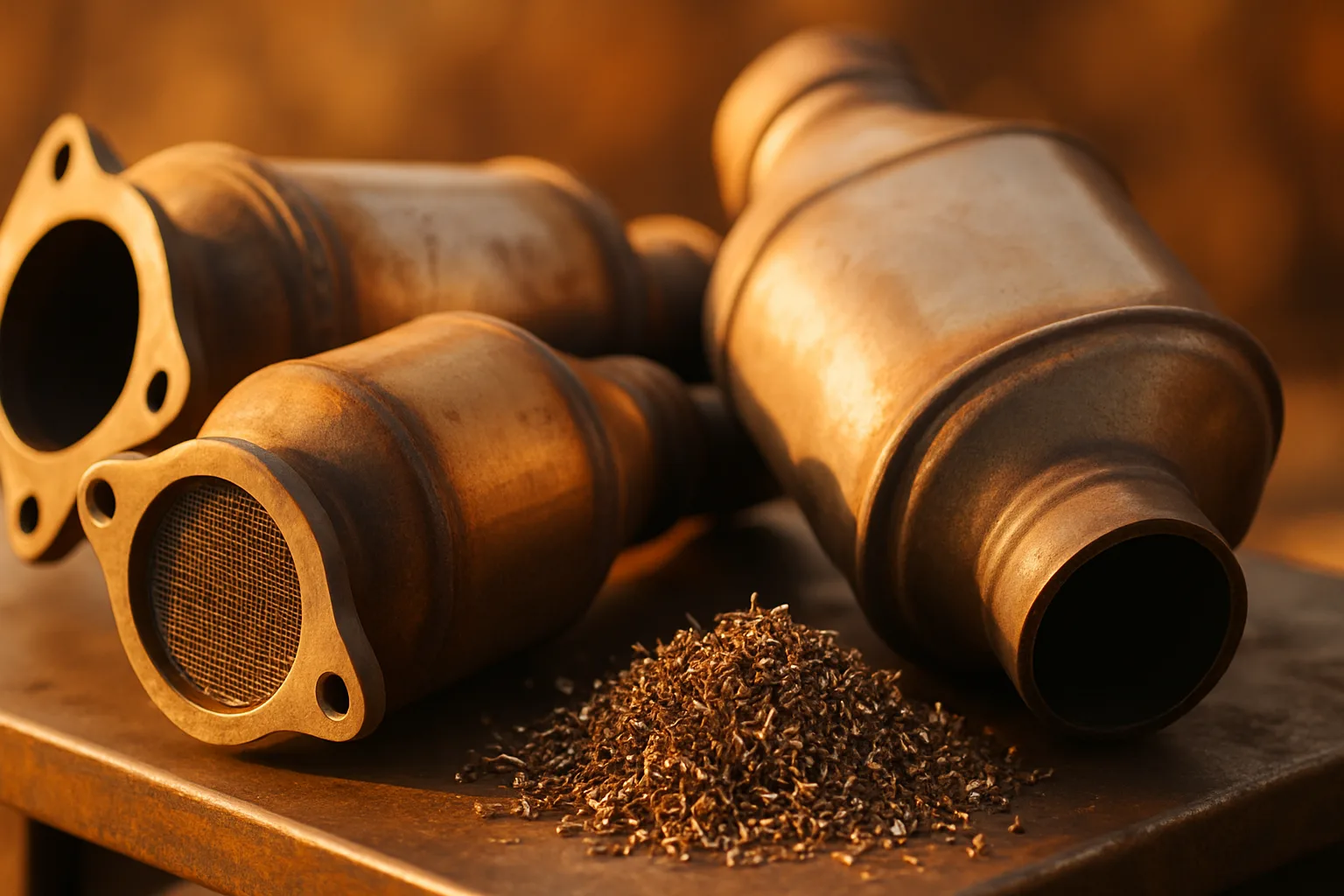
Diesel vs. Gasoline Catalytic Converters: What Every Scrapper in Gary Needs to Know
Most people selling scrap catalytic converters treat them all the same. That's a mistake that costs money. A diesel catalytic converter — specifically a DPF (Diesel Particulate Filter) or DOC (Diesel Oxidation Catalyst) — is a fundamentally different piece of hardware than the gasoline converter sitting on a Honda Civic. If you're a catalytic converter buyer in Gary, an auto shop, or a collector working the industrial corridors of Indiana, understanding that difference isn't just academic. It directly affects what your load is worth.
This breakdown covers what's inside each type of converter, why the scrap value differs, and how platforms like SMASH help sellers get proper price discovery instead of a lowball quote from a single buyer who's counting on your uncertainty.
What's Actually Inside a Gasoline Catalytic Converter
Gasoline converters use a ceramic or metalite honeycomb substrate coated with platinum group metals — primarily platinum, palladium, and rhodium. These three PGMs do the heavy lifting. They oxidize carbon monoxide, reduce nitrogen oxides, and burn off unburned hydrocarbons. The three-way catalyst design handles all of it simultaneously, which is why gasoline cats are often called TWCs (Three-Way Catalysts).
The PGM loading on a gasoline converter is typically the highest of any automotive exhaust component. That's what makes them valuable. An OEM converter from a late-model truck or SUV can carry meaningful amounts of rhodium — a metal that has traded at extraordinary multiples over platinum in recent years. The used catalytic converter scrap value on a quality gasoline OEM unit reflects that PGM density directly.
- Substrate: Ceramic (cordierite) or metalite (foil-based stainless steel)
- Primary PGMs: Platinum, palladium, rhodium
- Catalyst type: Three-Way Catalyst (TWC)
- Scrap value driver: Rhodium and palladium content, substrate integrity
- Common sources: Passenger cars, light trucks, SUVs, motorcycles
Condition matters. A converter that's been running rich, overheated, or physically cracked has degraded substrate and lower recoverable PGMs. Buyers who know what they're looking at will price accordingly. Buyers who don't will often just low-ball everything. That's the problem platforms like SMASH are built to solve — competition between informed buyers produces better price discovery than a single guess.
How Diesel DPF and DOC Units Work Differently
Diesel exhaust doesn't behave like gasoline exhaust. It burns lean, which means less hydrocarbon and CO output — but it produces a lot of particulate matter (soot) and nitrogen oxides. The aftertreatment system on a diesel engine is designed around that chemistry, and it uses different components to handle it.
The DOC (Diesel Oxidation Catalyst) is the first stage. It oxidizes carbon monoxide and hydrocarbons in diesel exhaust, similar in function to a gasoline converter. It does contain platinum and palladium — but typically at lower loadings than a gasoline TWC, and it carries no rhodium in most designs. That PGM difference is critical to understanding scrap value.
The DPF (Diesel Particulate Filter) is a different animal entirely. Its job is to trap and burn off soot particles through a process called regeneration. Most DPFs use a silicon carbide (SiC) or cordierite filter wall that physically captures particulates. Some DPFs have a catalytic coating to assist with regeneration — but many do not. The ones without a catalytic coating have very limited PGM content and therefore lower scrap catalytic converter value.
- DOC substrate: Ceramic honeycomb, coated with platinum and palladium
- DOC PGMs: Platinum and palladium — no rhodium in most units
- DPF substrate: SiC or cordierite wall-flow filter
- DPF PGMs: Varies significantly — catalyzed DPFs have some PGM coating; uncatalyzed DPFs have very little
- Common sources: Heavy trucks, commercial vans, buses, off-road equipment, light diesel passenger vehicles
The Gary, Indiana market sees a high volume of heavy diesel equipment — trucking, steel-adjacent logistics, construction. That means a lot of DPF and DOC units cycle through the region. Knowing how to sort and value them properly separates a yard running tight margins from one leaving money on the table.
Why Scrap Value Differs — and Why Misidentification Costs You
Here's where the rubber meets the road on catalytic converter price differences. A gasoline OEM converter from a full-size pickup can be worth multiples of a standard DOC from a commercial diesel, and an uncatalyzed DPF might not carry significant PGM value at all beyond its scrap shell weight. Getting these confused — or letting a buyer blur the lines — is a real cost.
The misidentification problem runs in both directions. Some sellers try to pass off aftermarket or diesel DOC units as high-value gasoline OEM cats. Sophisticated buyers won't fall for it — they'll assay or use serial tracking to confirm. But the reverse also happens: buyers undervalue diesel aftertreatment units, especially catalyzed DPFs, because the seller doesn't know what they have and can't push back with data.
Documentation is the equalizer. When you check current catalytic converter prices against verified serial numbers and proper unit classification, you're negotiating from a position of knowledge, not guessing. That's the difference between taking the first number offered and knowing whether it's fair.
Key value factors for each type:
- PGM loading: Gasoline TWCs generally carry more rhodium, which is often the highest-value PGM per gram
- Substrate integrity: Cracked, melted, or rattled-out substrates recover fewer PGMs at the refinery
- OEM vs. aftermarket: OEM units consistently carry higher PGM loading than aftermarket replacements
- Catalyzed vs. uncatalyzed DPF: Always determine whether the DPF has an active catalytic coating — it's not always obvious from the outside
- Weight and size: Heavy-duty diesel DOCs and DPFs can be large units — substrate weight and shell weight are priced separately by most buyers
How Gary Sellers Can Use Competitive Bidding to Capture Real Market Value
Gary sits at the intersection of industrial output and scrap metal flow. The region generates legitimate volume in both gasoline and diesel aftertreatment units, from the auto sector to freight and logistics. The challenge is that a single buyer — one phone call, one quote — has no reason to compete. You take what's offered or you start calling around manually.
That's the old way, and it's slow and opaque. Get competitive bids for your scrap metal through an auction format instead. SMASH connects sellers with vetted buyers who know the difference between a DOC and a DPF, who understand OEM serial tracking, and who bid against each other. Competition is what drives price discovery. Without it, the buyer sets the price and the seller wonders if they left money behind.
SMASH doesn't charge subscriptions. The platform works on a model where sellers win first. For a yard in Indiana processing mixed loads that include diesel aftertreatment units alongside standard gasoline cats, getting each unit properly identified and auctioned to buyers who specialize in those materials is a genuine operational advantage. If you want to get the best catalytic converter price today, the starting point is making sure your units are identified correctly and priced against real market demand — not a single buyer's margin target.
Sorting Your Load: Practical Tips for Diesel and Gasoline Cat Separation
If you're processing volume, sorting your load before you list or quote is non-negotiable. Mixing unit types in a single lot makes pricing harder for buyers and tends to result in the whole load being priced to the lowest-value units. Separation is money.
Here's a practical sorting approach:
- VIN or serial lookup first: If the unit has a legible serial number, use it. OEM serial tracking tells you the vehicle application, which narrows down PGM loading ranges significantly.
- Visual identification: DPFs are typically larger, heavier, and have a wall-flow honeycomb visible at the face if cut. DOCs look similar to gasoline cats but will often be marked with diesel-specific part numbers.
- Shake test: A rattling substrate means physical damage and lower PGM recovery. Flag those separately — they're not worthless, but they price differently.
- Photo documentation: Photograph both faces of each unit, the shell, and any visible markings. Buyers bid with more confidence on documented inventory.
- OEM vs. aftermarket separation: Keep OEM units distinct from aftermarket. They're separate categories with different value ranges.
Auto shops in Gary and across Indiana processing diesel vehicle repairs are sitting on DOC and DPF units regularly. Most aren't maximizing what those units return. Proper identification and competitive bidding closes that gap. To read catalytic converter pricing guides that help you understand what different units are worth in the current market, the resource section is a practical starting point.
The Bottom Line on Diesel vs. Gasoline Converter Scrap Value
Gasoline TWCs and diesel DPF/DOC units are not interchangeable categories. They contain different PGMs at different loadings, serve different functions, and price differently in the scrap market. Treating them the same is how sellers leave money behind and how buyers make margins they didn't earn.
In a market like Gary, where diesel and gasoline units both flow through in real volume, the difference in how you approach each category adds up fast. Know what you have, document it properly, and bring it to a market where buyers compete for it. That's how price discovery works. Platforms like SMASH are built on exactly that premise — no subscription, no guessing, no single buyer setting the terms.
If you're ready to stop leaving value on the table, get the best price for your catalytic converter — get a free quote at best-catalytic-converter-price.com and find out what your units are actually worth in today's market.
Disclaimer: Catalytic converter scrap prices fluctuate based on daily PGM spot prices, unit condition, and buyer demand. Always verify current rates before selling.
Frequently Asked Questions
Q: Are diesel catalytic converters worth less than gasoline converters as scrap?
It depends on the specific unit. DOCs contain platinum and palladium and carry real scrap value, though generally less than a comparable OEM gasoline TWC because they lack rhodium. Uncatalyzed DPFs have minimal PGM content and price much lower. Catalyzed DPFs fall in between. Proper identification before selling matters significantly.
Q: Where can I find a catalytic converter buyer in Gary, Indiana?
Rather than limiting yourself to a single local buyer, consider listing through a competitive bidding platform like SMASH, which connects sellers with vetted buyers across North America. Local buyers in Gary are an option, but without competition, you have no way to confirm you're getting market value. Competition is the only real price check.
Q: How do I tell if my DPF is catalyzed or uncatalyzed?
The cleanest method is a serial or part number lookup against OEM documentation. Visually, catalyzed DPFs may have a DOC brick incorporated into the same housing. If you're unsure, a buyer experienced in diesel aftertreatment units can assess it — documentation and photos help significantly. Don't guess and don't let a buyer's ambiguity work against you.
Q: Does it matter if my catalytic converter is OEM or aftermarket when selling scrap?
Yes — substantially. OEM converters carry higher PGM loadings than aftermarket replacements, which are designed to meet emissions standards at lower cost. Most buyers separate OEM from aftermarket for exactly this reason. Mixing them in a lot or misrepresenting one as the other creates problems. Sort them, document them, and price them separately.
Q: What's the best way to get the most money for a load of mixed catalytic converters near Gary?
Sort your load by type — gasoline OEM, gasoline aftermarket, DOC, DPF (catalyzed vs. uncatalyzed). Document each unit with photos and serial numbers where possible. Then bring that documented, sorted inventory to a competitive auction environment rather than a single buyer quote. More competition and better documentation consistently produce better price outcomes.
Follow SMASH on LinkedIn for industry updates, scrap metal market insights, and auction platform news: linkedin.com/company/scrap-metal-auction-sales-hub