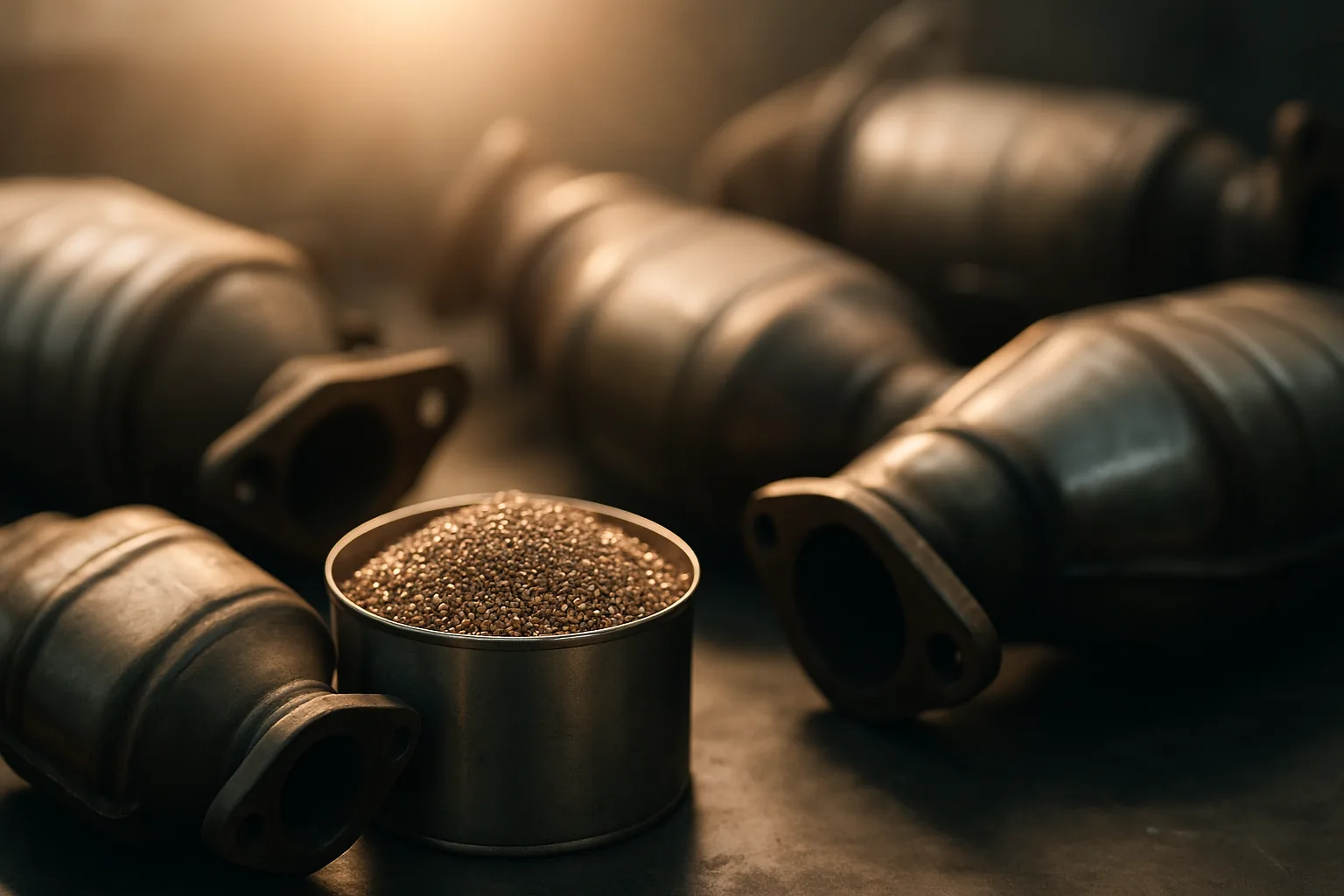
What's Actually Inside a Catalytic Converter — and Why It's Worth Real Money
Most people selling a scrap cat have no idea what makes it valuable. They just know someone's willing to pay for it. Here's the truth: a single catalytic converter can contain fractions of a gram — sometimes more — of platinum, palladium, and rhodium. Those three metals are among the most expensive commodities on earth. That's what drives catalytic converter scrap value. Not the steel shell. Not the ceramic substrate. The precious metal content locked inside.
If you're in Houston, Texas and sitting on a stack of used cats from your shop or salvage operation, understanding how pricing actually works puts money in your pocket. Let's break it down properly.
The Three Metals That Drive Catalytic Converter Scrap Value
Platinum, palladium, and rhodium — known in the industry as PGMs (platinum group metals) — are the backbone of every converter price. Each one does a specific job inside the converter, and each one trades independently on the global commodities market. When one spikes, certain converter types spike with it. When one drops, you feel it on your payout.
Here's how each metal functions and why it matters to your bottom line:
- Platinum (Pt): Primarily found in diesel converters. Platinum oxidizes hydrocarbons and carbon monoxide, converting them into less harmful compounds. Diesel applications load heavier on platinum because of how diesel combustion works. Pt prices fluctuate with industrial demand, auto production cycles, and mine output — mostly from South Africa and Russia.
- Palladium (Pd): The dominant metal in gasoline converters. Palladium is highly efficient at treating exhaust from petrol engines at lower temperatures. It's been the most volatile of the three PGMs over the past several years. Checking the palladium price today before you sell isn't optional — it's how you protect your margins.
- Rhodium (Rh): The rarest and often the most valuable per ounce. Rhodium handles nitrogen oxide reduction — critical for modern emissions compliance. Small rhodium swings create large changes in converter payouts because the concentrations inside each unit are so small that even minor per-ounce moves matter significantly.
The ratio of these three metals varies by converter type, engine size, vehicle manufacturer, and even model year. That's why no two cats pay the same, and why a proper cat converter value assessment requires more than a visual look at the unit.
How Refiners and Buyers Calculate What Your Cat Is Worth
When a buyer quotes your converter, they're doing math — not guessing. The process works like this:
- Assay and sample: Refiners crush or mill the substrate, take a sample, and run it through an ICP (inductively coupled plasma) analysis to determine actual PGM content in grams per unit.
- Apply spot prices: The grams of Pt, Pd, and Rh are multiplied by their current London Bullion Market (LBMA) or NYMEX spot price per troy ounce.
- Deduct refining costs: Processing, smelting, and logistics costs come off the gross value. This is called the "return percentage" — typically expressed as a percentage of gross metal value that gets paid back to the seller.
- Apply your negotiated return rate: Higher volume sellers — recycling yards, auto dismantlers, fleet operations — often negotiate better return rates. That's why two sellers with the same converter can walk away with different payouts.
Understanding this chain matters because it shows you exactly where leverage exists. Volume, documentation, and buyer competition all affect your net return. A buyer who knows you have no alternatives will price accordingly. That's the problem SMASH is designed to solve.
Why OEM vs. Aftermarket Converters Pay So Differently
Not all catalytic converters are created equal, and the difference in OEM converter price versus aftermarket can be dramatic. Original equipment manufacturer (OEM) converters — the ones that came from the factory on your vehicle — contain higher PGM loadings. They're built to meet stringent emissions standards and last the life of the vehicle. Aftermarket replacement converters use lower PGM content to hit a retail price point.
This means an OEM cat from a late-model truck or SUV can be worth multiples of what a replacement unit fetches. In Houston's active auto dismantling and fleet maintenance market, this distinction shows up constantly. A shop pulling converters from newer F-250s or Silverados is working with meaningfully different assets than someone pulling cats off economy cars from the 2010s.
Serial numbers and VIN data matter here. Buyers use these to verify converter identity and confirm PGM loading expectations before bidding. Platforms that support serial tracking and photo documentation give buyers the confidence to bid aggressively — which is how sellers get better price discovery. When you get the best catalytic converter price today, that documentation is a big part of what makes it possible.
Market Conditions in 2026 — What's Affecting PGM Prices Right Now
PGM markets in 2026 are being shaped by a few converging forces. The global transition to electric vehicles has created ongoing uncertainty about long-term palladium and platinum demand — but the transition is moving slower than automakers originally projected, keeping ICE vehicle production (and converter demand) strong in the near term. Rhodium supply remains constrained, as it's almost entirely a byproduct of South African platinum mining with no primary mine supply of its own.
For sellers in Texas, the practical takeaway is this: the market moves. A load sitting in your yard this week may not be worth the same in three weeks. Processors and refiners watch spot prices daily. You should too.
Timing your sale to market conditions is easier when you have access to real buyer competition — not just one local buyer quoting you a static price based on last week's numbers. That's exactly why sellers across Texas are increasingly turning to North America's B2B scrap metal auction platform to get competitive bids on their converter inventory rather than accepting a single take-it-or-leave-it offer.
Disclaimer: Catalytic converter prices fluctuate daily based on live PGM spot prices. Always check current catalytic converter prices before selling. The figures and market conditions described here reflect general conditions as of July 2026 and are subject to change.
How to Get a Better Price When You Sell Catalytic Converters in Texas
If you're looking to sell catalytic converters Texas at the best possible return, the single most important thing you can do is introduce competition. One buyer equals one price. Multiple buyers competing for your inventory equals price discovery — and a stronger payout.
Beyond competition, here's what moves the needle:
- Accurate identification: Know what you have. Use VIN lookup and serial tracking tools to confirm converter type before you list or quote. Unknown or unidentified units get discounted — buyers price in their uncertainty.
- Photo documentation: Clear, well-lit photos of the substrate (both ends), the serial number, and the overall condition signal a serious seller. Buyers bid higher when they trust what they're bidding on.
- Volume matters: If you're regularly pulling cats from your operation, bundling loads gives you negotiating power. A pallet of identified, documented converters from a Houston auto dismantler is a different proposition than a handful of loose, unidentified units.
- Sell through a platform with vetted buyers: SMASH connects sellers with verified buyers running competitive auctions — no subscription fees, no guessing. You only pay when the load sells. More buyers means better price discovery on every load you put up.
- Timing: PGM prices move. Selling into strength on palladium or rhodium — rather than letting loads sit — can make a real difference on a large converter load.
For Houston operations working through high converter volume — auto recyclers, fleet maintenance shops, collision centers — platforms like SMASH streamline the whole process. Inventory tool, photo uploads, auto-invoicing, and a network of vetted buyers. You list it, they bid, you move the load. To sell catalytic converters online without the runaround, that's the framework that works.
Local Houston scrap metal operations can also take advantage of regionally focused services. If you're new to selling cats and want to understand local options, start with Houston scrap metal services to get grounded in what's available in your area before going broader.
For deeper breakdowns on how converter grades and pricing categories work, read catalytic converter pricing guides to sharpen your knowledge before your next sale.
Frequently Asked Questions
Q: What metals give a catalytic converter its scrap value?
Platinum, palladium, and rhodium are the three precious metals that drive catalytic converter scrap value. These platinum group metals (PGMs) are embedded in the ceramic substrate inside the converter and recovered during the refining process. Their spot prices on global commodity markets change daily, which means your converter's value can shift from week to week.
Q: Why do different catalytic converters pay such different prices?
PGM content varies significantly by vehicle make, model, year, and whether the converter is OEM or aftermarket. Diesel converters tend to be platinum-heavy; gasoline converters lean on palladium. Higher-end or late-model OEM units carry more precious metal loading than budget replacement units. Accurate identification — using serial numbers and VIN data — ensures you get quoted based on what you actually have.
Q: How do I get the best price when I sell catalytic converters in Houston, Texas?
Start with proper identification and documentation of your units. Then introduce buyer competition — don't settle for one quote from one local buyer. Auction-based platforms like SMASH give multiple vetted buyers the chance to bid on your inventory, which typically results in stronger price discovery than a single static offer. Volume and consistency also help you negotiate better return rates over time.
Q: Does the palladium price today affect what I get paid for my cats?
Directly, yes. If your converters are gasoline-type units with significant palladium content, the palladium spot price at the time of settlement heavily influences your payout. Buyers and processors mark their bids to current market. Selling when palladium is trending up versus down can produce noticeably different outcomes on the same physical inventory.
Q: Is it better to sell catalytic converters online or to a local buyer?
It depends on your volume and how much you know about your inventory. A local buyer is convenient but gives you one price with no competitive pressure. Selling online through a platform that connects you to multiple vetted buyers introduces competition, which tends to produce better price discovery. For shops and yards in Houston moving regular converter volume, online auction platforms are increasingly the preferred approach.
Ready to stop guessing and start selling smart? Get the best price for your catalytic converter — get a free quote at best-catalytic-converter-price.com.
Stay current on PGM markets and scrap metal pricing trends — follow SMASH on LinkedIn for regular industry updates and market insights from across North America.