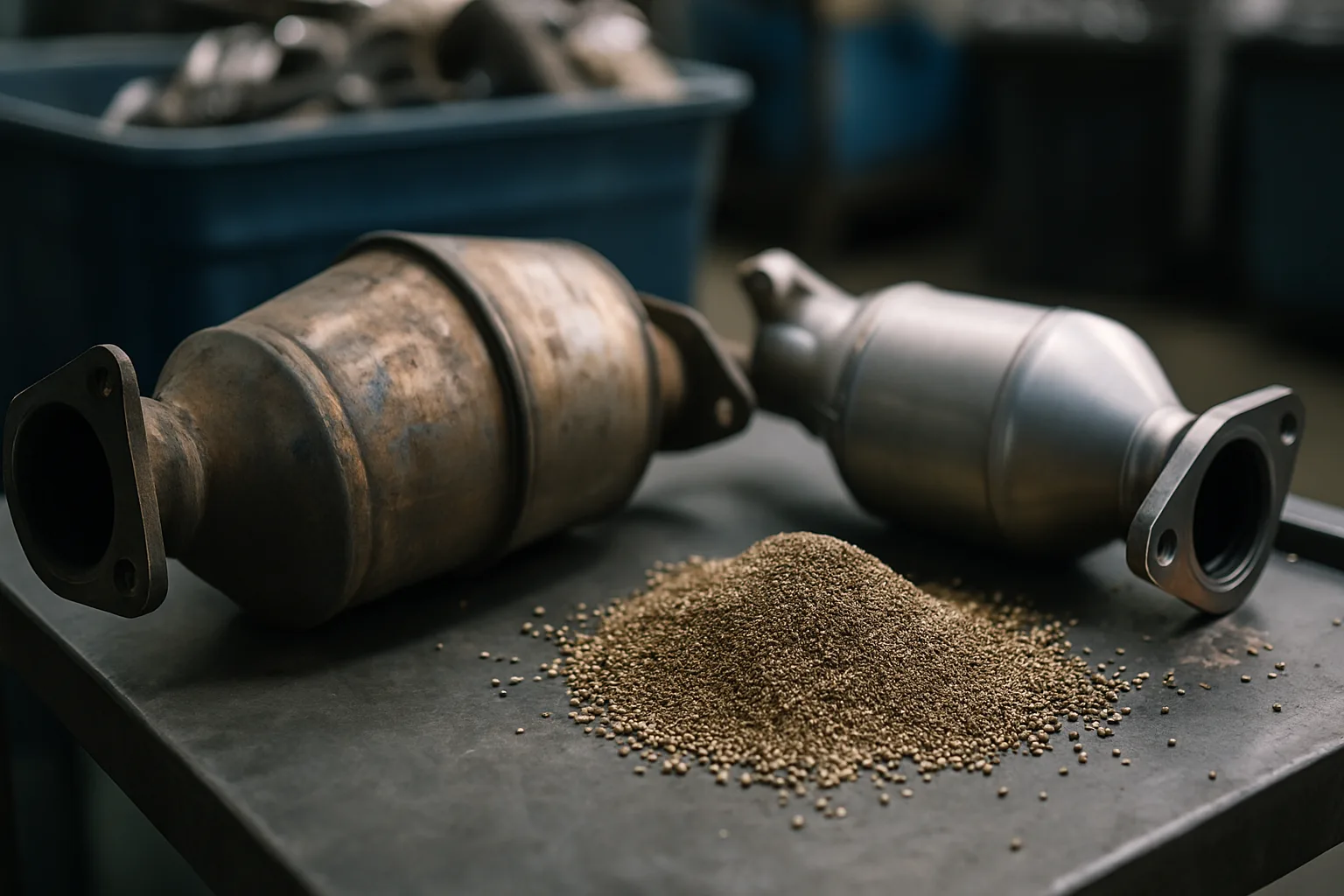
Why Your OEM Catalytic Converter Is Worth More Than You Think
Here's something most people selling scrap cats get wrong: they assume one converter is worth about the same as another. Hand over anything with a heat shield and a flange, collect your cash, move on. But if you've ever handed an OEM unit over for the same price as a cheap aftermarket replacement, you've likely left serious money on the table — and you'd never know it.
The gap between OEM and aftermarket catalytic converter values isn't minor. In some cases, it's the difference between a low payout and a genuinely competitive one. Understanding why that gap exists — and how it connects to platinum price today — puts you in a far stronger position when it's time to sell. Whether you're an auto shop running through a stack of used cats or an individual in Grand Forks pulling a converter off a trade-in, this matters.
What's Actually Inside a Catalytic Converter — and Why It Determines the Price
Every catalytic converter contains a ceramic or metallic substrate coated with platinum group metals (PGMs): platinum, palladium, and rhodium. These metals are the reason your converter has any scrap value at all. The steel shell, the heat wrap, the flanges — those are nearly worthless by comparison. The PGMs do all the heavy lifting, both in terms of emissions performance and resale value.
OEM converters — the ones installed at the factory by the vehicle manufacturer — are engineered to meet strict emissions standards for the life of the vehicle. To do that reliably, they're loaded with a meaningful concentration of PGMs. Aftermarket converters, often sold as replacement parts at lower price points, cut costs somewhere. Frequently, that somewhere is the PGM loading. Less platinum. Less palladium. Sometimes significantly less rhodium. That's not speculation — it's the business model.
When a recycler or smelter assays a load, they're measuring exactly what's in there. A depleted aftermarket substrate returns less precious metal, and the payout reflects that directly. This is why knowing what you have before you sell isn't just helpful — it's essential.
The Platinum Price Today and Why It Swings Your Payout
PGM markets move constantly. The platinum price today is set on international commodity exchanges, influenced by mining output from South Africa and Russia, automotive demand, industrial use, and broader economic conditions. Palladium and rhodium follow their own volatile curves — rhodium in particular has seen dramatic swings over the past several years, at times trading at multiples of gold's price before correcting sharply.
What this means practically: the value of the PGMs inside your OEM converter changes every trading day. A converter that paid out a certain amount twelve months ago may pay differently today — sometimes higher, sometimes lower. The underlying quantity of metal in the substrate doesn't change, but the price per troy ounce does. This is why buyers who give you a flat number with no explanation should raise a flag. That number should be rooted in current PGM spot prices, the specific converter type, and the actual assay data for that unit.
Platforms like SMASH connect sellers to vetted buyers who base their bids on real market data — not a number pulled from thin air. When you get the best catalytic converter price today, you want that price to reflect what the metals are actually worth on the day you're selling, not what they were worth six months ago when someone last updated a price sheet.
Disclaimer: PGM prices fluctuate daily. Always check current catalytic converter prices before selling to ensure you're working from up-to-date market rates.
OEM vs Aftermarket: A Breakdown of What Drives the Value Difference
The price gap between OEM and aftermarket cats isn't arbitrary. It's structural. Here's what drives it:
- PGM loading: OEM substrates are engineered to carry specific PGM concentrations. Aftermarket units are built to a price point, which typically means lower loading — sometimes dramatically so.
- Substrate quality: OEM converters often use higher cell-density ceramic or metallic substrates that hold more washcoat — the material that carries the PGMs. More washcoat surface area, more catalyst, more recoverable metal.
- Manufacturer specs: Factory-installed units from brands like Toyota, Honda, Ford, and GM are built to proprietary specs. Those specs frequently translate to richer PGM concentrations than an off-the-shelf replacement.
- Age and mileage: Even an OEM converter with high mileage retains more residual PGMs than a cheap aftermarket unit at low mileage. The starting concentration matters more than the depletion rate in most cases.
- Foil vs ceramic substrate: Some high-performance OEM units use metallic foil substrates, which process differently and often carry strong PGM concentrations. Misidentifying these will cost you.
None of this is visible from the outside. Two converters can look nearly identical under a vehicle and have wildly different scrap values. This is why photo documentation, serial number tracking, and VIN-based identification aren't optional — they're how you get paid correctly.
Why Grand Forks Sellers Need to Think About This Differently
If you're operating in Grand Forks, North Dakota — whether you're a shop pulling cats off repair jobs or someone selling a collection of cores — your local buyer pool may be limited. A single buyer with no competition has every reason to offer you the lowest number you'll accept. There's no pressure to do otherwise.
That's the old model. One call, one offer, one number. Take it or leave it, and you're not sure which to do because you have nothing to compare it to. The Grand Forks scrap metal services landscape is growing, but even in a well-connected market, a single-buyer dynamic suppresses what you actually receive.
What changes things is competition. When multiple vetted buyers see your documented inventory — converter type, condition, photo, serial or VIN data — and submit competing bids, the price discovery process works in your favor. You're not guessing. You're seeing what the market will actually pay. For a stack of OEM Toyota or Honda cats, that difference can add up fast. For aftermarket units, knowing their true value upfront helps you set realistic expectations instead of being surprised at the scale.
Shops in North Dakota running through dozens of cats a month especially benefit from a system where every unit is catalogued and priced on its actual merits — not lumped together into a single offer that averages down your better units.
How to Identify What You Have Before You Sell
Getting the right payout starts before you contact any buyer. Here's how to approach it:
- Photograph the converter from both ends and the side. Visible substrate, heat shield condition, and any markings all matter to buyers.
- Record the serial number or part number. This is stamped or cast on most OEM units. It allows buyers to cross-reference the unit against known assay data and give you an accurate bid.
- Use VIN lookup where available. For converters still attached to a vehicle or recently removed, a VIN confirms the OEM spec and helps identify whether the unit is original or a replacement.
- Don't mix loads without documentation. A pallet of mixed OEM and aftermarket cats, undocumented, will be priced conservatively. Separated and identified, your OEM units can command the premium they deserve.
- Check current PGM prices. Before you sell anything, know what platinum, palladium, and rhodium are trading at. If your buyer's offer doesn't move at all as the market shifts, ask why.
Tools built into platforms like compare scrap metal bids from verified buyers make this process structured and repeatable. Serial tracking, photo documentation, and buyer-facing inventory tools mean your units get priced accurately rather than generically. You can also read catalytic converter pricing guides to sharpen your understanding before your next sale.
Getting Paid Fairly: Why the Auction Model Changes Everything
The scrap catalytic converter market runs on information asymmetry. Buyers know more than sellers — about PGM prices, about assay data, about what your specific unit is actually worth. The traditional selling model reinforces that gap. You call one buyer, they name a price, and you have no reference point to evaluate it.
An auction model flips that dynamic. When your documented inventory goes in front of multiple catalytic converter buyers — all vetted, all motivated to compete — you see what the market actually thinks your cats are worth. That's not a promise of a higher number every time. It's transparency. It's price discovery working the way it's supposed to.
SMASH is built around exactly this model. No subscription fees. No obligation to sell if the bids don't meet your expectations. The platform only works when sellers win — that alignment is the whole point. For sellers in Grand Forks and across North Dakota, access to a broader vetted buyer network changes the math on every load.
If you've been selling cats the old way — one call, one number, no documentation — it's worth seeing what a competitive process looks like. The difference between an OEM and an aftermarket cat is real. The difference between one buyer and many can be just as significant.
If you're ready to stop guessing and start selling smarter, get the best price for your catalytic converter — get a free quote at best-catalytic-converter-price.com. It takes minutes to get started, and you'll know immediately whether you've been leaving money behind.
Frequently Asked Questions
Q: Why is the platinum price today important when selling a catalytic converter?
Platinum is one of three precious metals — alongside palladium and rhodium — recovered from catalytic converter substrates. Buyers price your converter based on current PGM spot prices, so when platinum, palladium, or rhodium prices move, your payout potential moves with them. Always check live market rates before you sell.
Q: How much less is an aftermarket catalytic converter worth compared to an OEM unit?
The difference varies significantly depending on the vehicle application and the specific aftermarket manufacturer. In general, aftermarket units carry materially lower PGM concentrations than OEM units designed for the same application. In some cases, the payout difference can be substantial — which is why identifying your units before selling is critical.
Q: Where can I find catalytic converter buyers near me in Grand Forks?
Local scrap yards and metal dealers in Grand Forks handle catalytic converter purchases, but a single local buyer may not offer competitive pricing. Using a platform that connects you to multiple vetted buyers — like SMASH — can help you see what your units are genuinely worth on the current market, regardless of your location in North Dakota.
Q: How do I know if my catalytic converter is OEM or aftermarket?
OEM converters typically carry a manufacturer part number, OEM branding, or a VIN-traceable serial number. Aftermarket units often feature a generic appearance and may have part numbers from suppliers like Walker, Magnaflow, or similar brands. A VIN lookup matched against the converter's part number is the most reliable identification method.
Q: Do scrap catalytic converter prices vary by state or region?
The underlying PGM spot prices are set globally and don't vary by location. However, buyer competition, local market conditions, and shipping logistics can affect what you're actually offered in a specific area. Connecting with buyers through a competitive auction platform helps neutralize geographic disadvantages — you're not limited to whoever happens to be within driving distance of Grand Forks.
Follow SMASH on LinkedIn for scrap metal market updates, PGM pricing insights, and industry news delivered straight to your feed.