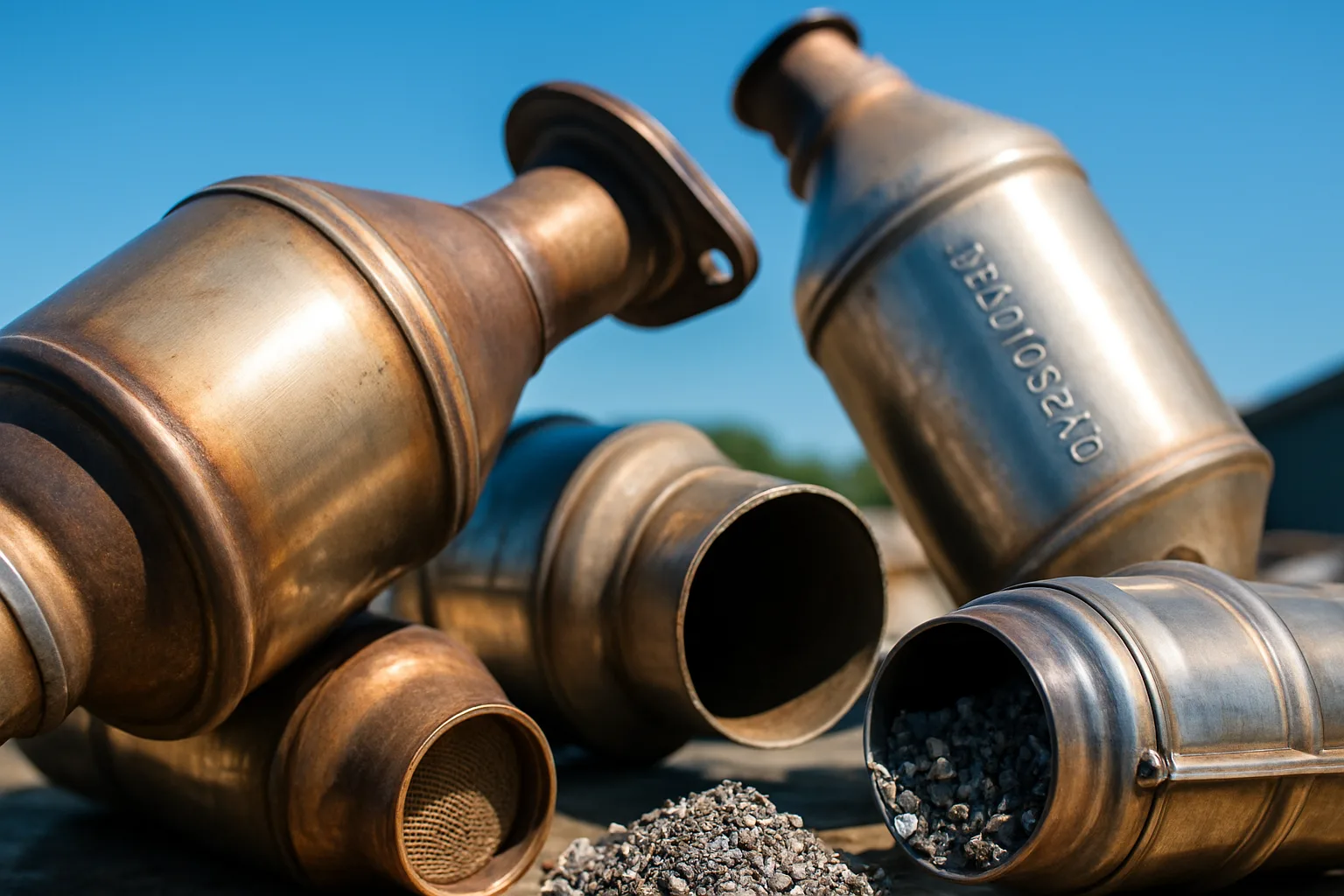
Why the Serial Number on Your Catalytic Converter Is Worth Real Money
Most people selling a scrap catalytic converter focus on weight and condition. They miss the one detail that actually drives the price: the serial number stamped directly on the converter body. That small string of letters and numbers tells a buyer exactly what precious metal content sits inside — platinum, palladium, and rhodium — before they ever cut it open.
If you're looking for a catalytic converter buyer in Raleigh and you want to negotiate from a position of knowledge, understanding how to read that serial number is where you start. It's the difference between taking the first offer and knowing when to push back.
What a Catalytic Converter Serial Number Actually Tells You
The serial number on a catalytic converter isn't random. It's an OEM (original equipment manufacturer) identifier that links your specific converter to a vehicle application, substrate type, and — most importantly — the precious metal loading used in production.
When a buyer looks up your serial number in a pricing database, they're pulling data tied to that exact part number: the estimated grams of platinum group metals (PGMs) — platinum, palladium, and rhodium — baked into the ceramic or metallic substrate. Rhodium alone can trade at multiples of gold. The difference between a high-PGM converter and a low-PGM one on the same vehicle platform can be hundreds of dollars.
- Platinum (Pt): Primary catalyst in diesel converters. Helps oxidize hydrocarbons and CO.
- Palladium (Pd): Dominant in gasoline converters. Handles oxidation at lower temperatures.
- Rhodium (Rh): The most valuable PGM per gram. Reduces nitrogen oxides (NOx).
Knowing your serial number means you can verify a buyer's quote against published reference data. No serial number means you're guessing — and buyers know it.
Where to Find the Serial Number on Different Converter Types
Location varies by manufacturer, vehicle make, and converter design. Most are stamped or laser-etched directly onto the converter shell. Here's where to look depending on what you're working with.
OEM Converters (Factory-Installed)
OEM converters carry the most reliable serial data. The number is usually stamped on the heat shield or the body of the converter housing — sometimes on a welded-on tag. Look for an alphanumeric string of 6 to 14 characters. On GM vehicles, you'll often find it on a pressed-in stamp near the inlet flange. Ford OEM cats frequently have it etched on the body near the downstream oxygen sensor bung. Toyota and Honda converters often have it on a raised metal tag welded to the shell.
Aftermarket Converters
Aftermarket converters — brands like MagnaFlow, Walker, or Eastern — do carry serial numbers, but their PGM loading is typically lower than OEM. The number format often includes a brand prefix followed by a part number. These are still worth recycling, but don't expect OEM-level payouts. The scrap catalytic converter value is directly tied to precious metal content, and aftermarket units are built to meet emissions specs, not maximize PGM loading.
Direct-Fit vs. Universal Converters
Direct-fit converters maintain a clear vehicle-specific part number. Universal converters are harder to cross-reference because they cover a range of applications. When selling a universal cat, weight and substrate condition carry more weight in pricing since serial lookup is less precise.
For anyone sorting through a pile of converters at a shop or salvage yard in Raleigh, photographing both the serial number and the converter body is the fastest way to get accurate quotes from multiple buyers. Platforms like SMASH Scrap — where verified buyers bid on your metal allow you to document inventory properly so buyers compete on the same information.
How to Read Common Serial Number Formats by Manufacturer
There's no universal standard — each OEM has its own convention. But once you know the patterns, reading a serial number gets faster with practice.
General Motors (GM)
GM converters often use a 7-digit format starting with a letter prefix tied to the plant or model year. Example: B234567. The prefix letter changed by decade, so buyers familiar with GM parts can narrow down vehicle application and approximate PGM loading quickly.
Ford Motor Company
Ford part numbers typically follow the format: YZZZ-XXXXX-AA, where Y represents the decade, ZZZ indicates the vehicle line, XXXXX is the part sequence, and AA is the revision code. Ford OEM cats from trucks — especially V8-equipped F-Series — tend to carry strong precious metal values due to higher engine displacement and stricter emissions compliance in certain model years.
Toyota / Honda / Nissan
Japanese OEM converters use manufacturer-specific part numbers that often appear as 5-digit codes with a hyphen suffix. Toyota cats from larger displacement engines (4Runner, Tacoma, Tundra) are particularly well-regarded in the scrap market. Honda uses a similar system but the numbers are often stamped smaller — use a flashlight and a clean rag before assuming the number isn't there.
BMW / Mercedes / European OEM
European OEM converters frequently carry 11-digit part numbers following a brand-standard convention. BMW uses the format XX-XX-X-XXX-XXX. These converters often carry high PGM loading relative to their size, particularly diesel-spec units intended for European emissions standards. They command strong prices per unit from experienced recyclers.
When you're ready to get the best catalytic converter price today, having the serial number documented — clearly photographed and legible — is your strongest starting position.
Why Serial Number Documentation Matters When Selling in Raleigh
North Carolina has seen increased regulatory attention on catalytic converter transactions over the past several years. Theft-related legislation has tightened documentation requirements for recyclers statewide. In Raleigh and across North Carolina, many legitimate buyers now require photo documentation, VIN records, or proof of ownership before completing a transaction.
This isn't just a legal formality — it's a pricing tool. When you walk into a transaction with clean documentation, serial numbers visible, and photos on file, you're positioned as a credible seller. Credible sellers get better offers. Buyers price in risk. Remove the risk and you remove the discount.
Shops in Raleigh pulling converters during routine exhaust work, or salvage yards accumulating inventory over weeks, benefit most from systematic serial tracking. A spreadsheet or even a basic inventory photo log by serial number gives you leverage when you contact multiple buyers and check current catalytic converter prices before committing to a sale.
If you're managing volume, Raleigh scrap metal services that use auction-style bidding — rather than a single static quote — give multiple buyers the chance to compete on the same documented inventory. That competition is how price discovery actually works in this market.
Using Serial Numbers to Avoid Getting Underpaid
Here's where knowledge earns its keep. A buyer who knows you don't know your converter's value will quote low. That's not malicious — it's just how commodity markets work. Your job is to close that information gap.
Step one: clean the converter body and photograph the serial number clearly. Step two: cross-reference the number using a reputable pricing guide or database. Step three: get quotes from at least two or three buyers before accepting anything. Step four: if you have volume — multiple converters from a shop or a vehicle fleet — present them as a lot with documented serials and let buyers compete.
Platforms like SMASH bring vetted buyers into a competitive auction format specifically designed for scrap metal sellers who want market-based pricing instead of a single take-it-or-leave-it offer. The same principle that applies to non-ferrous metals and catalytic cores applies here: more buyers seeing the same documented inventory means better price discovery. You can read catalytic converter pricing guides to sharpen your baseline knowledge before you approach any buyer.
The goal isn't to become a precious metals expert. The goal is to know enough to recognize a fair offer — and to walk away when the number doesn't reflect what your serial data shows.
Preparing Your Converters for Sale: A Quick Checklist
Whether you're a solo seller in Raleigh with two converters or a shop clearing out a month's worth of inventory, the prep process is the same. It's fast, and it protects your money.
- Clean the converter body. Grime and rust hide serial numbers. A wire brush and five minutes of work can reveal a stamping that changes your quote significantly.
- Photograph the serial number and the full converter body. Shoot in good light. Include a reference object for scale if you have multiple units.
- Note the vehicle source if known. Year, make, model, and engine size help buyers verify serial data and price more accurately.
- Separate OEM from aftermarket. Don't mix them into a single lot without flagging which is which. OEM units deserve OEM quotes.
- Check for physical damage. Cracked substrates, crushed bodies, and missing end caps all affect value. Disclose them upfront — buyers will discover them anyway.
- Get multiple quotes. One offer isn't a market. Two or three offers — especially from a competitive bidding environment — start to reveal what the market actually says your inventory is worth.
If you've done all of this and you're ready to move, the next step is simple: get the best price for your catalytic converter by working with a buyer or platform that uses your documentation to drive competition, not suppress it. Head to best-catalytic-converter-price.com for a free quote and see what your converters are actually worth in today's market.
Disclaimer: Catalytic converter prices fluctuate based on platinum, palladium, and rhodium spot prices, converter condition, and market demand. Always verify current rates before finalizing any sale.
Frequently Asked Questions
Q: Where is the serial number on a catalytic converter?
The serial number is usually stamped or etched on the converter's outer shell, heat shield, or a welded metal tag near the inlet or outlet flange. Clean the surface before looking — road grime often obscures the stamping. For most passenger vehicles, it's within a few inches of the inlet connection.
Q: How does a catalytic converter buyer in Raleigh use the serial number to set a price?
A reputable catalytic converter buyer in Raleigh cross-references your serial number against a PGM content database to estimate how much platinum, palladium, and rhodium the converter contains. That precious metal content — priced against current spot rates — drives the core value of your unit. Buyers without access to serial data typically offer lower prices to compensate for uncertainty.
Q: Does it matter if the serial number is partially worn or illegible?
Yes — a partially legible serial number reduces pricing accuracy and often results in a lower quote. Buyers may default to generic weight-based pricing if they can't identify the exact unit. Before selling, try cleaning the area with a wire brush or fine sandpaper to improve legibility and photograph it in strong side-light to reveal stamped characters.
Q: Can I sell catalytic converters in Raleigh without documentation?
North Carolina regulations and local Raleigh buyer policies increasingly require proof of ownership or vehicle documentation for catalytic converter transactions. This is largely a response to converter theft enforcement. Working with buyers who require documentation protects you legally and typically signals a more transparent pricing process.
Q: Is there a difference in scrap value between OEM and aftermarket catalytic converters?
Yes, typically a significant one. OEM converters are built with precise PGM loading for long-term emissions compliance, and they often contain more recoverable precious metals than aftermarket units. Aftermarket converters meet emissions standards with more economical PGM loads. Both are worth recycling, but don't expect the same per-unit price — always identify which type you have before accepting a quote.
Stay current on scrap metal market trends and PGM pricing — follow SMASH on LinkedIn for industry updates and insights that keep you informed between sales.
```