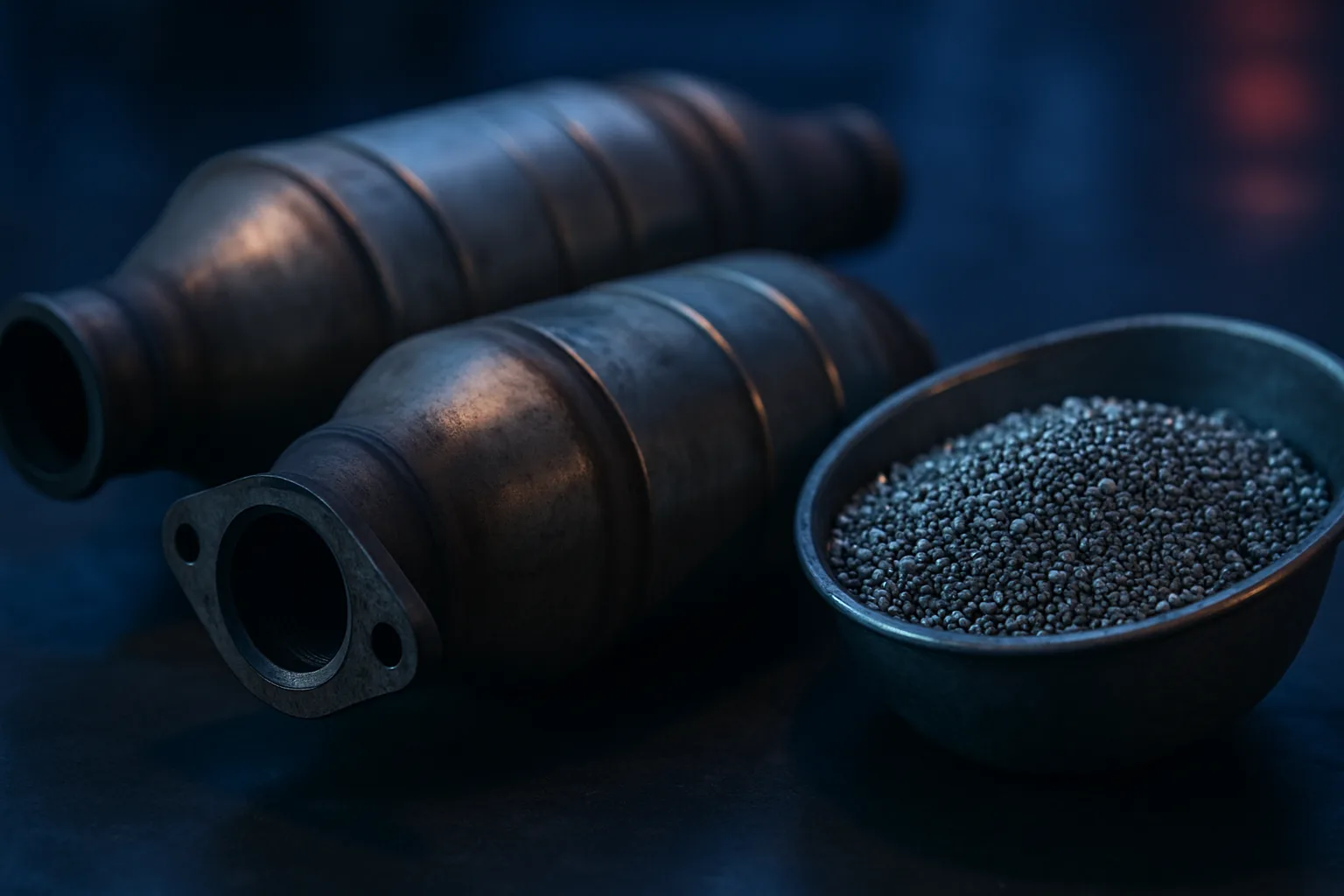
The catalytic converter sitting on your shelf right now could be worth more today than it was yesterday — or less. That's not a scare tactic. That's just how the precious metals market works. If you're doing catalytic converter recycling in Sacramento or anywhere else in California, understanding why prices move is the difference between leaving money on the table and getting paid what your cats are actually worth.
The scrap value of a catalytic converter isn't set by the recycler who buys it from you. It's driven by three metals — platinum, palladium, and rhodium — that trade on global commodity exchanges every single day. When those markets move, your converter moves with them. Most sellers don't know this. That information gap is exactly why some recyclers prefer you stay in the dark.
This article breaks down what drives catalytic converter scrap prices, what's happening in the market as of July 2026, and how to make sure you're not getting shortchanged when you sell.
What Actually Drives Catalytic Converter Scrap Prices Daily
Every catalytic converter contains a ceramic or metallic substrate coated with a combination of platinum group metals (PGMs) — primarily platinum, palladium, and rhodium. These metals are what processors pay for. The converter shell is almost incidental. When you sell a cat, you're really selling access to those metals inside it.
PGM prices are quoted in troy ounces and trade continuously on international markets. A single news event — a mining disruption in South Africa, a shift in electric vehicle adoption forecasts, or a change in automotive production volumes — can move palladium or rhodium prices by several percent in a day. That directly impacts what your converter is worth to a buyer that afternoon.
Here's what moves PGM prices on a regular basis:
- Mining supply disruptions — South Africa and Russia supply the majority of the world's platinum and palladium. Any instability in those regions tightens supply fast.
- Automotive sector demand — Converters are still required on combustion engine vehicles. Global auto production volumes directly affect how much demand exists for newly mined PGMs.
- EV adoption pace — Slower EV uptake sustains PGM demand. Faster adoption pressures it downward over the long term.
- Currency fluctuations — PGMs are priced in USD globally. A stronger dollar can suppress prices in relative terms.
- Refinery processing capacity — When processors are backed up, bids can soften. When they're hungry for material, competition pushes prices up.
None of this is speculation. This is how the market functions every day. If your buyer is quoting you a flat number with no reference to current PGM spot prices, you have no way to know if that number reflects reality — or their margin preference.
Why the Sacramento Market Feels Different From National Averages
California has some of the strictest vehicle emissions standards in the country, which means a higher concentration of OEM-grade converters in the scrap stream compared to states with looser standards. Sacramento, sitting at the center of a major agricultural and transportation corridor, sees a consistent volume of fleet vehicles, commercial trucks, and older model cars — all of which produce valuable cats.
But here's the friction point: Sacramento sellers often face a limited local buyer pool. When you're working with one or two buyers in your area, you don't have price discovery — you have price acceptance. You take what you're offered because you don't have a clear alternative. That dynamic suppresses what sellers actually receive, regardless of what the spot market is doing.
For Sacramento-area sellers — whether you're an auto shop clearing out a stack of cores, a collector, or a yard operator — the question isn't just "what are cats worth today?" It's "who's actually competing for my material?" Those are two different questions, and only the second one determines your payout. That's where comparing scrap metal bids from verified buyers changes the math entirely.
You can also access Sacramento scrap metal services built specifically for the local market — no guesswork, no one-buyer ceiling.
Understanding the Spread Between Spot Price and What You're Offered
Here's something most sellers don't fully understand: the price you receive for a catalytic converter is not the spot price of the metals inside it. There is always a spread — the difference between what a processor will eventually recover from the converter and what they pay you today. That spread covers processing costs, refining fees, assay risk, and profit margin.
A reasonable spread is normal. An unreasonable spread is the problem. And without competitive offers, you have no benchmark for what "reasonable" actually looks like for your specific material.
OEM converters — original equipment manufacturer units that have never been replaced — typically carry higher PGM loadings than aftermarket converters. A stock converter from a high-displacement truck or a luxury European vehicle can contain meaningfully more platinum, palladium, or rhodium than a small-displacement economy car unit. Buyers know this. If you don't, you won't know to push back when a low offer comes in on a high-value unit.
This is why documentation matters. Platforms like SMASH use serial tracking, VIN lookup, and photo documentation to give buyers accurate information about what they're bidding on. Better data produces more confident bids. More confident bids close the spread in the seller's favor. That's not a sales pitch — it's how markets work when information is symmetric.
How to Sell Catalytic Converters Online and Protect Your Price
The ability to sell catalytic converters online has fundamentally shifted how informed sellers operate. Instead of walking a load of cats to a single local buyer and accepting their number, you can put that same material in front of multiple vetted buyers and let competition determine the price. That's not complicated. It's just how auctions work — and it's a tool that was historically unavailable to individual sellers and small yards.
If you're trying to sell catalytic converters in California, here's a practical approach for 2026:
- Document everything before you sell. Photograph your converters clearly. Note the serial numbers where visible. If you can match units to vehicle makes and models, do it. Buyers pay more when they know exactly what they're getting.
- Check current PGM spot prices before any negotiation. Platinum, palladium, and rhodium prices are publicly available. Go in with a baseline number. You don't need to be a commodities trader — you just need to know the direction the market is moving.
- Get multiple offers. This sounds obvious, but most sellers don't do it consistently. One offer is just a number. Two or three offers are a market. SMASH's auction format is built specifically for this — vetted buyers competing on your material creates real price discovery instead of guesswork.
- Understand what you have before you sell. A foreign pre-cat from a higher-end vehicle is worth more than a standard aftermarket unit. Know the difference, or work with a platform that helps you identify it.
- Time your sale when you can. You don't always have the luxury, but if you have flexibility, watch the PGM market. Selling into a rising market versus a declining one can make a real difference over a volume of material.
Platforms like SMASH make it straightforward to get the best catalytic converter price today without needing to be a metals market expert. The platform handles buyer vetting, documentation, and competitive bidding — you bring the material and the information.
2026 Market Context: What's Affecting Prices Right Now
As of July 2026, the catalytic converter scrap market is navigating several intersecting pressures. Palladium has faced continued softness relative to its historic highs, driven partly by evolving EV penetration in major automotive markets and partly by improved above-ground supply from prior years' refining output. Rhodium, which saw extreme volatility in earlier years, has stabilized at levels that still make well-loaded converters highly valuable — but the days of extraordinary spikes appear to have plateaued for now.
Platinum has held steadier ground, supported by demand from hydrogen fuel cell development and continued use in diesel emissions systems. For sellers holding converters with higher platinum content — common in certain European makes — this is a relevant factor in 2026 pricing.
California's regulatory environment continues to enforce strict emissions compliance, which supports the ongoing flow of end-of-life converters into the scrap stream. Theft prevention legislation passed in several states has also tightened documentation requirements for converter transactions, making serial tracking and photo documentation not just good practice — but increasingly a legal expectation in California and beyond. If you're processing volume, being set up with proper documentation isn't optional. It's how you stay compliant and how you get paid.
For context on how these dynamics compare to other markets: searches for catalytic converter scrap price Canada reflect similar PGM-driven volatility, though currency differences and regional refinery capacity create their own spreads. The underlying metals driving value are identical across borders — what changes is the buyer landscape and the competitive pressure on any given transaction.
Getting the Best Price Means Getting the Right Buyers
Price transparency only exists when buyers compete. That's the core truth behind catalytic converter pricing — and behind why so many sellers consistently undervalue their material. One buyer with no competition has every incentive to offer less. Multiple buyers competing for the same load have every incentive to sharpen their numbers.
If you're doing catalytic converter recycling in Sacramento and you're still relying on a single relationship to price your cats, you're not doing price discovery — you're doing price acceptance. Those are very different outcomes over the course of a year's worth of material.
Read catalytic converter pricing guides to understand exactly how PGM content, converter type, and documentation quality affect your final payout. Then put that knowledge to work with a competitive selling approach.
The market moves every day. Your price should reflect that movement — not a static number your buyer set six months ago. If you're ready to stop guessing and start selling into real competition, check current catalytic converter prices and see what your material is actually worth right now. Getting a free quote at best-catalytic-converter-price.com takes minutes and gives you a real benchmark — not a number someone else decided was good enough for you.
Disclaimer: Catalytic converter scrap prices fluctuate daily based on platinum, palladium, and rhodium spot markets. All pricing references in this article reflect general market conditions as of July 2026. Always verify current rates before completing any transaction.
Frequently Asked Questions
Q: How often do catalytic converter scrap prices change?
PGM spot prices — platinum, palladium, and rhodium — update continuously during trading hours on global commodity exchanges. In practical terms, the price a buyer quotes for your converter can shift day to day, sometimes significantly. Checking current market rates before you sell is always worth the few minutes it takes.
Q: Where can I sell catalytic converters in Sacramento, California?
Sacramento has local scrap buyers, but relying on a single local offer limits your price discovery. Online platforms that connect you with multiple vetted buyers — like SMASH — allow you to get competitive bids regardless of your physical location. Combining local options with an online auction approach gives you the broadest market exposure.
Q: Does it matter what kind of catalytic converter I have when selling?
Yes — significantly. OEM converters from the original vehicle typically contain higher PGM loadings than aftermarket replacements, and values vary widely by vehicle make, model, and engine size. A foreign pre-cat from a luxury or high-displacement vehicle can be worth multiples of a standard aftermarket unit. Knowing what you have before you sell protects your price.
Q: Is it legal to sell catalytic converters in California?
Yes, selling scrap catalytic converters is legal in California, but state law requires proper documentation — including seller identification and documentation of the vehicle the converter came from in many cases. California has strengthened its converter transaction laws in recent years to combat theft. Always ensure you're transacting with licensed buyers and maintaining proper records.
Q: How do I know if I'm getting a fair price for my catalytic converters?
The most reliable way to validate a price is to get multiple competing offers. A single offer gives you no benchmark. Platforms like SMASH put your material in front of vetted buyers in a competitive auction format, so the price that emerges reflects actual market demand — not a single buyer's preferred margin. Checking current PGM spot prices beforehand gives you an additional reference point.
Stay current on scrap metal market trends and catalytic converter pricing — follow SMASH on LinkedIn for regular industry updates, market insights, and pricing context.
```