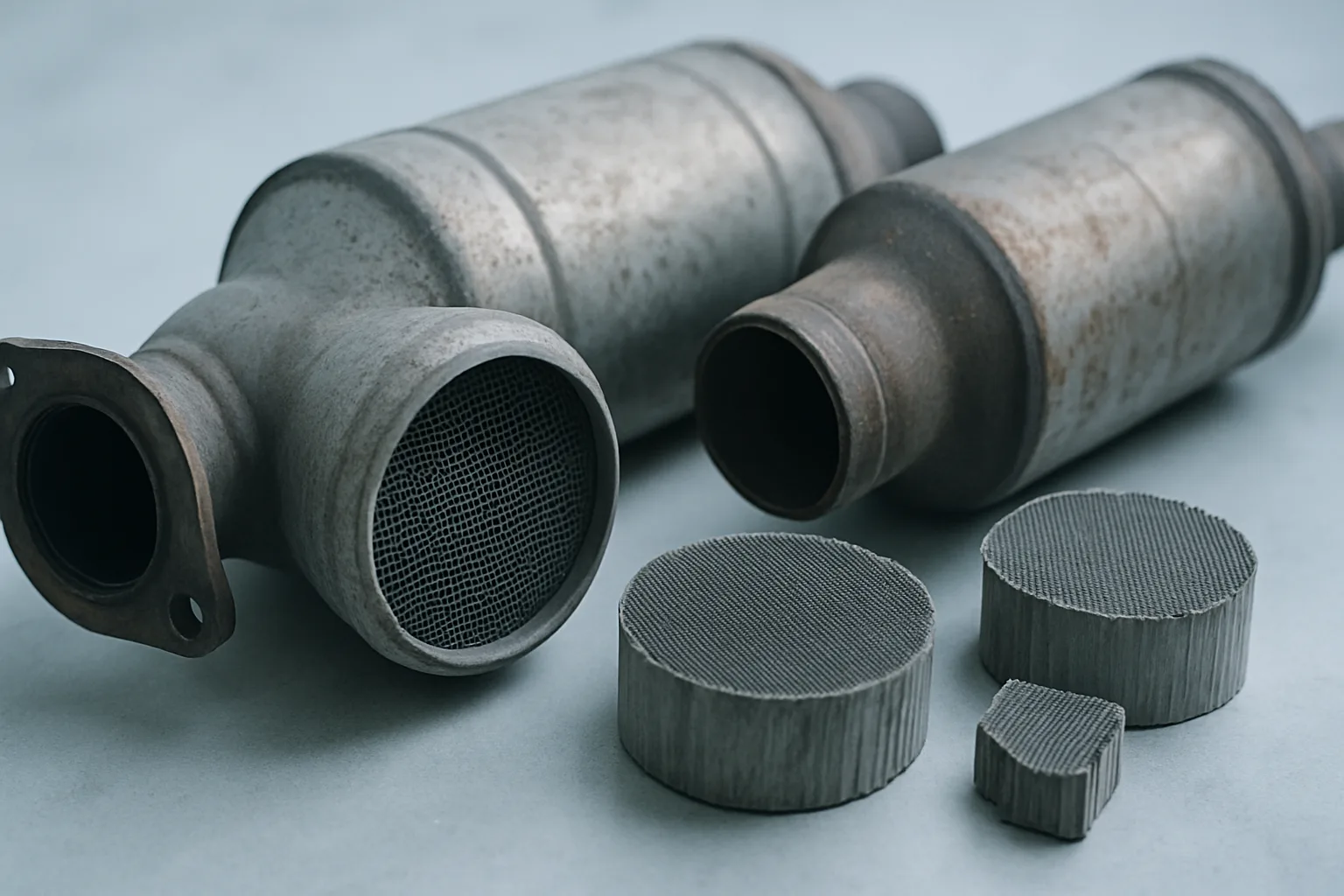
Most people have no idea that the exhaust system bolted under their car contains metals worth more per ounce than gold. Platinum, palladium, and rhodium — collectively known as platinum group metals (PGMs) — sit inside every catalytic converter, and the platinum price today directly affects what your scrap cat is worth. If you're in Rochester or anywhere across New York, understanding this lifecycle isn't just interesting. It's money in your pocket.
This guide walks you through the full journey of a catalytic converter — from the day it ships with a new vehicle to the moment those PGMs get recovered and re-enter the supply chain. At every step, there's an opportunity to get more or less for your converter. Knowing the process helps you land on the right side of that equation.
What's Actually Inside a Catalytic Converter (And Why It Matters for Price)
A catalytic converter does one job: it converts toxic exhaust gases into less harmful emissions before they exit the tailpipe. The chemistry that makes this possible depends entirely on a thin ceramic or metallic substrate coated with PGMs — platinum, palladium, and rhodium. These metals act as catalysts, triggering chemical reactions without being consumed themselves.
Here's the catch: mining new PGMs is expensive, geopolitically complicated, and environmentally intensive. South Africa and Russia supply the majority of the world's PGM output. That supply concentration is exactly why recycled PGMs from scrap catalytic converters carry serious value. When the platinum price today spikes or rhodium tightens, the price your converter fetches at the yard moves with it.
- Platinum: Used heavily in diesel converters. Prices fluctuate based on industrial demand and mining output.
- Palladium: The dominant PGM in gasoline converters. Has seen significant price swings over the past decade.
- Rhodium: Present in smaller quantities but historically the most volatile — and most valuable — of the three.
- Substrate type: Ceramic vs. foil (metallic) substrates have different PGM loadings and process differently at the smelter.
The combination of metals and their exact loading determines your converter's assay value. That's why a large OEM converter from a full-size truck can be worth substantially more than a small aftermarket unit from a compact car. Type, substrate, and current spot prices all factor into the final number.
The Vehicle Lifecycle: From Factory Floor to End of Life
Every converter starts at an OEM manufacturer — companies like BASF, Umicore, or Johnson Matthey coat the substrate with a precise PGM wash before it ships to an automaker's assembly plant. The converter gets installed, and from that point forward, it does its job silently under the vehicle, sometimes for 150,000 miles or more.
Heat, vibration, fuel quality, and driving patterns all affect how long a converter lasts. Most fail gradually — response times slow, sensors trip, and eventually the check engine light signals a problem. At that point, the converter either gets replaced at a shop (generating a used OEM core) or stays on the vehicle until the car itself reaches end of life.
When a vehicle gets scrapped — whether through an accident, mechanical failure, or simply old age — it typically heads to an auto recycler or salvage yard. That's where the converter comes off the vehicle and enters the secondary market. In a city like Rochester, with its mix of older vehicle stock and active scrap infrastructure, this happens thousands of times a year. The question isn't whether the converter will be recycled. It's who benefits from the value it holds.
How Scrap Catalytic Converters Get Processed — From Yard to Smelter
Once a converter leaves the vehicle, it enters a handling chain that most sellers never see. Understanding it explains why the price you're quoted can vary so dramatically depending on where you sell.
First, the converter gets identified — by serial number, VIN reference, or visual inspection — and slotted into a price category. This is where platforms with serial tracking and photo documentation provide a real advantage. A documented converter with a clean photo and confirmed serial number gives buyers more confidence, which typically translates into stronger bids.
- Collection and sorting: Converters are separated by type — OEM, aftermarket, diesel, foil — because each category has a different PGM profile.
- Decanning: The outer shell gets cut or pressed open to remove the substrate (the honeycomb material inside).
- Crushing and sampling: The substrate is crushed into powder. A sample gets assayed to determine exact PGM content.
- Smelting: The crushed material is processed at high heat. PGMs are separated from base metals through a series of chemical and thermal steps.
- Refining: Pure platinum, palladium, and rhodium are recovered and sold back into industrial markets — often to the same automakers who need them for new converters.
This closed-loop process is why platinum group metals recycling matters beyond environmental optics. Recycled PGMs re-enter the supply chain and reduce dependence on primary mining. For sellers in New York and across North America, the metals you sell today could end up in a new vehicle's converter within months.
Where Rochester Sellers Leave Money on the Table
Here's the uncomfortable truth: most people selling scrap catalytic converters in Rochester get less than they should. Not because the buyers are dishonest — though opacity is a real problem — but because single-buyer transactions remove the one thing that actually reveals market value: competition.
The traditional process looks like this: you pull a converter, call one buyer, get a number, and either take it or walk. You have no way of knowing whether that number reflects the actual platinum price today, current rhodium spot rates, or the buyer's margin target for that week. You're negotiating blind.
That's the gap that a scrap metal auction platform like SMASH fills. Instead of one call to one buyer, your converter gets in front of multiple vetted buyers who compete for it. More buyers means better price discovery. The market sets the price — not one buyer's offer on a slow Thursday afternoon. If you want to get the best catalytic converter price today, single-buyer transactions are the worst way to do it.
For yards and auto recyclers in the Rochester area handling volume — multiple loads of cats per month — this difference compounds quickly. A few extra dollars per unit across hundreds of converters adds up to real revenue. You can read catalytic converter pricing guides to understand how platform-based selling stacks up against traditional methods.
How SMASH Fits Into the Catalytic Converter Supply Chain
SMASH is built for exactly this moment in the lifecycle — after the converter leaves the vehicle and before it reaches the smelter. That middle step, the sale, is where value gets captured or given away.
The platform connects sellers — yards, auto recyclers, collectors — with a network of vetted catalytic converter buyers across the U.S. and Canada. No subscription fees. SMASH only earns when the seller earns. Listings include photo documentation, serial tracking where applicable, and full auction transparency. Buyers see what they're bidding on. Sellers see real competitive offers.
Inventory tools let you log and organize your cats before listing — useful if you're holding multiple units and want to move them as a load rather than one at a time. Auto-invoicing and documentation support clean transactions on both sides. If you're already selling scrap non-ferrous metals, you can sell your scrap metal on the SMASH marketplace and keep your converter sales in the same workflow.
The result: documented inventory, competitive bids, and a clear paper trail — without the cold calls and guesswork that defined the old way of doing this.
Timing Your Sale Around the Platinum Price Today
PGM prices move. That's not a warning — it's just the reality of commodity markets. Platinum, palladium, and rhodium respond to industrial demand (especially automotive production), mining output, currency movements, and macroeconomic conditions. Sellers who understand this can make smarter decisions about when to move their inventory.
A few practical notes for sellers in Rochester and across New York:
- Watch spot prices, not just local quotes. If a buyer's offer feels low relative to where platinum is trading, it probably is. Price transparency starts with knowing the benchmarks.
- Volume matters. Holding converters to consolidate a larger load can improve your negotiating position — but only if prices hold or improve while you wait. There's a real carrying cost to sitting on inventory.
- Document before you list. A clean photo and confirmed serial number increases buyer confidence. Documented units tend to attract stronger bids than mystery lots with no supporting info.
- OEM vs. aftermarket: OEM converters from trucks and SUVs typically carry higher PGM loadings and command better prices. Know what you have before you list it.
The best time to sell is when prices are strong and you have documented inventory ready to go. Platforms like SMASH let you move quickly when conditions are right — without scrambling to find a buyer at the last minute. When you're ready, check current catalytic converter prices before committing to any offer.
Disclaimer: Catalytic converter prices and PGM spot rates fluctuate daily based on commodity markets. Always verify current rates before selling. The information in this article reflects general market dynamics and should not be taken as a guaranteed price quote.
If you're sitting on cats in Rochester — or anywhere across New York — stop guessing what they're worth. Get documented, get competitive bids, and let the market do the work. Get the best price for your catalytic converter by requesting a free quote at best-catalytic-converter-price.com.
Frequently Asked Questions
Q: How does the platinum price today affect what I get for my scrap catalytic converter?
Platinum is one of three PGMs recovered from scrap converters, alongside palladium and rhodium. When the platinum price today rises, the assay value of your converter's substrate increases, which typically pushes scrap cat prices higher. Buyers track live spot prices closely, so staying informed gives you leverage in any negotiation.
Q: Where can I find a catalytic converter buyer in Rochester, New York?
Rochester has an active scrap and auto recycling market, but local single-buyer quotes don't always reflect the best available price. Using a platform like SMASH puts your converter in front of vetted catalytic converter buyers across the U.S., creating real price competition rather than a single take-it-or-leave-it offer.
Q: What's the difference between an OEM converter and an aftermarket converter in terms of scrap value?
OEM (original equipment manufacturer) converters typically contain higher PGM loadings than aftermarket replacements, which are designed to meet emissions standards at lower cost. This means OEM units — especially from trucks, SUVs, and luxury vehicles — generally fetch significantly higher scrap prices. Always identify your converter type before listing or selling.
Q: How many catalytic converters does a typical vehicle have?
Most modern passenger vehicles have one or two catalytic converters. V6 and V8 engines often run dual exhaust systems with one converter per bank, meaning two units per vehicle. Trucks and SUVs with larger engines sometimes have additional pre-catalysts. Each unit carries its own PGM content and scrap value.
Q: Is it worth holding onto scrap catalytic converters to wait for better prices?
It depends on your volume and your read on the market. Holding inventory creates carrying costs and market risk — if PGM prices drop while you wait, you lose. If prices rise, you gain. For most sellers in New York, the smarter play is to document your inventory properly and use a competitive auction platform so you capture the best available price at the time you're ready to sell, rather than guessing on future price direction.
Stay current on scrap metal market trends and PGM pricing by following SMASH on LinkedIn — regular updates on industry news, market movements, and catalytic converter pricing insights.
```